離開
離開 進入
進入《TAIPEI TIMES》 Court finalizes air force captain’s sentence for spying
2026/05/23 03:00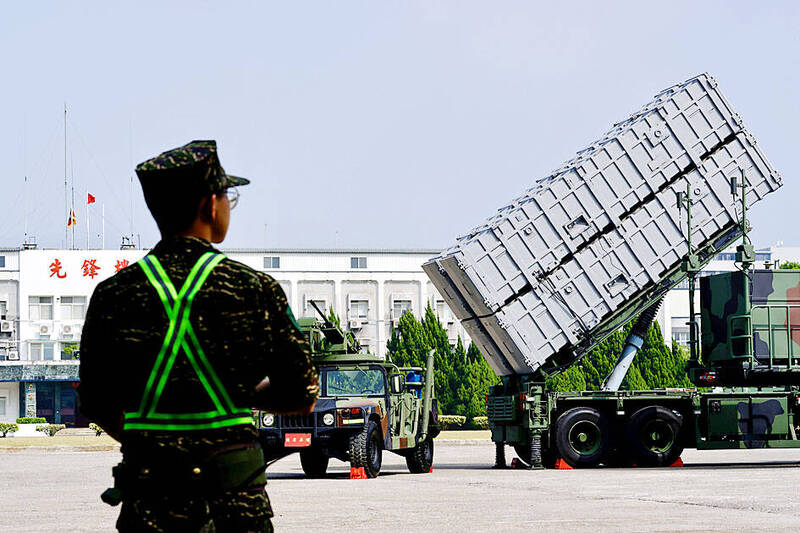
A soldier stands next to a Hsiung Feng III missile system at a naval base in Taoyuan on Oct. 18, 2024. Photo: Ritchie B. Tongo, EPA-EFE
By Weng Ching-you and Sam Garcia / Staff reporter, with staff writer
The Supreme Court on Thursday finalized a seven-year sentence for air force captain Hsu Chan-cheng (許展誠), who was found guilty of collecting military information for China, including data on Hsiung Feng III (Brave Wind III, 雄風) anti-ship missiles.
In a second-instance trial in February, the Taichung branch of the High Court sentenced Hsu to seven years in prison and stripped him of his civil rights for five years.
The Taichung court in March last year also sentenced former air force pilot Shih Chun-cheng (史濬程) for recruiting Hsu to provide sensitive information on the military’s response measures to Chinese aircraft incursions and training data in exchange for cash.
Shih retired from the air force in 2008 and in 2019 became acquainted with a Chinese intelligence operative known as Ziwen (子文), prosecutors said.
After accepting NT$2.1 million (US$66,523) in bribes, Shih recruited Hsu, then a captain in the air force’s Tactical Air Control Wing, prosecutors said.
Over four years, Hsu handed classified military documents to Shih, who paid him between NT$30,000 and NT$50,000 each time for a total of NT$226,000, prosecutors said.
Shih gave the documents to Ziwen using channels including WeChat, they said.
Hsu provided materials covering Taiwan’s military exercise and training data, response plans to Chinese military aircraft incursions and defense secrets related to the Indigenous Defense Fighter carrying Hsiung Feng III missiles, prosecutors said.
The Taichung District Court — which handled Hsu’s initial trials due to jurisdiction factors — ruled that the materials provided by Hsu would help China understand military information from Taiwan, harming national security and interests.
Hsu admitted guilt and returned more than NT$220,000 of the bribes, but as an active-duty service member, he disregarded the state’s investment in his training and betrayed his country, the district court said.
Hsu was found guilty of contravening the National Security Act (國家安全法) and the Anti-Corruption Act (貪污治罪條例), and was sentenced to seven years and four months in prison, stripped of his civil rights for five years and had his criminal proceeds confiscated.
The High Court reduced the sentence to seven years.
Hsu appealed to the Supreme Court, but it found no errors in the second-instance ruling and rejected his appeal, finalizing the case.
In Shih’s case, the High Court found him guilty of two contraventions of the National Security Act for “collecting classified official documents for China” — one completed offense and one attempted offense.
It sentenced him to two years and two months in prison for the completed offense, and 10 months for the attempted offense, for a combined sentence of two years and six months.
Shih appealed and the Supreme Court upheld the sentence for the completed offense, while remanding the attempted offense for a retrial.
In the second-instance trial for the attempted offense, the High Court convicted Shih of corruption and sentenced him to one year and six months in prison, and suspended his civil rights for two years.
Last month, the Supreme Court upheld the ruling, finalizing Shih’s combined sentence at three years and two months.
Additional reporting by CNA
新聞來源:TAIPEI TIMES