離開
離開 進入
進入《TAIPEI TIMES》 Han Kuang exercises to include US-style methods
2026/04/13 03:00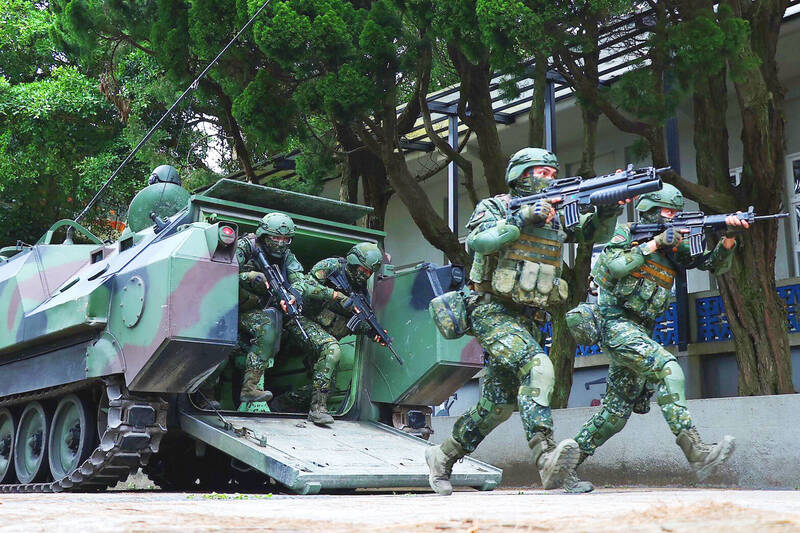
Soliders in Lienchiang County take part in the Han Kuang military exercise on July 17 last year. Photo courtesy of the ROC Army Matsu Defense Command via CNA
/ Staff writer, with CNA
Taiwan’s largest annual military drills are introducing several key US-style rehearsal methods aimed at improving coordination and combat readiness, an unnamed senior defense official said yesterday.
The drills, known as the Han Kuang exercises, are held annually in two stages: computerized simulations and live-fire drills.
This year’s edition began with tabletop war games on Saturday, which are to run through April 24, the Ministry of National Defense said.
A major focus of this year’s drills is testing troops in four types of US military rehearsals, the official said on condition of anonymity.
These include Combined Arms Rehearsal (CAR), confirmation briefs (backbriefs), support rehearsals and battle drills or standard operating procedure (SOP) rehearsals.
A backbrief involves subordinates explaining to commanders how they intend to carry out assigned missions, allowing leaders to confirm understanding, identify gaps and align execution before operations begin.
CAR integrates maneuver and firepower to ensure units operate in-sync on the battlefield. Support rehearsals focus on coordination within Battlefield Operating Systems, such as fire support and combat service support.
Battle drills and SOP rehearsals ensure troops are familiar with specific procedures and can execute them quickly.
While Taiwan’s military has similar concepts, the US has pushed for more rigorous implementation of these methods, the official said.
The shift is intended to make frontline troops more active decisionmakers rather than passive recipients of orders, improving effectiveness in modern combat.
Su Tzu-yun (蘇紫雲), director of the Institute for National Defense and Security Research’s Defense Strategy and Resource Research Institute, said past exercises were often treated as formalities aimed at satisfying superiors, but are now more practical, allowing different branches to test and align their defensive plans through simulations and live-fire exercises.
Echoing remarks by the unnamed official that this year’s drills would mark the first time Taiwanese military intelligence units have been included in tabletop war games, Su said the move reflects US practices and would enhance battlefield awareness by complementing data from radar and reconnaissance aircraft, enabling more precise support for frontline units.
First held in 1984, the Han Kuang exercises are designed to test Taiwan’s combat readiness in the event of a possible Chinese invasion.
The ministry has not yet announced the dates or duration of this year’s live-fire drills.
Minister of National Defense Wellington Koo (顧立雄) has said the live-fire segment, typically held in the summer, is expected to last 10 days and nine nights, as it did last year.
新聞來源:TAIPEI TIMES