離開
離開 進入
進入《TAIPEI TIMES》 CDC raises travel health alert on Ebola
2026/05/28 03:00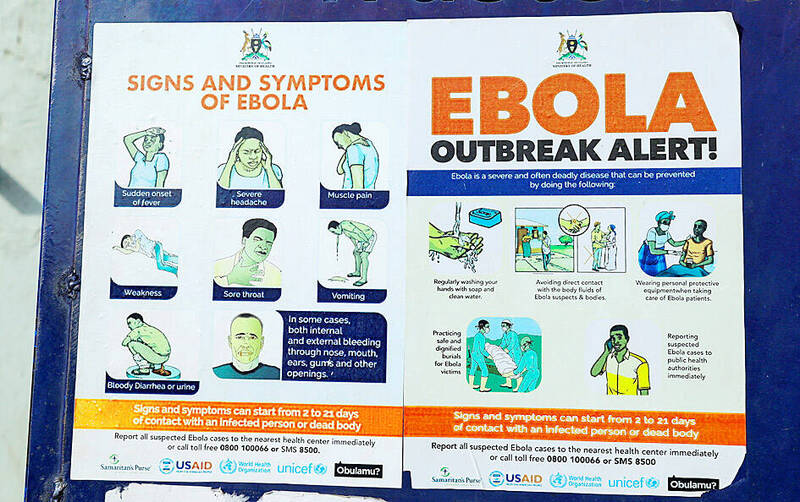
An advocacy poster against the spread of Ebola virus is placed along the walkway at the Platinum Medical Centre in Kampala yesterday. Photo: Reuters
OUTBREAK: People are advised to avoid traveling to DR Congo and Uganda unless necessary and to practice protective measures if travel is unavoidable, the CDC said
By Hou Chia-yu / Staff reporter
The Centers for Disease Control (CDC) yesterday raised the travel advisory for the Democratic Republic of the Congo (DRC) and Uganda to “Level 3: Warning” due to an Ebola outbreak, requiring returning travelers to undergo 21 days of self-health management.
Early symptoms of Ebola include fever, diarrhea, headache and abnormal bleeding, the CDC said, adding that anyone experiencing these symptoms after returning to Taiwan should report their conditions to the CDC’s “1922” hotline and seek medical attention immediately.
The WHO on May 17 declared that the Ebola outbreak caused by the Bundibugyo virus in the DRC constitutes public health emergency of international concern.
CDC Deputy Director-General and spokeswoman Tseng Shu-hui (曾淑慧) yesterday said that the Ebola epidemic is spreading rapidly in the two countries, and while Ituri Province in the DRC is the primary hotspot, cases have also emerged in North Kivu Province and South Kivu Province, as well as and the neighboring country Uganda.
The Level 3 advisory means people should avoid nonessential travel to these areas, she said.
People who have visited the two countries within the past 21 days are required to practice self-health management for 21 days after entering Taiwan, which includes measuring their body temperature daily and reporting their health condition through an online self-reporting system, Tseng said.
They should report their conditions as soon as they exhibit suspected symptoms and have the local health department refer them to a hospital for treatment, she added.
As of Sunday, the DRC had accumulated 112 confirmed cases, including 11 deaths, along with 906 suspected cases and 223 suspected deaths, she said.
Uganda had seven confirmed cases and one death, Tseng said, adding that a US citizen tested positive after coming into contact with the virus at a local medical facility, indicating continued risk of the outbreak spreading.
Tseng said the Ebola virus is primarily transmitted through contact with the blood, body fluids, secretion, or contaminated objects of infected individuals.
Initial symptoms include fever, headache, muscle aches, nausea, abdominal pain, diarrhea and vomiting; and in severe cases, it can lead to bleeding, multiple organ failure or even death, she said.
There is currently no approved vaccine or antiviral drug for this particular strain, and combined with local political instability and frequent population movement, disease prevention and control have become even more challenging, she added.
To reduce the risk of imported cases, the CDC has enhanced cross-departmental border control measures, including reminding travelers through airport electronic displays, news tickers and in-flight announcements, and airport quarantine personnel intensifying “TOCC” — travel history, occupation, contact history and cluster history — assessments and health evaluations, she said.
While the outbreak is currently limited to two countries in Africa and the overall risk to Taiwan remains low, the possibility of imported cases cannot be ruled out due to frequent global travel, Tseng said, adding that people should avoid traveling to affected areas unless absolutely necessary.
Those who must travel there should practice protective measures, such as washing their hands frequently, wearing masks, and avoiding contact with wildlife and patients’ bodily fluids, she added.
新聞來源:TAIPEI TIMES