離開
離開 進入
進入《TAIPEI TIMES》 President outlines population strategy
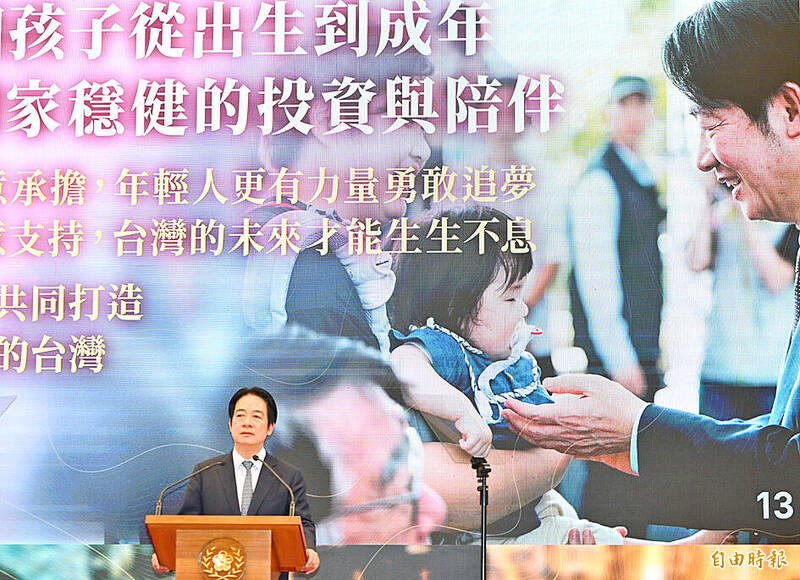
President William Lai speaks at a news conference at the Presidential Office in Taipei yesterday. Photo: Tien Yu-hua, Taipei Times
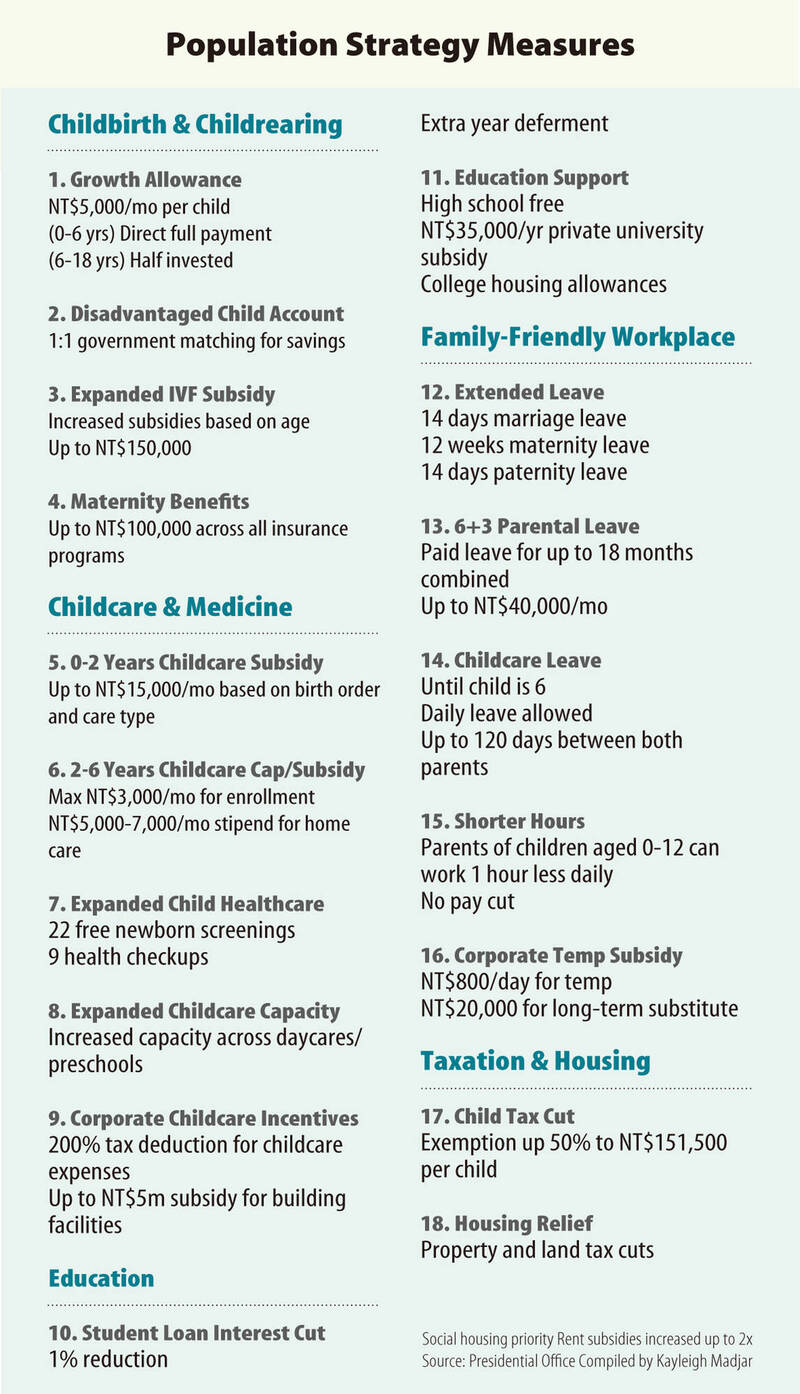
EIGHTEEN MEASURES:The plan has childbirth, childrearing and education stages, with goals to increase subsidies, lighten loads, improve flexibility and expand care
By Hollie Younger / Staff writer
President William Lai (賴清德) yesterday announced a new population strategy with 18 measures to counter the nation’s low birthrate and aging population, from monthly subsidies for children up to age 18, to expanded assisted reproduction assistance and policies to create a more family-friendly workplace culture.
Raising children would no longer be the responsibility of the parents alone, but a joint effort by the state, society and businesses, Lai told a news conference at the Presidential Office following a meeting on the nation’s population strategy.
The strategy would move Taiwan fully beyond subsidy-based childcare and toward a publicly supported childcare model, he said.
The policy package would require an estimated additional annual budget of NT$205 billion (US$6.52 billion), with total planned funding of NT$380 billion, Presidential Office Deputy Secretary-General Xavier Chang (張惇涵) said.
The 18 strategies are separated into three stages — childbirth, childrearing and education — and four key strategies: increased subsidies, lighter loads, greater flexibility and expanded care, the Presidential Office said.
The policies address five priority areas: a secure start for families, improved childcare, investing more in education, family-friendly workplaces and easing housing pressures, it said.
The policy package would benefit parents equally to support them in balancing childcare responsibilities with work, Lai said.
“An advanced country must never force anyone — especially women — to choose between career and family,” he said.
The policies encompass tax reductions for families with children; extended marriage leave, and maternity and paternity leave; and maternity insurance benefits.
One of the strategies is to provide a monthly NT$5,000 subsidy to families with children aged up to six, while families with children aged six to 18 would be granted a NT$2,500 monthly payment, with the government investing another NT$2,500 into an interest-generating account that the child can use at age 18.
Savings accounts were previously restricted to low and middle-income youth, but the new program expands eligibility to everyone aged 18 or younger.
The savings accounts would have returns guaranteed at no less than the interest rate of a two-year fixed deposit, and would contain at least NT$360,000 once the holder reaches age 18, Chang said.
Investing in children would benefit three generations of a family, Lai said, adding that the policy aims to support holders as they enter the next stage of their lives.
Separately, the government would continue to support disadvantaged children by matching parents’ savings in the dedicated accounts by up to NT$1,250 per month.
Another policy would expand subsidies for assisted reproduction, providing more funding for those younger than 40 compared with those aged 45 or younger, to encourage earlier treatments with higher efficacy rates, Chang said.
Lai also directed the Executive Yuan to establish a task force to implement the new population strategy and monitor progress, convened by Premier Cho Jung-tai (卓榮泰).
Lai called on the opposition, which holds a majority in the legislature, to support the regulatory amendments.
The initial cost of the 18 measures is estimated to be about NT$380 billion, which is equivalent to 1 percent of the annual GDP and similar in scale to South Korea’s demographic policy push, he said.
The policy rollout comes ahead of the local government elections in November.
Taiwan is under pressure to address its demographic crisis; its fertility rate stood at just 0.86 in 2024, making it one of the lowest globally, Ministry of the Interior data showed.
Additional reporting by CNA and Bloomberg
新聞來源:TAIPEI TIMES