離開
離開 進入
進入《TAIPEI TIMES》 First imported chikungunya case from China reported
2025/08/08 03:00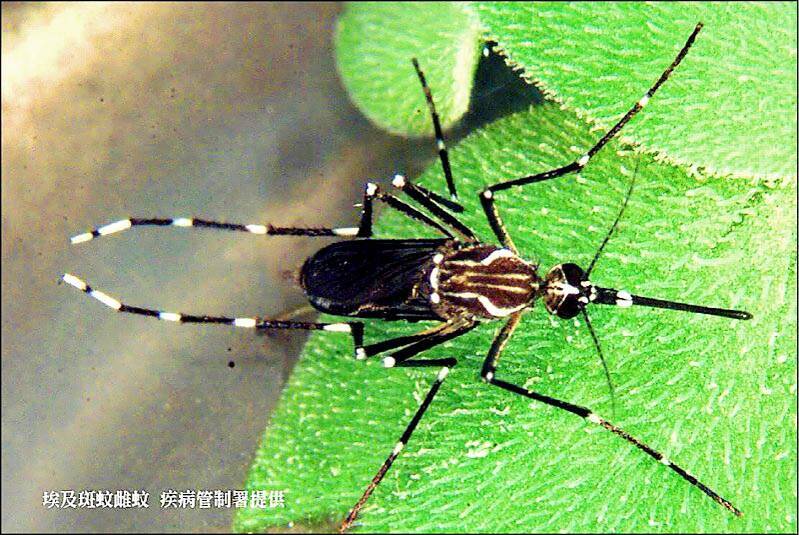
An Aedes aegypti mosquito is pictured in an undated photograph. Photo courtesy of the Centers for Disease Control
/ Staff writer, with CNA
A Taiwanese woman in her 40s has been confirmed as the first person this year to have contracted chikungunya fever in China and tested positive in Taiwan, the Centers for Disease Control (CDC) said in a statement yesterday.
The woman visited friends in Guangdong Province’s Foshan and Shenzhen in the middle of last month and returned to Taiwan on Wednesday last week, the CDC said.
She developed a fever the next day and was admitted to hospital on Friday last week with rashes and pain in her limbs and ankles, the statement said.
Having heard chikungunya fever travel warnings on her flight back to Taiwan, the woman told medical workers about her travel history and that she had been bitten by mosquitoes during her trip, it said.
She was discharged after four days and is to be monitored until Aug. 26, it said.
Local health authorities have completed a vector mosquito density investigation, mosquito breeding source elimination and pest control activities around the woman’s home, the CDC said.
The CDC on Monday raised its travel advisory for Guangdong Province to Level 2 for chikungunya fever due to 2,892 new cases being reported in the region from July 27 to Saturday last week.
The CDC has a three-tier travel advisory, with Level 1 being “Watch,” advising people to “practice usual precautions,” Level 2 “Alert” calling for “enhanced precautions” and Level 3 “Warning” urging people to “avoid nonessential travel.”
As of Wednesday, there were 17 confirmed chikungunya fever cases in Taiwan this year, the highest figure for the period in six years.
All of the cases have been imported, with 13 from Indonesia, two from the Philippines and one each from Sri Lanka and China, the CDC said.
The fever is transmitted by Aedes albopictus (also known as the Asian tiger mosquito) and Aedes aegypti (also known as the Egyptian mosquito) carrying the virus, the agency said.
The public should take measures against mosquito bites when traveling to places where chikungunya fever is spreading, such as wearing light-colored clothing and using approved insect repellents, it said.
Symptoms of the disease are similar to dengue fever, including high fever, headache, joint pain in the lower back, ankles, knees, wrists or phalanges, joint swelling, rashes, muscle pain, nausea and fatigue, the centers said, adding that severe joint pain can last weeks, months or even years.
There is no specific antiviral treatment for chikungunya virus, only medications to alleviate the symptoms, it said, adding that it rarely causes severe illness or death, and most people fully recover.
As of Wednesday, China had reported more than 7,000 cases of the virus, mostly in Foshan.
The number of new cases appears to be dropping slowly, authorities said.
It appears to be the largest outbreak of chikungunya fever ever documented in China, said Cesar Lopez-Camacho, a researcher at the University of Oxford.
“What makes this event notable is that chikungunya has never been established in mainland China before,” Lopez-Camacho said in a statement. “This suggests that most of the population had no pre-existing immunity, making it easier for the virus to spread quickly.”
Additional reporting by Lee I-chia and AP
新聞來源:TAIPEI TIMES