離開
離開 進入
進入《TAIPEI TIMES》 NDC outlines expected tariffs for chips
2025/08/08 03:00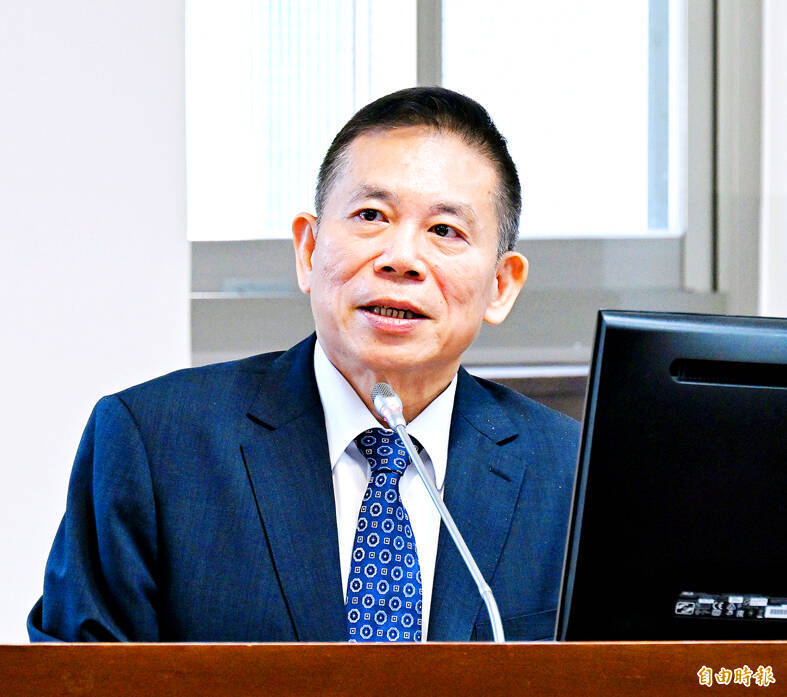
National Development Council Minister Paul Liu speaks at a meeting of the legislature’s Economics Committee in Taipei yesterday. Photo: Fang Pin-chao, Taipei Times
US INVESTMENTS: Most chips made by local companies are for domestic assembly plants, so the potential effects of US tariffs would be limited, the NDC minister said
By Meryl Kao / Staff reporter
Local chipmakers that have invested or pledged to invest in the US — including Taiwan Semiconductor Manufacturing Co (TSMC, 台積電) — are expected to be exempt from US President Donald Trump’s semiconductor tariffs, National Development Council (NDC) Minister Paul Liu (劉鏡清) said yesterday.
After Trump on Wednesday announced a 100 percent tariff on imported semiconductors, Liu told reporters ahead of a meeting of the legislature’s Economics Committee that Taiwanese chipmakers are seeking to lower tariff effects by building factories in the US, pursuing mergers and acquisitions to produce in the US, and forming partnerships with US firms.
For instance, United Microelectronics Corp (聯電), the nation’s second-largest contract chipmaker, might also reduce the effect of tariffs through its cooperation with Intel Corp, Liu said.
“Taiwan’s semiconductor industry is among the most resilient in the world... We have faith in our industry,” he said.
Regarding the potential effects of tariffs on the local chip industry and broader macroeconomic conditions, Liu said that most chips made by local manufacturers are for domestic assembly plants, with exports to the US last year of less than US$6 billion, excluding those from TSMC’s and GlobalWafers’ US facilities, which accounted for just 1.12 percent of total exports.
The impact is limited, he added.
In general, semiconductor firms have said they can compete globally as long as tariff rates remain on a par with rivals, Liu said.
Liu, a TSMC board member, said that the company’s planned investment in Arizona is US$165 billion and the board has yet to discuss any extra investment in the US.
TSMC’s exports to the US accounted for just 1 percent of its total capacity, Liu said, adding that the figure is expected to rise to 6 percent by 2029.
Liu said he could not predict whether Trump would request additional investment from TSMC, but added that any decision would depend on sales and orders, as the firm is publicly listed and is accountable to its shareholders.
Trump has imposed a temporary 20 percent tariff on Taiwan, excluding semiconductors, as Taipei and Washington continue negotiations to reach a trade deal.
The government still expects GDP this year to reach 3.1 percent, despite the tariff impact, Liu said.
Responding to a leak of TSMC’s trade secrets related to the company’s advanced 2-nanometer technology, Liu said that the government would not permit leading-edge fabs to be built overseas.
TSMC is building 2-nanometer fabs in Taiwan and has plans for 1.4-nanometer fabs locally as well, he said.
With about 90 percent of TSMC’s research-and-development personnel and leadership team based in Taiwan, and more than six factories under construction in Kaohsiung, two in Chiayi County, and further investments planned in Tainan and Taichung, the government is committed to safeguarding key technologies, he said.
As small and medium-sized enterprises are unlikely to invest in the US, the government is allocating more than NT$95 billion (US$3.19 billion) to support them in the short term, while promoting artificial intelligence adoption to aid their business transformation in the long term, he added.
新聞來源:TAIPEI TIMES
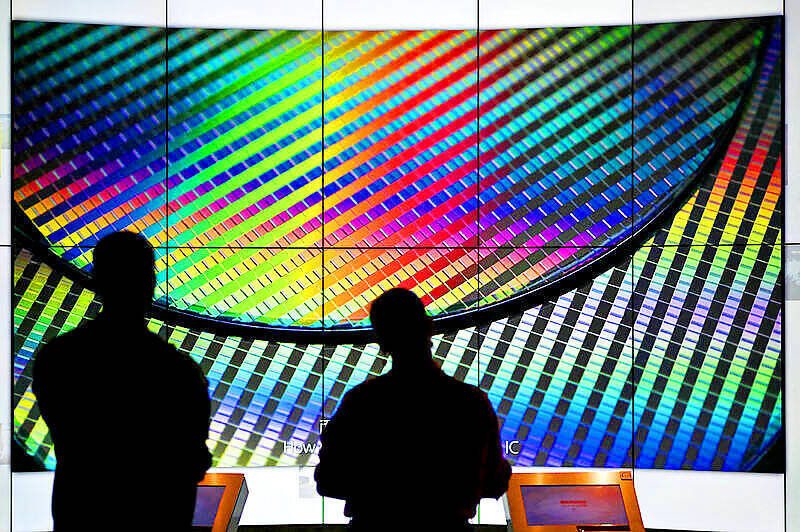
Visitors look at a wafer shown on screens at the Taiwan Semiconductor Manufacturing Co Renovation Museum at the Hsinchu Science Park in an undated photograph. Photo: Sam Yeh, AFP