離開
離開 進入
進入《TAIPEI TIMES》 Taiwan to produce more than 1,200 new missiles
2026/06/06 03:00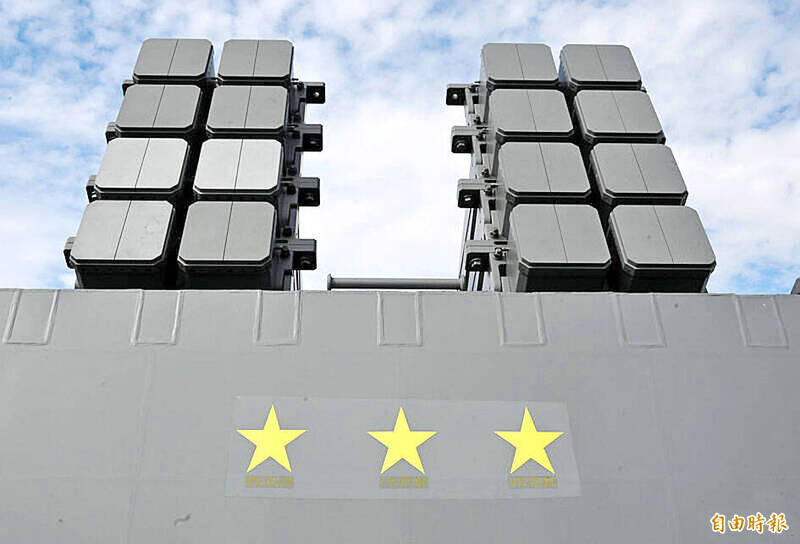
Tien Chien II missile launchers are deployed on the deck of the Yushan, a Republic of China Navy amphibious landing platform, in an undated photograph. Photo: Liao Chen-hui, Taipei Times
UPGRADE: The Kang Ding-class frigate is replacing its Chaparall missiles with Tien Chien II and Hua Yang VLS, which would provide it with long-range, 360° air defense
By Lo Tien-pin and Jonathan Chin / Staff reporter, with staff writer
Taiwan plans to produce 1,200 to 1,376 Hai Chien II missiles (海劍二, Sea Sword II) — also known as TC-2N — to serve as the standard air defense system of the navy’s surface combatant fleet, a source said yesterday.
Last week, the Hai Chien II, the naval version of the Tien Kung II missile (天劍二, Sky Sword II), completed a live-fire test in waters off the National Chungshan Institute of Science and Technology’s Jiupeng facility (九鵬) in Pingtung County’s Manjhou Township (滿州).
The MIM72 Chaparral and other dated air defense missiles that currently arm Taiwanese ships have inadequate range to combat Chinese People’s Liberation Army (PLA) aircraft, a defense official said on condition of anonymity.
The navy moved to standardize Hai Chien II missiles following the institute’s development of the weapon and its integration in shipborne vertical launch systems (VLS), they said.
The navy must obtain 688 missiles to fill the magazines of all ships in service and those being planned, they added.
This consists of 192 missiles for six Kang Ding-class frigates, 288 for the proposed next-generation light frigates, 176 for 12 Tuo Chiang-class corvettes and 32 for the Yushan landing platform dock, the source said.
The estimate excludes the next-generation principal combatant, the design of which is still on the drawing board and bid is yet to be awarded to a contractor, they said.
A senior navy logistician commenting on condition of anonymity said that military requirements dictate that a fleet prepare 1.5 to 2 times the amount of ammunition required to fill the fleet’s magazines to sustain combat.
The navy leans toward the higher end of the estimate, because the PLA is highly likely to carry out saturation strikes on Taiwanese ships, they said.
The Kang Ding-class frigate, based on the French Lafayette-class design, is being retrofitted with the Tien Chien II and the Hua Yang VLS — a design featuring eight cells, with each holding four missiles — to replace the Chaparall missile systems.
This combination provides the Kang Ding-class frigate with a long-range, 360° air defense system, addressing a significant gap in its capabilities.
The next-generation light frigate would have an air defense and anti-submarine variants.
The air defense version would be armed with the Hua Yang VLS and would stow 32 Tien Chien missiles in total, while the anti-submarine version would be armed with two pairs of eight-missile launcher racks for a total of 16 missiles.
The anti-submarine version also carries a smaller number of air defense missiles to make room for torpedo launcher tubes and a towed sonar array for its core mission.
The Tuo Chiang-class corvettes would carry a pair of eight-missile launcher racks, except for the class’ lead ship, which features an experimental design.
The air defense capability is essential for the “wolf pack” role envisioned for the class, or relatively small, but heavily armed vessels.
The Yushan, an amphibious landing dock designed to defend the nation’s outlying islets and islands, is armed with rack-type launchers mounted to the sides of its island, with a total capacity of 32 missiles.
新聞來源:TAIPEI TIMES