離開
離開 進入
進入《TAIPEI TIMES》Cabinet mulls alternative arms funding
2026/05/15 03:00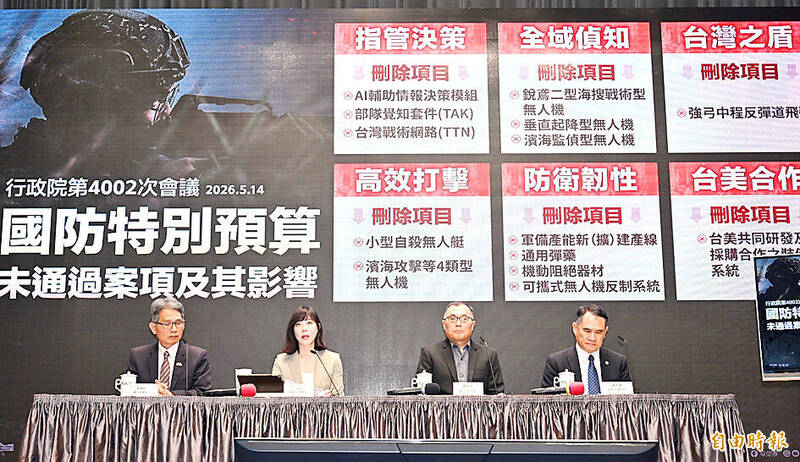
From left, Deputy Minister of Economic Affairs Lai Chien-hsin, Executive Yuan spokeswoman Michelle Lee, Deputy Minister of National Defense Chen Wen-hsing and National Science and Technology Council Deputy Minister Lin Faa-jeng attend a post-Cabinet meeting news conference in Taipei yesterday. Photo: Fang Pin-chao, Taipei Times
DRONE ISSUES:A defense official said that the legislature’s downsized budget would cut funding for person-portable counterdrone systems
Staff writer, with CNA
The Cabinet is considering ways to fund key weapons programs excluded from a supplementary budget bill passed by the legislature last week, Premier Cho Jung-tai (卓榮泰) said yesterday.
The options include proposing another supplementary budget or increasing the Ministry of National Defense’s annual budget, Cabinet spokeswoman Michelle Lee (李慧芝) quoted Cho as saying at a weekly Cabinet news conference.
The legislature last week passed an opposition-backed supplementary budget bill to fund purchases of US weapons systems, including High Mobility Artillery Rocket Systems (HIMARS), M109A7 self-propelled howitzers, TOW 2B missiles, Altius-700M and 600 drones, and Javelin anti-armor missiles.
However, the NT$780 billion (US$24.75 billion) bill excluded funding for domestic contract production programs and foreign direct commercial sales.
Department of Strategic Planning head Huang Wen-chi (黃文啟) told the news conference that the legislature’s decision to cut funding for person-portable counterdrone systems would significantly weaken Taiwan’s ability to respond to attacks by swarms of small drones.
Swarms are an expected threat in modern warfare, Huang said, citing their use in the Russia-Ukraine war.
The exclusion of funding for domestically produced littoral warfare attack drones and small kamikaze uncrewed surface vessels had hurt Taiwan’s defense industry, as reflected in the weak performance of local defense stocks in the past few days, he said.
Chiang Kung (強弓, “Strong Bow”) anti-ballistic missiles, which have a higher interception altitude than PAC-3 MSE missiles and are made in Taiwan, would improve the nation’s ability to intercept incoming strikes, Huang said.
Excluding funding for the Chiang Kung system has weakened Taiwan’s air defense, he added.
Cho urged lawmakers to quickly approve funding for the HIMARS, which the US has approved for sale to Taiwan, as required under the supplementary budget bill signed into law by President William Lai (賴清德) on Monday, Lee said.
The legislation stipulates that approved and future arms sales must still receive legislative approval before funding can be disbursed.
Taiwan must make its first HIMARS payment by the end of this month, after the US agreed to extend the original March 30 deadline amid a legislative deadlock over the Cabinet’s supplementary budget proposal.
Deputy Minister of National Defense Chen Wen-hsing (陳文星) said that the ministry is prepared to use its first reserve fund or request access to the Cabinet’s second reserve fund as a backup if the legislature does not approve the disbursement.
新聞來源:TAIPEI TIMES