離開
離開 進入
進入《TAIPEI TIMES》No surprises at Xi-Trump talks: MAC
2026/05/15 03:00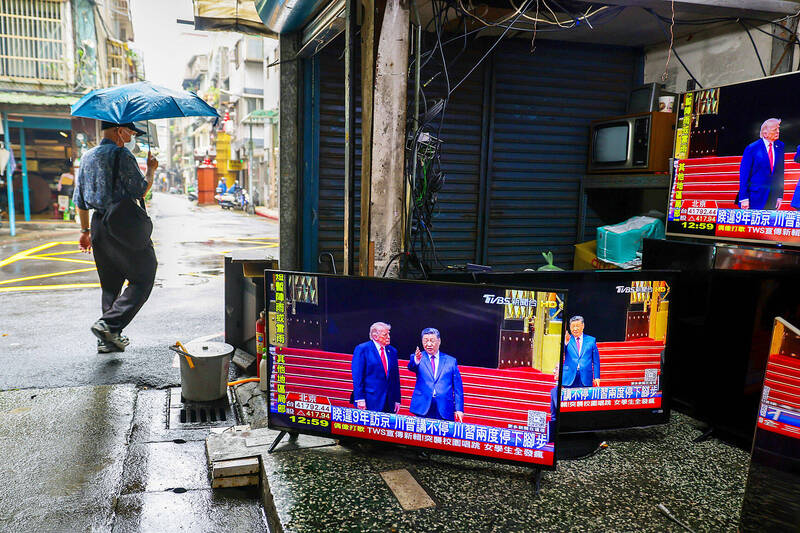
A man in Taipei yesterday walks past a store with TV screens broadcasting the Beijing meeting between US President Donald Trump and Chinese President Xi Jinping. Photo: Ritchie B. Tongo, EPA
TAIWAN ISSUE: US treasury secretary Scott Bessent said on the first day of meetings that ‘it wouldn’t be a US-China summit without the Taiwan issue coming up’
By Shelley Shan / Staff reporter, with AFP
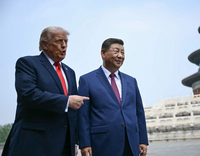
There were no surprises on the first day of the summit between US President Donald Trump and Chinese President Xi Jinping (習近平), the Mainland Affairs Council (MAC) said yesterday, as the government reiterated that cross-strait stability is crucial to the Asia-Pacific region, as well as the world.
As the two presidents met for a highly anticipated summit yesterday, Chinese state media reported that Xi warned Trump that missteps regarding Taiwan could push their two countries into “conflict.”
Trump arrived in China with accolades for his host, calling Xi a “great leader” and “friend,” and extending an invitation to visit the White House in September.
Beyond the pomp as he welcomed Trump, Xi in less effusive tones said the two sides “should be partners and not rivals” and immediately highlighted the issue of Taiwan.
“The Taiwan question is the most important issue in China-US relations,” Xi said, according to remarks published by the Xinhua news agency shortly after the start of the talks, which lasted two hours and 15 minutes.
“If mishandled, the two nations could collide or even come into conflict, pushing the entire China-US relationship into a highly perilous situation,” Xi added.
Trump on Monday said that he would speak with Xi about US arms sales to Taiwan, a departure from Washington’s previous insistence that it would not consult Beijing on the matter.
The White House said the initial talks yesterday had been “good,” although it did not mention Taiwan in the readout.
Adam Ni (倪淩超), editor of newsletter China Neican, said that while Xi’s “blunt language” was not uncommon in party state media, it was unusual coming from the leader himself.
China has been “signaling a desire for US compromise on Taiwan,” said Chong Ja Ian (莊嘉穎), an assistant professor at the National University of Singapore.
Xi’s demand could suggest that China sees “some opportunity to convince Trump,” he said.
Trump yesterday did not comment to reporters regarding Taiwan, but US Secretary of the Treasury Scott Bessent told CNBC that Trump would say more “in the coming days.”
“It wouldn’t be a US-China summit without the Taiwan issue coming up,” said Bessent, who is with Trump in China.
“President Trump understands the issues here and understands the sensitivities around all this. Anyone who has been saying otherwise does not understand the negotiating style of Donald Trump,” Bessent added.
In Taipei, the Ministry of Foreign Affairs said that Beijing was “the sole risk to regional peace and stability.”
Taiwan would continue to cooperate with the US, and other countries that uphold freedom and democracy to ensure regional security and prosperity, a ministry spokesperson said.
Cabinet spokeswoman Michelle Lee (李慧芝) said that the government believes any actions that would “contribute to regional stability and manage the risks posed by authoritarian expansion” should be viewed positively.
The government’s national security and diplomatic teams have remained in close contact with the US side during the Trump-Xi meeting, Lee said, adding that Taipei is grateful Washington has repeatedly reiterated its firm support for Taiwan.
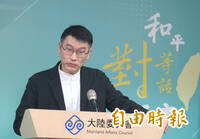
Xi told Trump that peace and stability across the Taiwan Strait was the greatest common denominator to the US and China, but also to the Asia-Pacific region, as well as to the world, MAC Deputy Director Liang Wen-chieh (梁文傑) said.
The council did not consider Xi’s statements to be particularly severe or unusual, as Chinese senior government officials have made similar statements.
“We want to emphasize it is China, not Taiwan, that seeks to destroy the status quo. Taiwan seeks to maintain the status quo of the Republic of China and the Taiwanese way of life. The biggest risk that threatens peace across the Taiwan Strait is China’s military intimidation, and deployment of military aircraft and vessels to harass Taiwan,” Liang said.
The US’ Taiwan Relations Act stipulates that the scale of the arms sales to Taiwan depends on the level of military threat China poses, he said.
If Beijing wants Washington to stop selling defensive weapons to Taiwan, it should cease intimidating Taiwan militarily, he said.
China dispatched three military aircraft and six military ships to operate around Taiwan while Trump and Xi met in Beijing, he added.
Asked what he would consider as a surprise, Liang said that many experts were concerned whether Taiwan’s interests would be damaged due to China’s demands.
“All people in Taiwan should form a united front against the Chinese Communist Party (CCP). However, we are seeing that the Chinese Nationalist Party (KMT) Chairwoman Cheng Li-wun (鄭麗文) urged Trump in an interview with Japanese media — which was published on Wednesday — to state that he opposes Taiwan independence,” Liang said.
“She has turned into a propaganda machine for the CCP, making the KMT a political party comparable to the he pro-establishment camp in Hong Kong,” he added.
Additional reporting by CNA
新聞來源:TAIPEI TIMES