離開
離開 進入
進入《TAIPEI TIMES》Minister outlines plastic-reduction plan
2026/04/09 03:00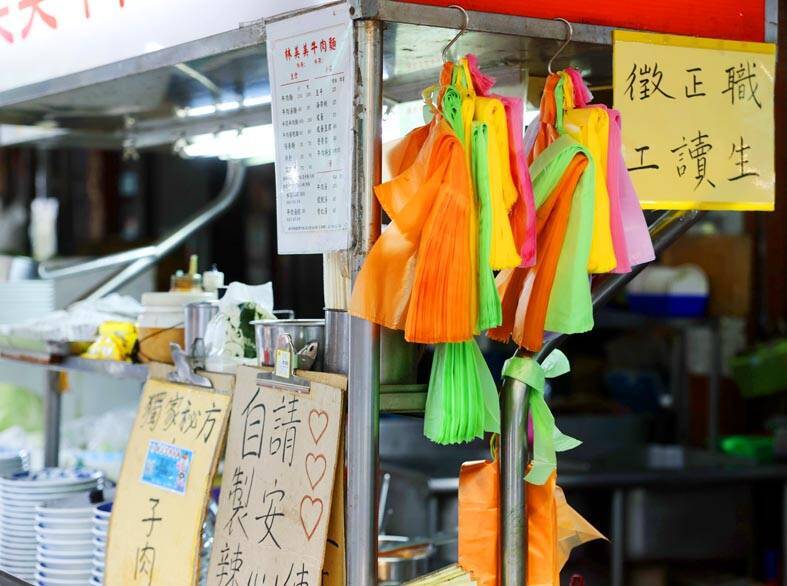
Plastic bags hang on the side of a street vendor’s cart in Taipei yesterday. Photo: CNA
REUSE STRATEGY: Lawmakers asked Peng Chi-ming about the apparent conflict between the reduction policy and a separate plan to boost plastic manufacturing
By Esme Yeh / Staff reporter
Engagement from microbusiness operators such as night market and street vendors is key in covering the last mile to reduce single-use plastic bags, Minister of Environment Peng Chi-ming (彭?明) said yesterday.
The legislature’s Social Welfare and Environmental Hygiene Committee at a meeting addressed the issue of domestic supply stability amid global supply chain disruptions and soaring oil prices due to conflict in the Middle East, as well as the ministry’s plastic reduction policy.
Many countries have been limiting plastic bag use due to raw material supply shortages with international oil prices soaring to a record US$170 per barrel this year, Peng said.
Ministry data showed that annual plastic shopping bag use in Taiwan was estimated to be 384 to 427 bags per person in 2023, he said.
Other East Asian countries such as Japan and South Korea had similar rates, while most European countries used much less, he said, adding that the UK used only eight bags per person last year.
The ministry has launched a shopping bag circulation scheme to promote plastic reduction, with Jianguo Flower Market (建國花市), in collaboration with EasyCard Corp, being a demonstration zone that offers monetary incentives, he said.
The scheme encourages use of reusable shopping bags, and assists companies in collecting and providing second-hand bags for reuse in markets and shopping areas, Peng said.
The last mile of reducing plastic shopping bags — which would be the most difficult phase — depends on engagement by microbusinesses, he said, adding that there are five major obstacles:
First, microbusinesses are more sensitive to cost increases, which would lead to higher prices and scare off customers; second, service efficiency is the priority for street vendors and paper containers are not as convenient as plastic bags; third, most street food in Taiwan contains liquids, which requires durable containers like plastic; fourth, plastic bags are commonly used in food delivery services to prevent leaks; and fifth, establishing a rent-and-return container sharing system would incur large costs to which a solution has yet to be found, Peng said.
The ministry has set targets of a 5 percent reduction in single-use plastic products by 2030 and a cumulative 10 percent by 2030 in line with EU standards.
Industrial Development Administration Deputy Director-General Chen Kuo-hsuan (陳國軒) said that the Ministry of Economic Affairs has coordinated industry operators to ensure that manufacturing and supply of plastic raw materials and plastic bags in Taiwan remain stable.
Democratic Progressive Party (DPP) Legislator Huang Hsiung-fang (黃秀芳) and Chinese Nationalist Party (KMT) Legislator Hung Meng-kai (洪孟楷) expressed concern over the conflict between the plastic reduction policy of the environment ministry and the plan to boost plastic manufacturing.
Peng said that the economic ministry focuses on short-term relief amid shortages and preventing anticipatory purchasing by the public, while his ministry promotes source reduction by incentivizing corporate participation in reusable bag circulation and increasing individual retailers’ plastic reduction awareness.
Chen said that the plastic production expansion scheme is temporary and whether it would continue depends on changes in the international situation.
DPP Legislator Chung Chia-pin (鍾佳濱) said the environment ministry should use the analogy of plastic reduction as “losing body fat by working out” rather than relying on “slimming injections.”
The agency should differentiate between agricultural plastics, medical plastics and plastic packaging materials, and prioritize them in its plastic reduction policy, especially during shortages, Chung said, adding that a two-pronged approach could be used to facilitate plastic reduction and supply stability.
Peng said stable supply of medical plastics should be prioritized over the other plastics and his ministry would set reduction targets for plastics through interministerial efforts within the next two months.
新聞來源:TAIPEI TIMES