離開
離開 進入
進入《TAIPEI TIMES》Cheng’s comments harmed Taiwan: DPP
2026/04/09 03:00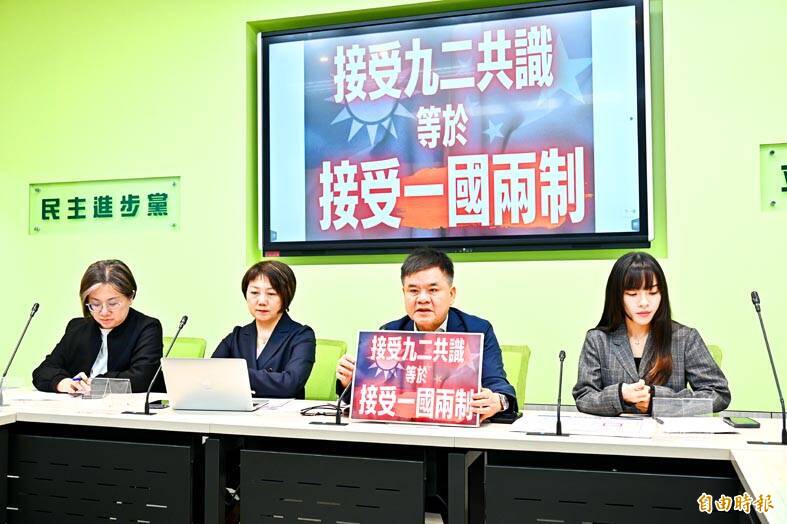
Democratic Progressive Party legislative caucus chief executive Chuang Jui-hsiung, second right, speaks at a news conference at the Legislative Yuan in Taipei yesterday. Photo: Tu Chien-jung, Taipei Times
By Chen Cheng-yu, Fang Wei-li and Jonathan Chin / Staff reporters, with staff writer
Chinese Nationalist Party (KMT) Chairwoman Cheng Li-wun’s (鄭麗文) comments in China have harmed the nation’s legitimacy, government officials and Democratic Progressive Party (DPP) lawmakers said yesterday, as the opposition leader visited the Sun Yat-sen Mausoleum in Nanjing amid fanfare.
Cheng is expected to meet with Chinese President Xi Jinping (習近平) later in her scheduled six-day trip to China, with Taiwan’s special defense budget and government funding hanging in legislative limbo.
DPP caucus chief executive Chuang Jui-hsiung (莊瑞雄) told a news conference at the legislature in Taipei that the KMT has no right to decide the nation’s future behind closed doors with the Chinese Communist Party (CCP).
Cheng’s praise for the so-called “1992 consensus” as an enduring document facilitated Beijing’s narrative, as the agreement allegedly reached by the KMT and the CCP is part of China’s blueprint for annexing Taiwan, he said.
The so-called “1992 consensus” — a term that former Mainland Affairs Council chairman Su Chi (蘇起) in 2006 admitted making up in 2000 — refers to a tacit understanding between the KMT and the CCP that both sides of the Taiwan Strait acknowledge that there is “one China,” with each side having its own interpretation of what “China” means.
Chuang said the opposition leader has claimed to represent the majority of Taiwanese, but the latest National Chengchi University poll showed that only 2.5 percent of the public identify themselves as Chinese and 62 percent identified as Taiwanese.
Taiwan’s only path to survival is to fight for its democracy, not relying on a politician who bailed out to her party’s ideological opposite, the totalitarian regime in Beijing, he said.
Citing a Mainland Affairs Council survey, DPP Legislator Fan Yun (范雲) said that 81 percent of Taiwanese are opposed to China’s “one country, two systems” formula for “unifying” Taiwan, and 70 percent want the KMT to pass the government’s special defense budget.
Separately, the Mainland Affairs Council said that Cheng’s homage at Sun’s tomb played into China’s propaganda campaign aimed at negating the legitimacy of the Republic of China (ROC).
The CCP has long portrayed Sun as a forebear to the communist revolution with itself as his legitimate heir, without recognizing the KMT or the ROC, the council said.
“Cheng’s furtive references to the ROC served to only placate a domestic audience in Taiwan and went entirely unnoticed by Chinese media,” it said.
Seperately National Security Bureau Director-General Tsai Ming-yen (蔡明彥) said that the bureau is not at liberty to comment on the activities of political parties, but called attention to China’s “united front” strategy.
Beijing’s main strategy for undermining Taiwan is to use “gray zone” tactics — such as surrounding the nation with jets and warships, and making threatening remarks — to scare Taiwanese into believing that war is imminent, he said.
Simultaneously, China uses cross-strait exchanges with specific people and groups as a pretext to sow division in Taiwan, with the goal of making Taiwanese accept a peace dictated by Beijing, Tsai said.
These targeted exchanges are choreographed to yield certain benefits to promote pro-Beijing political factions and weaken Taiwan, he said.
新聞來源:TAIPEI TIMES