離開
離開 進入
進入《TAIPEI TIMES》Cabinet unveils tariff-offset programs
2025/04/05 03:00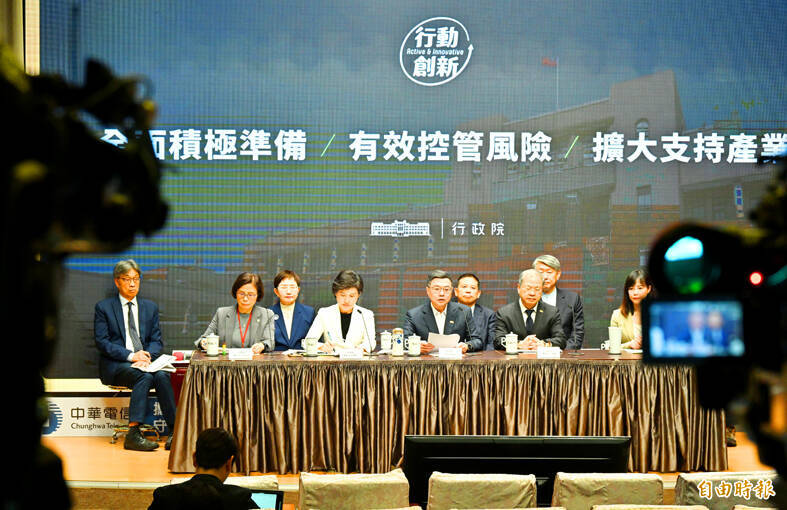
Premier Cho Jung-tai, fifth left, speaks at a news conference at the Executive Yuan in Taipei yesterday. Photo: Tien Yu-hua, Taipei Times
TALKS FOCUS: The premier said that the Trade Negotiations Office would continue to negotiate with the US to seek reciprocally beneficial trade and economic ties
By Esme Yeh / Staff reporter
A gross budget of NT$88 billion (US$2.66 billion) would be allocated to assist the industrial and agricultural sectors to address the effects of the latest US tariff policy on Taiwan, Premier Cho Jung-tai (卓榮泰) told a news conference in Taipei yesterday.
The Cabinet unveiled government programs in support of export supply chains at the news conference after US President Donald Trump on Thursday announced a “reciprocal” tariff of 32 percent on Taiwanese imports.
The government has planned 20 measures and allocated NT$88 billion to broaden support for industries and control risks, Cho said.
The industrial sector would receive NT$70 billion to offset administrative costs, boost industrial competitiveness, diversify markets, offer preferential taxation and stabilize employment, while NT$18 billion would go to the agricultural sector, he said.
“The Cabinet’s Trade Negotiations Office would continue to negotiate with the US government to bolster reasonable, favorable and reciprocally beneficial economic and trade relations,” Cho said.
“The Ministry of Economic Affairs, the Ministry of Finance and the Ministry of Labor should promptly put forward details about the 20 measures for people and industries to follow,” he said, adding that 190 hotlines would be set up under affiliated agencies by Tuesday next week to provide information on the Cabinet’s programs.
“Our evaluation showed that of all Taiwanese exports to the US, the manufacturing industry, including electronics and information technology, steel and other metals, machinery, vehicles and especially auto parts, building materials and domestic appliances would be materially affected by the increase in US tariffs,” he said.
As for agriculture and fisheries, exports of moth orchids, edamame, tea, tilapia, common dolphinfish and sea bass “might suffer from shrunken consumer markets or decreased competitiveness,” he added.
Given that the US’ tariff policy remains volatile, as Washington plans to lay out more details, the government would continue to observe the situation, and communicate with industries and society to propose pragmatic countermeasures, Cho said.
Vice Premier Cheng Li-chun (鄭麗君) said that the Cabinet in November last year set up a Taiwan-US economic and trade task force to monitor changes in US tariff policy, estimate the effects on industries and plan countermeasures.
The government would follow up on developments in the US’ policy for sectors such as semiconductors, pharmaceuticals and timber — which were not covered in the US’ announcement on Thursday — as well as their effects on overseas Taiwanese businesspeople, she said.
“Premier Cho has ordered agencies to announce the procedures and timelines by April 14 so industries could apply for the funding,” Cheng said, adding that the government would fully support the nation’s industries.
Minister Without Portfolio Jenni Yang (楊珍妮) said that in talks with Washington the government would focus on the complementary trade structure and high-tech strategic partnership between Taiwan and the US to seek bilateral trade balance.
It would also stress the US’ trade surplus with Taiwan in agricultural products and suggest including that surplus in the calculation of reciprocal tariffs, she added.
Asked whether a potential joint venture between Taiwan Semiconductor Manufacturing Co (台積電) and Intel would be a bargaining chip in negotiations, Cho said that the focus would be on national interests.
There is no further information about the issue and its progress, and the government would adhere to the principle of having national interests as its sole concern, he said.
Additional reporting by Lisa Wang
新聞來源:TAIPEI TIMES