離開
離開 進入
進入《TAIPEI TIMES》 China bases old jet drones near Strait
2026/03/28 03:00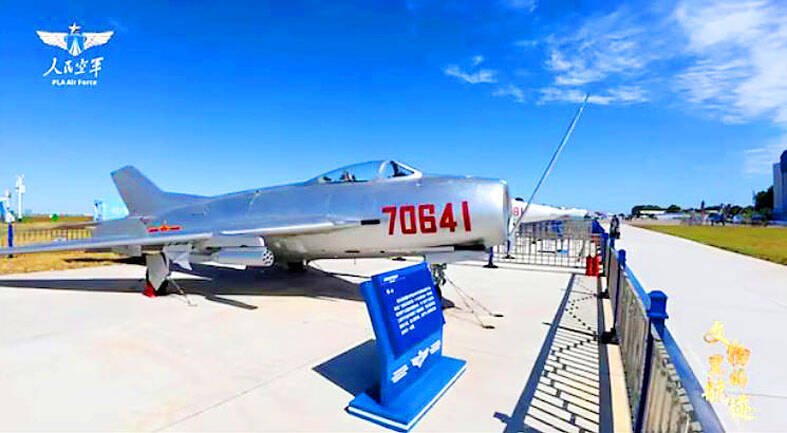
A retired J-6 fighter is displayed at a Chinese air force exhibition last year. The Chinese People’s Liberation Air Force has converted some of the fighters into attack drones. Photo: Reuters / Screen grab via PLA Air Force WeChat page
J-6 REMODEL:The converted drones are part of Beijing’s expanding mix of airpower weapons, including bombers with stand-off missiles and UAV swarms, the report said
/ Reuters, HONG KONG
China has stationed obsolete supersonic fighters converted to attack drones at six air bases close to the Taiwan Strait, a report published this month by the Arlington, Virginia-based Mitchell Institute for Aerospace Studies said.
Satellite imagery of the airfields from the institute’s “China Airpower Tracker” shows what appear to be lines of stubby, swept-winged aircraft matching the shape of J-6 fighters that first flew with the Chinese People’s Liberation Army (PLA) Air Force in the 1960s. Since their conversion to drones, the aircraft have been identified at five bases in China’s Fujian Province and one in Guangdong Province, the report said.
J. Michael Dahm, a senior fellow at the Mitchell Institute, said that the PLA has deployed an estimated 200 or more obsolete fighters converted to drones to airfields near the Taiwan Strait.
The jets-turned-drones would fly into targets in the opening phase of an assault on Taiwan, said Dahm, a former US naval intelligence officer.
They would be used more like cruise missiles than autonomous or remote-controlled uncrewed aerial vehicles (UAV), he said.
“They will attack Taiwan, US or allied targets in large numbers, effectively overwhelming air defenses,” he said.
He compiled the data for the report from open-source intelligence and commercial satellite imagery.
China dominates the global commercial drone market. It is also investing heavily in military drone technologies.
The converted drones identified in the Mitchell Institute report are part of Beijing’s expanding mix of airpower weapons, including bombers with stand-off missiles, modern fighters, ballistic missiles, cruise missiles and swarms of modern UAVs, experts on air warfare said.
This month, the US intelligence community said that its assessment is that China is not currently planning to invade Taiwan in 2027.
That contrasted with the Pentagon’s annual report on China’s military power late last year that said China “expects to be able to fight and win a war on Taiwan by the end of 2027.”
The key purpose of the converted drones is “to exhaust Taiwan’s air defense systems in the first wave of an attack,” a senior Taiwanese security official said.
To prevent China from “striking high-value targets, we will inevitably face the cost-efficiency issue of using expensive missiles to intercept them at a distance,” the official said.
In a report to the legislature this week, the Ministry of National Defense outlined plans to rapidly acquire a new generation of counterdrone systems.
The ministry referred to a 2022 report by the Institute for National Defense and Security Research, which said that the drones were “a form of asymmetric warfare that cannot be ignored.”
The Chinese Ministry of National Defense and Beijing’s Taiwan Affairs Office did not respond to questions for this story.
The Pentagon also did not respond to a request for comment.
In a Taiwan conflict, China could launch a “large attack wave” of strike aircraft, missiles flying on different trajectories, and fast and slow drones, said Peter Layton, a visiting fellow at Griffith University in Australia and a retired Royal Australian Air Force group captain who has worked at the Pentagon.
“There would be a lot of diverse things all coming at the same time,” Layton said. “It would be an air defense nightmare.”
The drones do not rank among China’s most threatening, advanced UAVs, but they would be costly to combat, he said.
The small, high-speed interceptor drones that Ukraine has been fielding in its war with Russia would be ineffective in shooting them down, he said.
“Those J-6s would need a proper expensive missile,” he added.
The protracted conflict in Ukraine and the US-Israeli war with Iran have demonstrated that drones are a crucial element of modern warfare.
Some can be built in large numbers, deployed in mass formations and quickly replaced after battlefield losses.
China is developing new UAVs, including a stealth attack drone that experts said would operate from an aircraft carrier.
Military attaches and security analysts said that China is already testing the use of drones in deception operations in potential rehearsals of a Taiwan invasion.
The twin-engine J-6 was derived from the 1950s-era Soviet Mig-19 fighter.
This jet and other Soviet-derived aircraft formed the core of China’s fighter fleet until the mid-1990s, the US Air Force’s Air University said.
Dahm estimated that more than 500 of the aircraft have been converted to drones.
The drone version of the J-6 is designated the J-6W.
The PLA Air Force in September last year exhibited one of the converted fighters at the Changchun Air Show in northeast China.
On an information board displayed next to the drone, it was described as a J-6 UAV, a photograph from the air show published by the Chinese Ministry of National Defense showed.
“This aircraft is a modified version of the J-6 fighter jet,” the information board said.
The fighter’s cannons and other equipment were removed, and it was fitted with an automatic flight control system and terrain matching navigation technology, it said.
The UAV made its first successful flight in 1995 and could be used as attack aircraft, or a training target for fighter pilots, anti-aircraft guns, surface-to-air missiles or radar operators, the board said.
The Chinese airfields closest to the Taiwan Strait where J-6 drones are based would be vulnerable to counterattack from Taiwan and its allies in a conflict, Dahm said.
“The idea is to launch all the drones in the first hours of a PLA operation,” he said.
新聞來源:TAIPEI TIMES