離開
離開 進入
進入《TAIPEI TIMES》Videos prompt review of election law
2025/10/16 03:00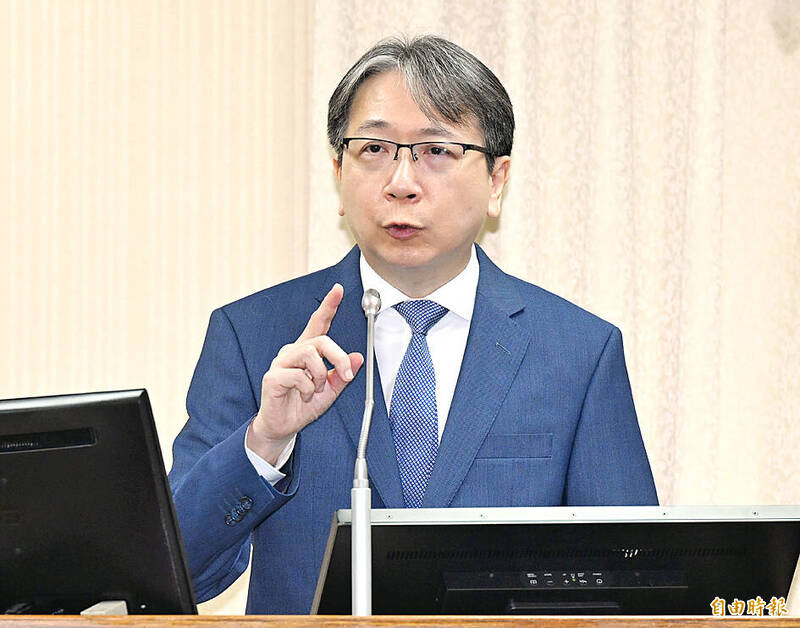
National Security Bureau Director-General Tsai Ming-yen speaks at a meeting of the legislature’s Foreign Affairs and National Defense Committee in Taipei yesterday. Photo: Liao Chen-hui, Taipei Times
ONLINE SCRUTINY: Efforts to amend the law would improve following reports of foreign interference in the KMT election depending on who wins, a source said
By Sam Garcia / Staff writer, with CNA
The National Security Bureau (NSB) yesterday said it has found more than 1,200 TikTok and YouTube videos, mostly from overseas accounts, discussing the Chinese Nationalist Party (KMT) chairperson election, prompting the Executive Yuan to review legal measures to counter foreign interference in elections.
Former Broadcasting Corp of China (中國廣播) chairman Jaw Shaw-kong (趙少康) on Monday said that most of the videos on TikTok and YouTube about the election express strong support for specific candidates and are posted by accounts registered just before the KMT started the election process.
Jaw called on national security agencies to investigate foreign interference in the election.
NSB Director-General Tsai Ming-yen (蔡明彥) yesterday told reporters that the bureau has started investigating the circulation of online videos referencing the election, looking for possible foreign interference.
More than 1,000 TikTok videos discuss the election, while 23 YouTube accounts have published about 200 related videos, Tsai said ahead of a meeting of the Legislative Yuan’s Foreign Affairs and National Defense Committee.
More than half of the 23 YouTube accounts were registered overseas, he said, without specifying where.
Tsai said that he would not discuss which candidate the videos supported to avoid influencing the election.
The NSB found that there are insufficient legal tools to address the issue, as neither the National Security Act (國家安全法) nor the Anti-Infiltration Act (反滲透法) have provisions regarding foreign forces infiltrating domestic associations or political party elections, he said.
The Executive Yuan has held multiple interministerial meetings to discuss how to improve national security legislation, he said, adding that the NSB gave advice during the meetings.
Tsai said he hopes all political parties would discuss the legislation when it is proposed to boost the national security framework and provide a more complete legal foundation for digital governance.
Separately, a source said that the Executive Yuan has conducted a preliminary review of national security legislation, but has not prioritized amendments for this legislative session.
As for whether efforts to amend the law would proceed more smoothly following reports of foreign interference in the KMT election, the source said: “That depends on who wins.”
Ministers without portfolio Ma Yung-cheng (馬永成) and Lin Min-Hsin (林明昕) convened interministerial meetings to discuss national security legislation, including the National Security Act, the Anti-Infiltration Act, the Act Governing Relations Between the People of the Taiwan Area and the Mainland Area (臺灣地區與大陸地區人民關係條例), the Cyber Security Management Act (資通安全管理法) and the Nationality Act (國籍法), the source said.
While the preliminary review is complete, no proposed amendments have been reported to Premier Cho Jung-tai (卓榮泰), so when the bills would be submitted to the Legislative Yuan remains uncertain, the source said.
Cho said at a ceremony for the Directorate-General of Personnel Administration that it was previously thought that cyberattacks would only target the ruling party, but now even opposition parties are under assault.
This shows that cognitive warfare, disinformation and cyberattacks have spread throughout the nation, and all sectors of society must exercise caution, he said.
The world is watching Taiwan to see whether it can safeguard national security in the face of such infiltration attempts, he added.
Sadly, some government agencies and active-duty military personnel have forgotten their duty to protect Taiwan, instead forming ties with foreign forces and being swayed by improper interests, Cho said.
In Taiwan, anyone deemed useful or susceptible to influence could become a target for cognitive warfare, he said.
Additional reporting by Liu Wan-lin
新聞來源:TAIPEI TIMES