離開
離開 進入
進入《TAIPEI TIMES》 Successor of Taiwania 2 to begin working in May
2025/02/10 03:00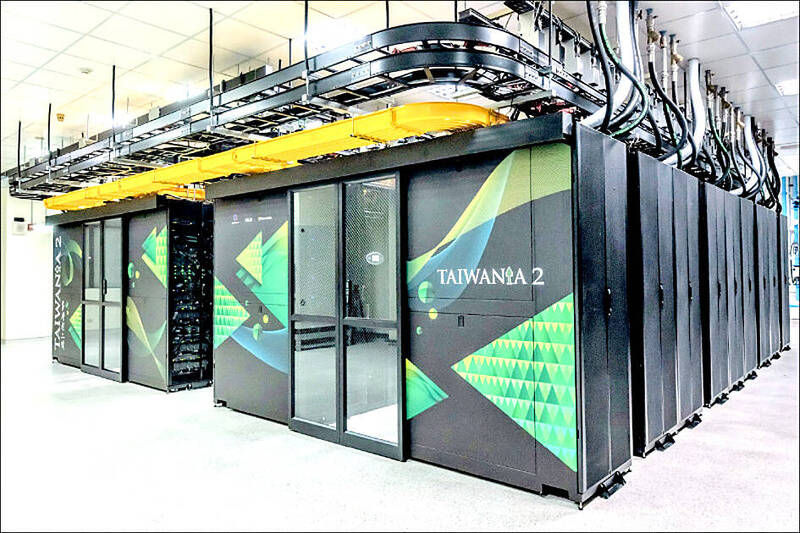
The supercomputer Taiwania 2 is pictured in an undated photograph. Photo courtesy of the National Center for High-Performance Computing
NEXT-GENERATION:The new supercomputer is expected to facilitate the development of generative AI and strong AI, and be integrated into an AI cloud service platform
By Shelley Shan / Staff Reporter, with CNA
Taiwan’s first next-generation supercomputer for artificial intelligence (AI), which would be equipped with Nvidia’s H100 graphics processing units (GPU), is scheduled to begin working with a capacity of 16 petaFLOPS in May. The government is planning to gradually expand the computing power to 200 petaFLOPS to facilitate the development of applications for generative AI and artificial general intelligence, also known as strong AI.
One petaFLOP is equivalent to 1 quadrillion calculations per second.
The National Center for High-performance Computing (NCHC) is tasked with building supercomputers to be used by researchers of physics, chemistry, mathematics, atmospheric science, engineering, life science and AI.
Researchers, the government and academic institutions can apply to access those computers.
The center’s supercomputer for AI, Taiwania 2 (台灣杉二號), has a computing power of nine petaFLOPS, which is capable of processing massive datasets, deep learning and AI computing. It was built in 2018 using Nvidia’s VI00 GPU.
With the rapid development of AI, the center wanted to build a next-generation AI supercomputer with more advanced GPUs to succeed Taiwania 2. The new supercomputer, which uses Nvidia’s H100 GPU as its main framework, is to be available for use in May and would have a computing power of 16 petaFLOPS, the NCHC’s plan showed.
It also plans to increase the computing power of the new supercomputer to 100 petaFLOPS, or even 200 petaFLOPS. The scale would be determined by the funding allocated to the project.
The center has yet to decide on the name for the new supercomputer.
Council officials said that the new supercomputer would facilitate the development of generative AI and strong AI, and could be integrated into a one-stop AI cloud service platform when a traditional Chinese version of Trustworthy AI Dialogue Engine is added.
Generative AI uses generative models to produce text, images, videos or other forms of data, while strong AI refers to machines that have intelligence and capabilities comparable to human cognition. The latter possesses the ability to learn, reason and adapt to unfamiliar environments.
The platform would provide computing power and a large language model base, which would help reduce the amount industry operators spend on developing a large language model base, they said.
It would also allow industry operators of various disciplines to create customized knowledge bases and other applications using their own datasets, they added.
The NCHC also uses the Taiwan 3 and the Forerunner 1 for high-performance computing, which were built using central processing units.
It plans to upgrade the computing power and energy use efficiency of supercomputers through the Taiwan Chip-based Industrial Innovation Program and Southern Silicon Valley project, with the goal of reaching 480 petaFLOPS in the government sector by 2029.
In the same year, the nation’s accumulative computing power would top 1.2 exaFLOPS when efforts from the private sector are included.
新聞來源:TAIPEI TIMES