離開
離開 進入
進入《TAIPEI TIMES 焦點》 Monkeys target sugar-apple crop
2015/01/04 03:00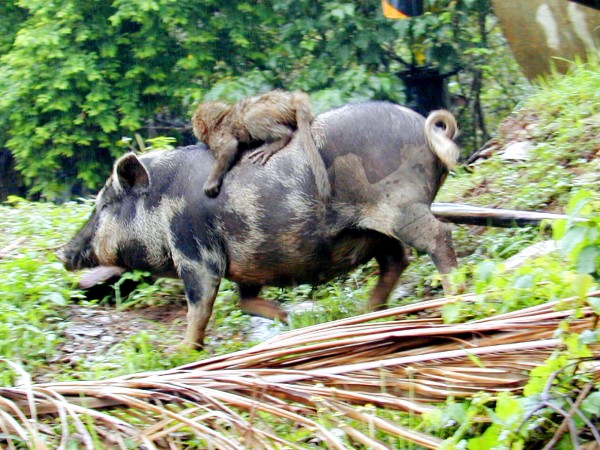
A Formosan rock monkey rides a Formosan wild boar in Taitung yesterday. Photo: CNA
WREAKING HAVOC: Farmers said they had tried everything possible to deter the animals without success, while authorities said that extermination in a humanitarian way was legal
As atemoyas — also known as pineapple sugar apples — enter harvest season, farmers have reported incidents in which troops of Formosan rock monkeys (Macaca cyclopis) have ransacked their crops, resulting in what they said were immeasurable financial losses.
Lin Te-yi (林德益), a farmer growing pineapple sugar apples in Donghe Township (東河), said his fruit had been “looted” by at least two troops of Formosan rock monkeys, which caused him a loss of at least half of the estimated overall yield.
Saying the monkeys were uncontrollable, Yanping Township (延平) Office secretary Hu Wu-jen (胡武仁) said that with the exception of ginger, the primates tamper with literally any crop they can find, wreaking havoc on farms in the mountains.
Farmers said they had tried everything to deter the monkeys, including setting off firecrackers, playing music over loudspeakers and passing electricity through nets set up around their fields, but nothing worked and they have all resolved that the most effective way to deal with the problem is to exterminate the monkeys.
Citing Article 21 of the Wildlife Conservation Act (野生動物保育法), Forestry Bureau Wildlife Conservation Section head Lin Kuo-chang (林國彰) said that if wild animals cause financial loss or threaten personal safety on private property, owners may destroy the animals using humanitarian methods.
He said that the use of poison, firearms (except shotguns), traps and nets are banned for hunting wild animals, but the situation described in Article 21 of the act is an exception, even if the animals in question are protected species.
“For example, many poisonous snakes are protected species, but if they enter private properties, endangering personal safety, then killing them is not a violation of the act,” he said.
However, Hu said there is not yet an agreed definition of what humanitarian methods are.
He said that in his opinion, the most humanitarian means to kill the monkeys is by “a clean shot,” because it induces the least pain over the shortest period of time.
In response, Forestry Bureau Deputy Director-General Yang Hung-chih (楊宏志) said that using a shotgun is one option, although this is not the only way to put down the primates, and that the standard procedure should be decided after further discussions.
He said there are at least 250,000 Formosan rock monkeys nationwide, and that the primate is listed as Category III on the bureau’s list of protected species, meaning that they are among the animals on the list that are least likely to face extinction.
He stressed that the question of how to destroy the primates is not a technical problem, but a moral issue, as all the required expertise is in place.
Referencing the conclusions reached during a nationwide conference last month to address the problem, Yang said that all the farmers who attended the symposium said the monkey’s behavior is “unacceptable,” and that countermeasures should be enforced.
Furthermore, the meeting concluded that the size of the monkey populations in Donghe and Changhua County’s Ershuei Township (二水) has already exceeded the capacity of the areas to sustain them.
He said the bureau would bring the issue of how to destroy the monkeys to the public domain by consulting zoologists, animal protection groups, farmers and Aborigines.
The bureau aims to come up with a solution by the end of next month, he said.
新聞來源:TAIPEI TIMES
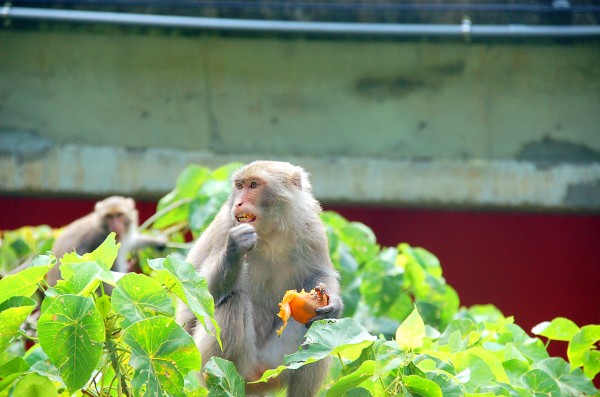
A Formosan rock monkey on Oct. 13 eats fruit at a fruit orchard in Taitung County, where a rise in the animal’s population is creating problems for local farmers. Photo: Chang Tsun-wei, Taipei Times