離開
離開 進入
進入《TAIPEI TIMES》F-16 collision avoidance upgrade to begin in July
2026/05/26 03:00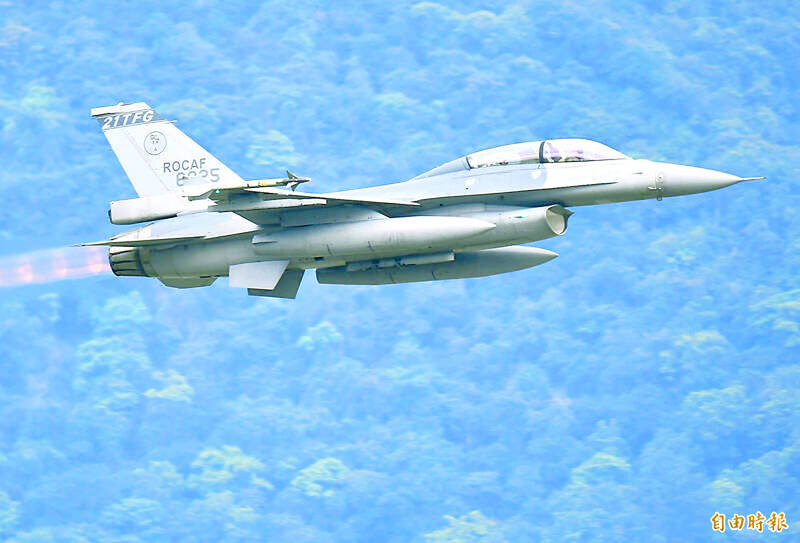
An F-16V takes off from Hualien Jiashan Air Force Base during live-fire exercises on March 20. Photo: You Tai-lang, Taipei Times
SAFER FLIGHTS:The Auto-GCAS uses data such as aircraft speed, heading and terrain information to assess the risk of a ground or sea collision, and alert the pilot
Staff writer, with CNA
Installation of an automatic ground collision avoidance system (Auto-GCAS) across Taiwan’s F-16V fleet would begin this summer, with all jets expected to be fully equipped with the system before the end of 2028, the air force said yesterday.
Air force Chief of Staff Lieutenant General Lee Ching-jan (李慶然) made the remarks during a legislative session in Taipei when asked by lawmakers for updates on the Auto-GCAS program for the nation’s F-16Vs.
Lee said software updates for the system are scheduled to begin in July, followed by hardware upgrades in September.
The system is expected to become fully operational by 2028, he added.
The Auto-GCAS upgrade became a topic of public discussion earlier this year after an F-16V jet piloted by Captain Hsin Po-yi (辛柏毅) disappeared off eastern Taiwan in January during a training mission.
Following a months-long search, the air force retrieved the flight data recorder (FDR) from the sea in March, but Hsin’s body has yet to be found. The FDR was later sent to its manufacturer in the US for data decoding.
A computer failure could have caused the F-16V crash, the air force said.
Since January, lawmakers have been urging the air force to expedite the installation of the system across the F-16V fleet, but the military said the process would take time.
The Auto-GCAS uses data such as aircraft speed, heading and terrain information to assess the risk of a ground or sea collision, and alert the pilot. If the pilot does not respond, the system automatically adjusts the aircraft’s altitude to prevent a crash.
Commenting on the latest developments in the search for Hsin, Lee told lawmakers that the US manufacturer was still decoding the FDR data.
Meanwhile, during yesterday’s session, army Chief of Staff Lieutenant General Chen Chien-yi (陳建義) told lawmakers that the army established drone units in northern, central and southern Taiwan last month as part of efforts to bolster asymmetric warfare capabilities.
The establishment of the drone units came after the army inaugurated an Uncrewed Aerial Vehicle Training Center in January last year. The center is tasked with providing training in basic drone operations and maintenance, as well as developing instructors, tactics, and research and development capabilities for the armed forces.
新聞來源:TAIPEI TIMES