離開
離開 進入
進入《TAIPEI TIMES》US tariffs lowered to 15% with no stacking: Cabinet
2026/01/17 03:00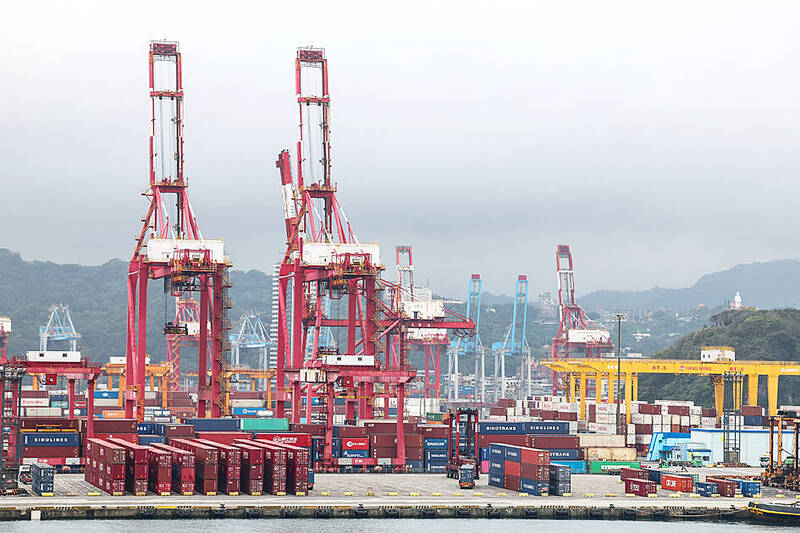
Gantry cranes and shipping containers at the Port of Keelung are pictured yesterday. Photo: CNA
FAVORABLE:The deal should help Taiwan’s non-tech sectors become more competitive, as they would be on equal footing with other major US trade partners
Staff writer, with CNA
The US has agreed to lower tariffs on Taiwanese goods from 20 percent to 15 percent, without stacking them on existing most-favored-nation (MFN) rates, the Executive Yuan said yesterday, adding that Taiwan has also become the first country to secure the most-favorable treatment for its semiconductor and related product suppliers under Section 232 of the US Trade Expansion Act.
The trade negotiations, which concluded on Thursday, included commitments to expand supply chain investment cooperation and deepen Taiwan-US collaboration on artificial intelligence (AI), the Cabinet said.
The new tariff rate matches US rates on goods from major trade partners such as Japan, South Korea and the EU.
Taiwanese semiconductor, electronics manufacturing services, AI and energy companies would invest US$250 billion in the US, it added, but did not give a timeframe.
The government has also agreed to provide financial institutions up to US$250 billion in credit guarantees to support semiconductor, and information and communications technology investments, the Executive Yuan said.
Taiwan is the first country to secure the most-favorable treatment for its semiconductor and related product suppliers, which should significantly ease uncertainties in the local semiconductor industry, the Cabinet said.
Taiwanese semiconductor firms would be granted most-favorable status when they import raw materials, equipment and electronic components for their US operations, it said.
Washington has recognized and accepted a “Taiwan model,” which allows Taiwanese companies to follow their own plans for investing in the US and moving closer to US clients, the Cabinet said, adding that it should encourage local companies to enter the US’ supply chain and build industrial capacity there.
Taiwan has the sixth-largest trade surplus with the US, 90 percent of which is related to sales of semiconductors, information and communications products, and electronic components, it said.
The consensus was reached on Thursday, and a memorandum of understanding was signed with the US Department of Commerce, it added.
A more formal trade pact would be signed in the coming weeks, said Vice Premier Cheng Li-chiun (鄭麗君), who led Taiwan’s trade negotiation team.
Taiwan secured two deals: A reciprocal tariff of 15 percent with no stacking, the lowest rate among countries with which the US runs a trade deficit, and a US pledge to grant the nation “most-favored treatment” if it imposes tariffs under the Trade Act, she said.
The US Department of Commerce described the arrangement as “a historic trade deal that will drive a massive reshoring of America’s semiconductor sector” and “strengthen US economic resilience, create high-paying jobs and bolster national security.”
The Cabinet said the 15 percent tariff without stacking should help make Taiwan’s non-tech sectors more competitive, as they would now be on equal footing with Japan, South Korea and the EU.
Taiwan has also secured most-favorable treatment for other items, such as auto parts, wooden furniture and aircraft components, under the Trade Act, it said, adding that the two countries have agreed to set up a negotiation mechanism under Section 232.
Regarding whether tariffs on vehicles imported from the US would be reduced to zero, Cheng said a full briefing would be provided when the Taiwan-US trade agreement is signed.
Taiwan currently imposes a 17.5 percent tariff on cars imported from the US.
Additional reporting by Chen Yu-fu
新聞來源:TAIPEI TIMES
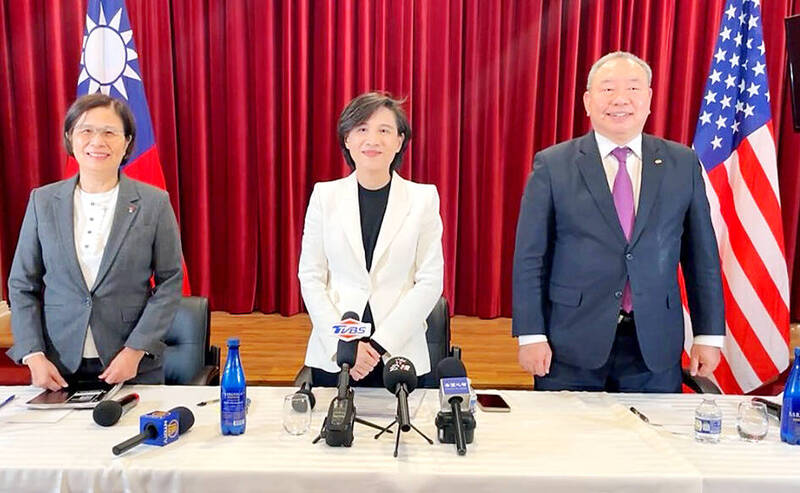
From left, Minister Without Portfolio Yang Jen-ni, Vice Premier Cheng Li-chiun and Representative to the US Alexander Yui hold a news conference in Washington on Thursday. Photo: screen grab from the Executive Yuan’s livestream