離開
離開 進入
進入《TAIPEI TIMES》Tax deal to lift competitiveness: Kung
2026/01/17 03:00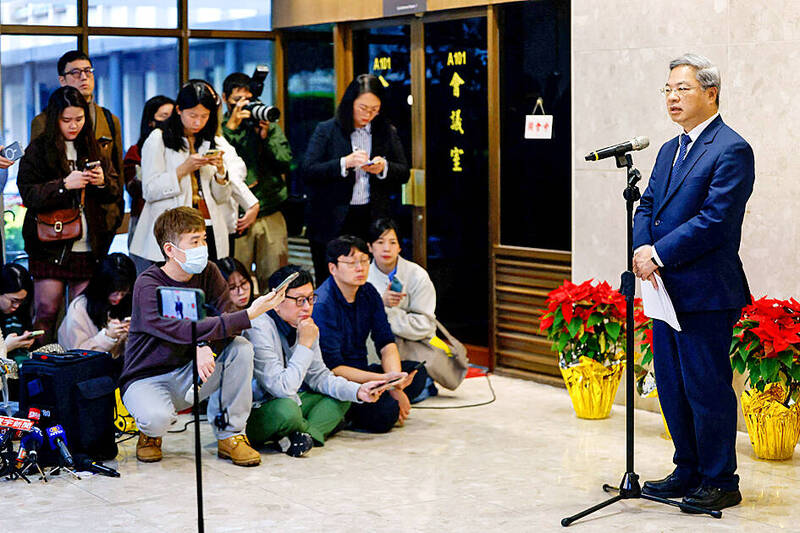
Minister of Economic Affairs Kung Ming-hsin answers questions from members of the media regarding the Taiwan-US trade deal in Taipei yesterday. Photo: Ann Wang, Reuters
EQUAL FOOTING:The 15% tariff is on par with that imposed on Japan and South Korea, and removes uncertainty over the US probe into Taiwan’s ICT industry, the minister said
By Meryl Kao / Staff reporter
Local manufacturers, particularly traditional industries and small and medium-sized enterprises, should benefit from the lower US tariffs, as Taiwan gains an equal footing with competitors in Japan and South Korea, Minister of Economic Affairs Kung Ming-hsin (龔明鑫) told reporters yesterday.
After concluding the trade negotiations with Taiwan on Thursday, Washington agreed to lower tariffs on Taiwanese goods to 15 percent from the 20 percent that US President Donald Trump’s administration announced in August last year, without stacking them on existing duties, the Executive Yuan said.
As Taiwan does not have a free-trade agreement with the US, its tariff structure has long been at a disadvantage, while Japan and South Korea have largely enjoyed zero-tariff treatment, Kung said.
The deal places Taiwan on par with Japan and South Korea, as all three are now subject to a 15 percent tariff, he said.
For example, the machine tool industry used to face a duty of up to 4 percent on top of the 20 percent imposed in August, he said.
The outcome also helped stabilize industry expectations regarding the results of the US’ Section 232 investigation, Kung said.
Information and communications technology (ICT) manufacturers were afraid that they could face high tariffs after being included in the Section 232 investigation, but the new deal would allow most ICT products to continue to enjoy tariff exemptions, he said.
ICT products accounted for more than 80 percent of Taiwan’s total exports to the US in 2024, a share that is likely to rise further, he said.
Overall, Taiwan would enjoy a relatively stable tariff framework and will not only compete on equal footing with peers in other countries, but also gain more advantageous conditions for some product categories, Kung said.
Based on the agreement, Taiwan is to invest up to US$250 billion in the US, mostly in semiconductors, he said.
However, the ministry is not worried that this would lead to offshoring of the semiconductor industry, he added.
About 85 percent of advanced chips deploying 5-nanometer or more sophisticated process technologies would still be produced in Taiwan by 2030, and only 15 percent would be made in the US, he said.
By 2036, the split between Taiwan and the US is projected to shift to 80 percent and 20 percent, he said.
This means Taiwan would remain the world’s most important production base for artificial intelligence (AI) chips, while the US would serve as the primary market for AI applications and data centers, the minister said.
Taiwan is also to provide credit guarantees of up to US$250 billion to support companies investing in the US.
Meanwhile, US companies are also expected to expand investment in Taiwan, targeting defense, drones, smart robots, quantum technology and biotechnology, in addition to chips and AI, Kung said.
The investments would not only help complete Taiwan’s semiconductor and AI ecosystem, but also address gaps in areas such as memory, materials and equipment, where the US has comparative strengths, he said.
Both sides aim to build a more complete and resilient supply chain system to achieve a win-win outcome over the long term, he added.
On whether the government would adjust the NT$46 billion in special budget originally earmarked for traditional industries, he said that industrial financial support is not limited to short-term relief.
The government will continue to engage with industry associations and business groups to ensure that companies can accelerate upgrading efforts under the new trade framework, he said.
新聞來源:TAIPEI TIMES