離開
離開 進入
進入《TAIPEI TIMES》Opposition votes to split up budget
2026/01/17 03:00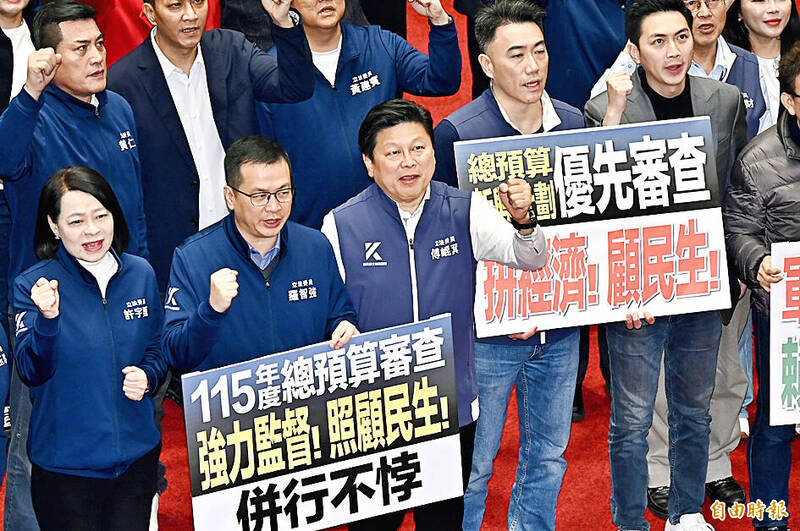
Chinese Nationalist Party (KMT) lawmakers hold placards stating their stance on general budget at the Legislative Yuan in Taipei yesterday. Photo: Tu Chien-jung, Taipei Times
By Liu Wan-lin and Fion Khan / Staff reporter, with staff writer and CNA
Opposition lawmakers yesterday fast-tracked a motion to the second reading that would authorize the disbursement of the central government’s NT$71.8 billion (US$2.2 billion) budget for 38 projects, including subsidies to address the low birthrate and funding for the TPass program.
During a plenary session, the Chinese Nationalist Party (KMT) and the Taiwan People’s Party (TPP) used their combined majority to bypass committee review and send the motion, which covers 38 budgetary items, directly to the second reading and cross-party negotiations.
Despite objections from the Democratic Progressive Party (DPP), the motion passed 59 to 49, with one abstention from KMT Legislator Hsieh Yi-fong (謝衣?).
The 38 proposed projects include subsidies to address Taiwan’s low birthrate, funding for the TPass program, and flood control and water management initiatives.
Regarding the birthrate, the subsidies include NT$235 million to cover gaps in government employee birth benefits and NT$2.96 billion for labor insurance birth subsidies.
For the TPass program, the subsidies include NT$1.58 billion for the Executive Yuan’s TPass implementation program and NT$5.94 billion for local governments to implement TPass from this year to 2029.
As for flood control and water management, the proposal includes subsidies for river and drainage improvement projects to address climate change.
In the proposal, the KMT and the TPP said that amid international uncertainty and rising cross-strait tensions, the Executive Yuan had “maliciously and illegally” failed to budget for pay raises for volunteer military personnel, and higher replacement ratios for police and firefighter pensions.
They accused the Cabinet of failing to present viable alternatives, and of undermining the Constitution and public opinion by spreading misinformation and sowing social division.
The proposal cited a “non-shutdown mechanism” in the budgetary process, arguing that under Article 54 of the Budget Act (預算法), the legislature may adopt a resolution allowing the advance release of urgent and major livelihood-related capital expenditures and new projects included in this year’s general budget.
The opposition hopes the legislature would first approve funding for these projects, TPP caucus deputy whip Chang Chi-kai (張?楷) said.
However, the Executive Yuan should address the root of the issue by fully budgeting for military pay raises and related items to enable substantive review of the overall budget, he added.
The motion mainly targets new local and livelihood-related projects, or specific expenditures within new initiatives, KMT Legislator Lo Chih-chiang (羅智強) said.
It is regrettable that the matter was not handled by the Executive Yuan, as it could have sought legislative approval to release funds for these initiatives, he said.
This year’s general budget has not even been submitted for review, DPP caucus chief executive Chung Chia-pin (鍾佳濱) said, questioning how the opposition could selectively deem NT$71.8 billion in projects especially urgent without full review.
The Legislative Yuan usually refers the central government budget to committees for item-by-item scrutiny before second and third readings in plenary, he said.
By utilizing a “resolution” format to authorize specific expenditures, the opposition is attempting to circumvent the standard review process, he added.
新聞來源:TAIPEI TIMES
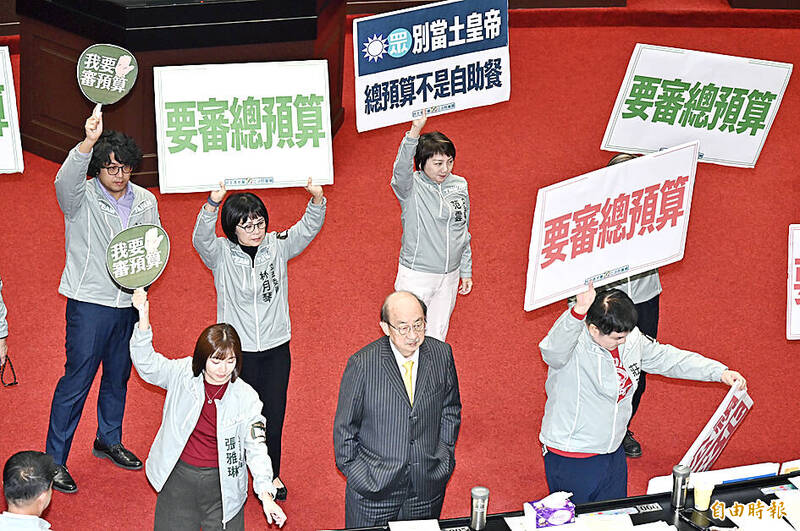
Democratic Progressive Party lawmakers hold placards stating their stance on general budget at the Legislative Yuan in Taipei yesterday. Photo: Tu Chien-jung, Taipei Times