離開
離開 進入
進入《TAIPEI TIMES》 Executive Yuan unveils livelihood policies for 2021
2020/12/25 03:00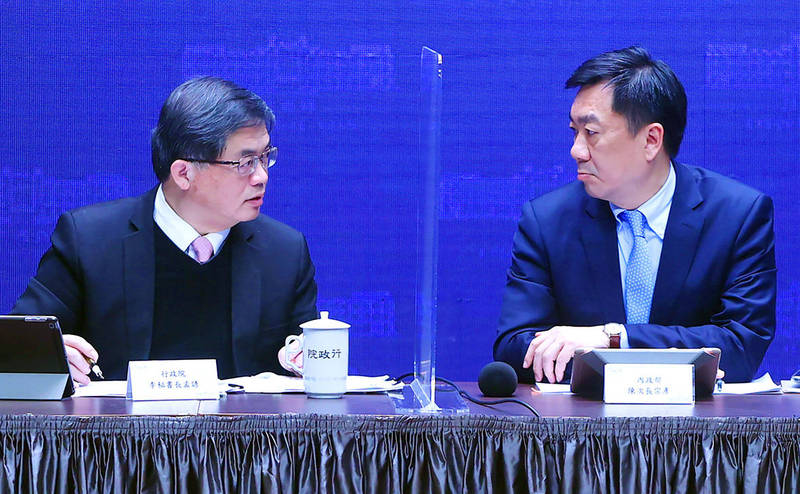
Executive Yuan Secretary-General Li Meng-yen, left, and Deputy Minister of the Interior Chen Tsung-yen speak at a news conference in Taipei following the Executive Yuan’s weekly meeting yesterday. Photo: CNA
By Lee Hsin-fang and Jonathan Chin / Staff reporter, with staff writer
The Executive Yuan yesterday unveiled livelihood policies to be implemented next month, including adjustments to the minimum wage, adjustments to the basic living expenses for filing taxes and the establishment of a farmers’ pension fund.
Executive Yuan Secretary-General Li Meng-yen (李孟諺) made the announcements at a news conference in Taipei following the Executive Yuan’s weekly meeting.
On Friday next week, the monthly minimum wage would rise to NT$24,000 (US$840.54) from NT$23,800, and the hourly minimum wage would rise to N$160 from NT$158, Li said, adding that the policies would benefit about 2.08 million salaried workers.
Farmers are to make monthly contributions to the Farmers’ Pension Fund that the government would match for 40 years, Li said.
When they retire, farmers would receive a pension of NT$45,000 per month, he said.
The Farmers’ Insurance Act (農業保險法), which President Tsai Ing-wen (蔡英文) signed into law on May 27, would be promulgated to subsidize one-third to one-half of monetary losses in the agricultural sector incurred by natural disasters, disease or market fluctuations, he said.
The Council of Agriculture is to allocate NT$10 billion to the Agricultural Insurance Fund per year, which is expected to stabilize agrarian income, he said.
Subsidies for public-school lunches are to rise to NT$6 per meal from NT$3.5, while the Executive Yuan is to require that schools only use ingredients certified as produced in Taiwan, he said.
The basic living expense — as defined by the income tax filing system to calculate personal tax exemptions — is to rise to NT$18,200 from NT$17,500, which is expected to benefit 20,500 households when they file taxes in May, he said.
Publishers involved in book imports or exports would be able to apply for business tax exemptions, he said.
People who buy masks through the government’s rationing program, which allows nine masks to be bought every two weeks at a fixed price of NT$45, would be able to buy 10 masks per 14 days for a fixed price of NT$40, Li said.
Separately yesterday, the Ministry of Labor’s Bureau of Labor Insurance said that the labor insurance premium is to be increased to 11.5 percent.
This means an estimated increase of NT$28 to NT$46 per month in an employee’s share of the labor insurance premium, and an estimated increase of NT$84 to NT$160 per month in the employer’s share, the bureau said.
National pension premiums are to increase to 9.5 percent from 9 percent, as the current premiums would not cover the National Pension Fund for the next two decades, the Ministry of Health and Welfare’s Department of Social Insurance said.
The measure is expected to add NT$1.69 billion to the fund, it said.
About 3.02 million people would pay higher premiums, including 2.7 million people who are normal-status insurance payers, who are expected to pay an additional NT$55 per month, department Director Shang Tung-fu (商東福) said.
Additional reporting by CNA
新聞來源:TAIPEI TIMES