離開
 進入
《TAIPEI TIMES》 MAC urges China to respect elections
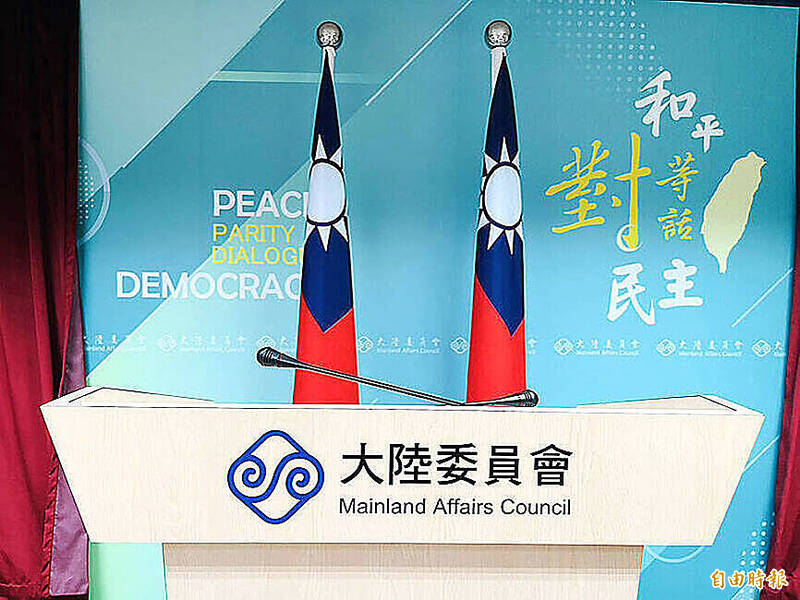
Republic of China flags and a podium at the Mainland Affairs Council in Taipei are pictured in an undated photograph. Photo: Chen Yu-fu, Taipei Times
PRAGMATIC EXCHANGES: The council called on China to engage in dialogue with Taiwan’s government without preconditions, while respecting equality and dignity
/ Staff writer, with CNA
The Mainland Affairs Council (MAC) yesterday urged Beijing to respect Taiwan’s democracy and the choices of its people after the Chinese government responded to Saturday’s local election results by reiterating its goal of unification.
The smooth completion of the elections demonstrated the maturity and resilience of Taiwanese democracy, as well as the freedom of Taiwanese voters to choose their preferred candidates in a “festive election atmosphere,” the MAC said. “The Beijing authorities should respect Taiwan’s democratic system and the choices of Taiwanese.”
It also called on Beijing to face the election results “pragmatically,” and engage in exchanges, cooperation and dialogue with Taiwan’s democratically elected government “without preconditions” and on the principles of “equality and dignity.”
The statement came after China’s Taiwan Affairs Office spokesperson Zhang Han (張?) earlier yesterday said: “No matter how Taiwan’s political landscape changes, it cannot alter the forward trajectory of cross-strait relations, much less halt the overarching historical trend that the motherland must and will inevitably be reunified.”
Beijing will uphold its “one China” principle and the so-called “1992 consensus,” deepen cross-strait exchanges and integrated development, oppose external interference and combat “Taiwanese independence separatist forces,” she said.
The so-called “1992 consensus,” a term former MAC chairman Su Chi (蘇起) in 2006 admitted making up in 2000, refers to a tacit understanding between the Chinese Nationalist Party (KMT) and the Chinese government that both sides of the Strait acknowledge there is “one China,” with each side having its own interpretation of what “China” means.
In the local elections, the ruling Democratic Progressive Party (DPP) doubled its number of city and county government seats from five in 2022 to 10.
The KMT won 11 of the mayoral and county commissioner races, down from the 14 it gained in the 2022 local elections.
The KMT retained control of Taipei, but lost Taichung in central Taiwan to the DPP after eight years.
Beijing suspended official cross-strait dialogue after the DPP returned to power in 2016 over the party’s refusal to endorse the “1992 consensus.”
The DPP has never acknowledged the “consensus,” saying that Beijing does not recognize the Republic of China and acceptance of the understanding would imply agreement with China’s claim over Taiwan.
新聞來源:TAIPEI TIMES