離開
 進入
《TAIPEI TIMES》 VP details drone development strategy
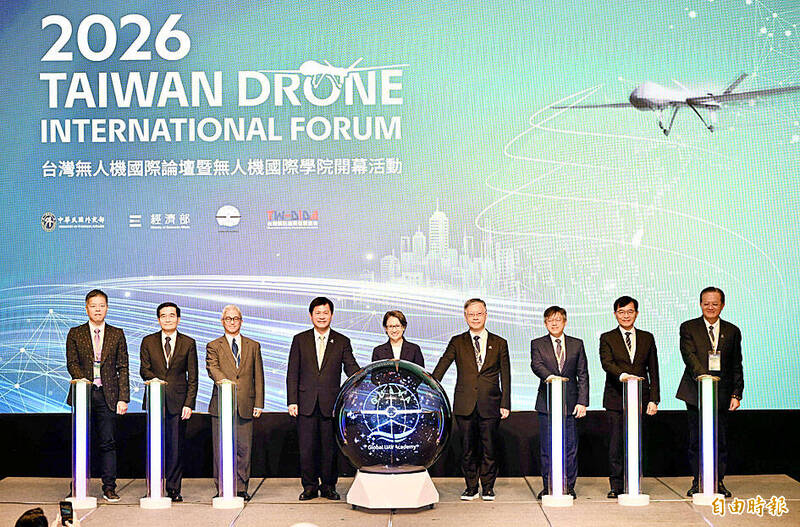
Vice President Hsiao Bi-khim, center, Minister of Foreign Affairs Lin Chia-lung, fourth left, and other officials pose at the Taiwan Drone International Forum in Taipei yesterday. Photo: Lo Pei-de, Taipei Times
GUAVA: The vice president listed ‘three pillars’ that are critical to creating a national uncrewed aerial vehicle industry and making Taiwan the top exporter in the region
By Fang Wei-li and Jonathan Chin / Staff reporter, with staff writer
Vice President Hsiao Bi-khim (蕭美琴) yesterday detailed the government’s uncrewed aerial vehicle (UAV) development strategy at the formal opening of the new Global UAV Academy (GUAVA) in Taipei.
The value of Taiwan’s drone exports in the first half of this year already exceeded the total for last year, she told a forum hosted by GUAVA and Taiwan Defense Industry Development Association.
Deputy Minister of National Defense Hsu Szu-chien (徐斯儉), former Czech Chamber of Deputies president Marketa Pekarova Adamova and representatives from the US, Japan, Ukraine and Poland were among the serving and retired officials who attended the event.
For Taiwan to become the top Asian exporter of drones to fellow democracies, the government must first establish “three pillars” to build a national UAV industry, Hsiao said.
First, the nation must forge fully non-Chinese supply chains to eliminate risks from built-in backdoor exploits and dependence on authoritarian regimes, Hsiao said.
Mircoprocessors, flight control systems, electro-optical sensors and batteries must meet the highest standards for cybersecurity and operational integrity before supply chains can be deemed trustworthy, she said.
Second, edge artificial intelligence must be developed and integrated into truly autonomous platforms capable of unassisted decisionmaking, sensor fusion and navigating under GPS jamming, she said.
Third, Taiwan must cement international partnerships to allow joint research and development, technology transfers and collaborative manufacturing, she added.
This part of the strategy leverages Taiwan’s advantage in researching and developing systems, original equipment manufacturing and production at scale, Hsiao said.
In June, Taiwan reached an agreement with Palau to transfer four multipurpose patrol and rescue training drones, she said.
GUAVA and Palau Community College also launched a collaboration to train drone pilots to bolster the latter’s maritime law enforcement capabilities, she added.
President William Lai (賴清德) has elevated uncrewed system technologies development to the nation’s highest strategic priority given their value to national defense and the economy, she said.
Although a latecomer to the global drone industry, Taiwan’s technical leadership in semiconductors, precision engineering and advanced manufacturing have allowed the nation to rapidly catch up, she said.
The Ministry of Foreign Affairs established a drone diplomacy task force in October last year, drawing on its experience with “chip diplomacy” to push Taiwanese drones onto the global stage, Minister of Foreign Affairs Lin Chia-lung (林佳龍) said.
GUAVA’s launch would make the national drone team more flexible, professional and globally integrated, he added.
GUAVA chairman Lee Hahn-ming (李漢銘) said that cybersecurity and UAVs rely on public-private collaboration and international cooperation.
Founded with donations from private enterprises, the academy would leverage its flexibility as a nongovernmental body to connect industry, government, academia and research institutions through international talent cultivation, geopolitical research and technical standardization, he said.
Following previous agreements with the US-based Association for Uncrewed Vehicle Systems International, the Japan Drone Consortium and Palau Community College, GUAVA yesterday signed memoranda of understanding with the Polish Chamber of Unmanned Systems and Taiwan’s National Chungshan Institute of Science and Technology focusing on international cooperation, training and industrial promotion, Lee said.
新聞來源:TAIPEI TIMES