離開
離開 進入
進入《TAIPEI TIMES》 China test-launches ballistic missile, irritating neighbors
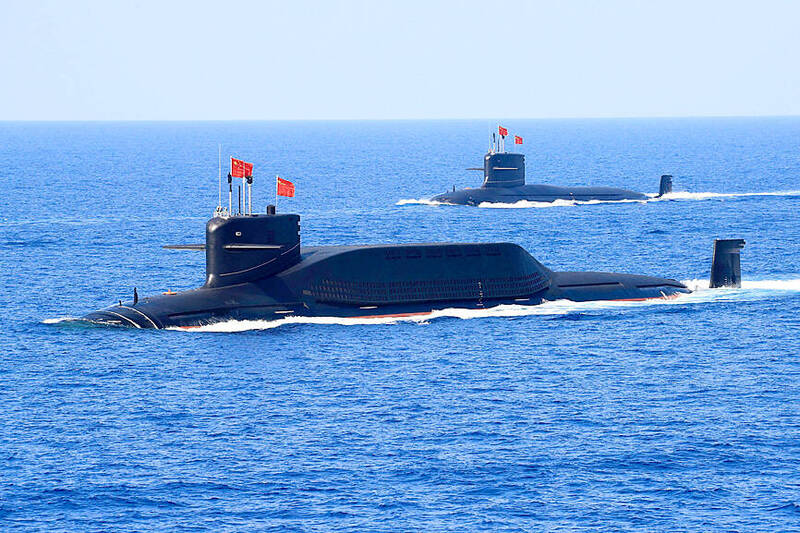
A nuclear-powered Type 094A Jin-class ballistic missile submarine of the Chinese People`s Liberation Army Navy in waters during a military display in the South China Seain 2018. Photo: Reuters
/ AP, BANGKOK
China’s military test-launched a long-range ballistic missile yesterday from one of its nuclear-powered submarines in the South Pacific in a rare move that drew sharp criticism from countries in the region.
The missile was launched at 12:01pm and carried a dummy warhead, according to the state-run Xinhua News Agency. China’s last missile test in the Pacific was two years ago, firing an intercontinental ballistic missile with a dummy warhead. That launch in international waters was the first since 1980.
The launch was part of routine annual training, complied with international law and practice and was not directed against any country or target, according to the one-line statement from Xinhua, which was reposted by China’s Ministry of National Defense.
The 2024 launch mirrored testing that the US carries out with its own ballistic missile fleet, and analysts viewed it at the time as an assertion of China’s growing superpower status.
Australia, Japan and New Zealand criticized the launch.
The New Zealand government said it was informed of the planned launch hours beforehand and said that the missile was fired into the South Pacific Nuclear Free Zone.
The nuclear-free zone was established by the 1986 Treaty of Rarotonga, which prohibits nuclear weapons throughout the region. China in 1987 ratified the protocols pledging not to test nuclear weapons within the zone, or to threaten to use them against signatories with territory in the region.
“It appears that despite our long-standing concerns about this type of activity, China carried out the test within hours of informing us,” New Zealand Minister of Foreign Affairs Winston Peters said in a statement.
“Australia has been clear with China that we regard this as destabilizing to the region,” Australian Minister of Foreign Affairs Penny Wong told reporters in Fiji, in response to the test.
Japan’s Ministry of Defense conveyed its concern about China’s increasing military activity in a statement, and asked Beijing to “rethink” its missile testing so the projectiles would not fly over Japan or pose other security risks.
China has a fleet of six ballistic missile submarines and 59 nuclear-powered attack submarines, according to the Nuclear Threat Initiative, a Washington-based think tank.
Taiwan condemned the missile test, calling it an attempt to intimidate the international community and further destabilize regional security.
Presidential Office spokesperson Karen Kuo (郭雅慧) said the launch followed Beijing’s recent escalation of military activities along the island chains and the implementation of legislation enabling what she described as “transnational repression,” referring to China’s new “ethnic unity” law.
“Now, it is further attempting to intimidate the international community by test-firing an intercontinental ballistic missile,” Kuo said.
The Presidential Office “strongly condemns this series of unilateral actions,” and it called on Beijing to exercise restraint, abide by the rules-based international order, and immediately cease its irresponsible unilateral actions, she said.
Taiwan’s Ministry of National Defense (MND) issued a similar statement, saying that although the missile’s trajectory did not pass through Taiwan’s airspace, the launch nevertheless undermined regional peace and stability.
The ministry said Taiwan’s armed forces are working closely with partner countries to monitor the situation and respond appropriately.
Additional reporting by CNA
新聞來源:TAIPEI TIMES