離開
離開 進入
進入《TAIPEI TIMES》Beijing’s ‘ethnic unity’ law voted off agenda
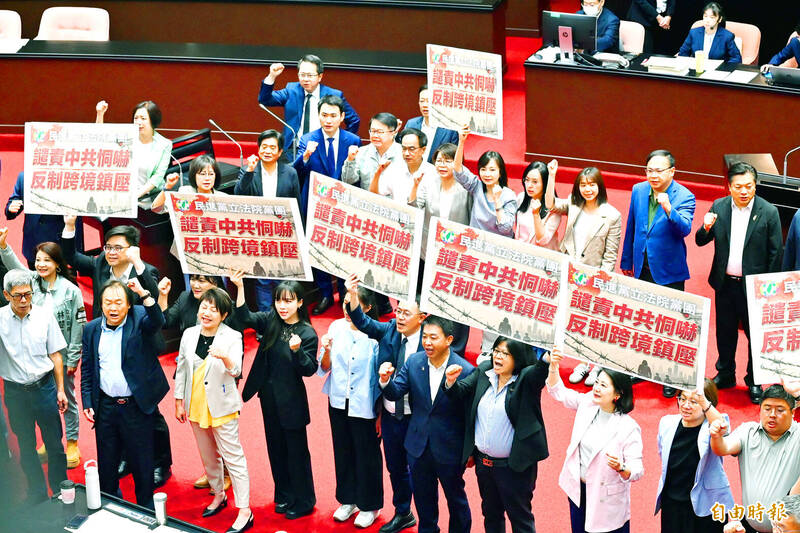
Members of the Democratic Progressive Party hold placards in the main chamber of the Legislative Yuan in Taipei yesterday. Photo: Wang Yi-sung, Taipei Times
By Hsu Yung-ching and Fion Khan / Staff reporter, with staff writer
The opposition parties yesterday voted down the Democratic Progressive Party (DPP) caucus’ resolution condemning Beijing’s new “ethnic unity” law from being placed on the legislative agenda.
China’s Law on Promoting Ethnic Unity and Progress, which took effect on Wednesday, uses legislation as a tool of intimidation and seeks to create a chilling effect in the international community while threatening the personal safety of Taiwanese citizens, the DPP caucus said, proposing a motion to condemn Beijing’s transnational repression efforts.
The law could threaten people around the world, particularly those in Taiwan who maintain that the Republic of China (ROC) is an independent sovereign state, DPP caucus chief executive Chuang Jui-hsiung (莊瑞雄) said.
Beijing’s implementation of the law represents an attempt to use domestic legislation to infringe on the sovereignty and human rights of other countries, extend authoritarian political control beyond its borders and expand transnational repression, the motion said.
The law’s provisions are vaguely defined and subject to arbitrary enforcement, seriously contravening international norms, including principles enshrined in the UN Charter, it said.
The DPP proposed that the Legislative Yuan adopt the resolution, which called for cross-party condemnation of the law and a joint commitment to safeguarding the safety of Taiwanese citizens.
It also said that, given the law’s potential to significantly increase risks for Taiwanese traveling, conducting business or engaging in academic exchanges abroad, the government should take appropriate countermeasures.
It also called on like-minded countries to deepen cooperation to counter authoritarian expansion, prevent infringements on other states’ sovereignty and uphold universal human rights values.
DPP Legislator Rosalia Wu (吳思瑤) said that the Chinese Nationalist Party (KMT) and Taiwan People’s Party (TPP) were “Chinese Communist Party’s collaborators” for their votes blocking the motion from being placed on the agenda, while DPP Legislator Chen Pei-yu (陳培瑜) asked that if they are unwilling to defend the ROC, what right do KMT and TPP lawmakers have to serve as members of its legislature.
TPP caucus whip Jacky Chen (陳清龍) said that the DPP was “spreading misinformation all day” and does not even understand legislative procedure.
He said the vote concerned the legislative agenda, adding that on procedural matters, the TPP caucus supports its own position while other caucuses back their respective versions.
There was no “blocking” of the condemnation motion, he said.
Additional reporting by Lin Hsin-han and Lo Kuo-chia
新聞來源:TAIPEI TIMES