離開
離開 進入
進入《TAIPEI TIMES》 Civic groups slam China’s ethnic unity and progress law
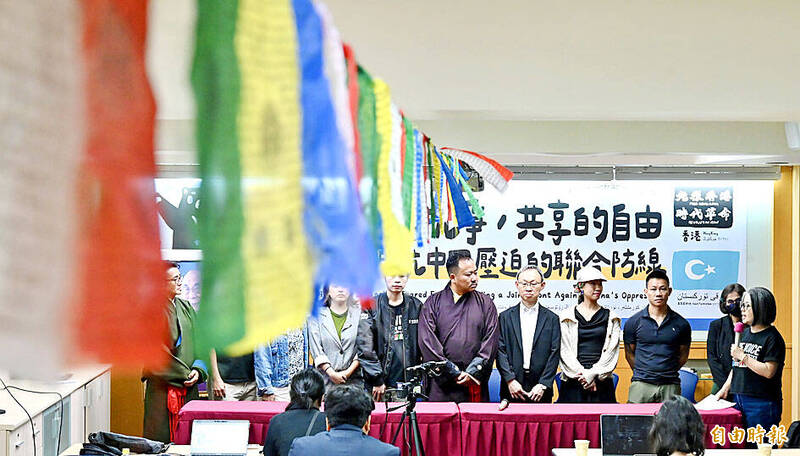
Representatives from civic groups including the Economic Democracy Union, Human Rights Network for Tibet and Taiwan, and Hong Kong Outlanders hold a press conference in Taipei yesterday. Photo: George Tsorng, Taipei Times
By Lo Kuo-chia and Jake Chung / Staff reporter, with staff writer
Civic groups yesterday criticized China’s Law on Promoting Ethnic Unity and Progress, slated to be promulgated on July 1, saying that it amounted to forced assimilation and cultural cleansing.
The groups said the law seeks to impose a single national identity, eroding the identities of non-Han ethnic groups, and promotes the “integration” of different ethnic groups through policies spanning education, housing, population movement, community life, culture, tourism and development.
Taiwan Economic Democracy Union convener Lai Chung-chiang (賴中強) said the law amounts to repression under the guise of unity, targeting Uyghurs, Tibetans, Southern Mongolians, Hong Kongers and Taiwanese.
He also argued that the law deliberately exploits the similarity in wording between zhonghua minzu (中華民族, “the Chinese nation”) and zhonghua minguo (中華民國, the Republic of China), to further narrow Taiwan’s attempts to break into the international community.
Lai said the core of the Chinese Communist Party’s (CCP) “great revival of the zhonghua minzu” was unification, both in terms of territory and ethnicity.
Whether it is Chinese President Xi Jinping’s (習近平) 2019 “Five-point Plan” or the 2022 white paper issued by China’s Taiwan Affairs Office, “The Taiwan Question and China’s Reunification in the New Era,” both explicitly link the “great rejuvenation of the zhonghua minzu with the goal of reunification,” Lai said.
As such, echoing this framing is effectively equivalent to endorsing Beijing’s position, he added.
Soochow University political science associate professor Chen Fang-yu (陳方隅) yesterday said the core logic behind China’s nationalism was that the people of Taiwan and Hong Kong should all identify themselves as “Chinese” or “Han,” and that Chinese nationalism could not accept diverse ethnicities.
Chen cited a recent experience with Chinese academics in New York as an example, stating that when he said that Taiwan promotes ethnic equality and no longer identifies solely with the Han ethnicity, some Chinese experts said that such actions were an act of pro-Taiwanese independence.
Civic groups criticized the CPP’s enforcement of “integration” through law as well as it making little effort to conceal its expansionist ambitions, saying that Taiwan is likely to face an increasingly overt form of hegemonic pressure.
“Unity” to the CCP is based on state violence and the trampling of cultural dignity, while Taiwan’s definition is to safeguard ethnic diversity and the autonomy of ethnic dignity, they said.
The two concepts of unity, they added, are fundamentally different.
新聞來源:TAIPEI TIMES