離開
離開 進入
進入《TAIPEI TIMES》 MAC slams CCP’s ‘deceptive’ approach
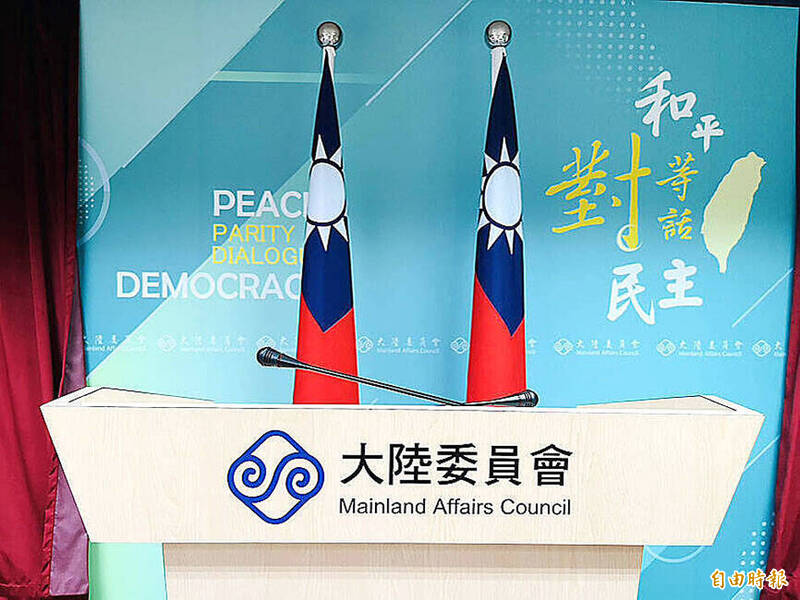
Republic of China flags and a podium at the Mainland Affairs Council in Taipei are pictured in an undated photograph. Photo: Chen Yu-fu, Taipei Times
TWO-PRONGED APPROACH:China harasses Taiwan while promoting ‘integrated development’ and exchanges to conceal its annexation intention, the MAC said
By Fan Wei-li / Staff reporter
The Mainland Affairs Council (MAC) yesterday criticized Beijing’s two-pronged “fake integration, real pressure” approach toward Taiwan as deceptive, and said it laid bare its intention to annex the nation.
The council issued the remarks after Chinese People’s Political Consultative Conference Chairman Wang Huning (王滬寧) during a meeting with Chinese Nationalist Party (KMT) figures at the Straits Forum in Xiamen, China, reiterated Beijing’s position on Taiwan, such as the “one China” principle and the so-called “1992 consensus.”
The “1992 consensus,” a term former MAC chairman Su Chi (蘇起) in 2006 admitted making up in 2000, refers to a tacit understanding between the KMT and the Chinese government that both sides of the Strait acknowledge there is “one China,” with each side having its own interpretation of what “China” means.
Wang talked about Chinese President Xi Jinping’s (習進平) “four principles” — adhering to the “correct” identity to promote spiritual harmony, “safeguarding the shared homeland” through peaceful development, enhancing people’s well-being through exchanges and integration, and achieving the “great rejuvenation of the Chinese nation” through unity and struggle — as the direction for the cross-strait relations.
Meanwhile, KMT Vice Chairman Chang Jung-kung (張榮恭) said the “1992 consensus” and “resisting Taiwanese independence” are beneficial to cross-strait exchanges and development.
The MAC said the main cause of failure in cross-strait communications is China’s refusal to accept the existence of Taiwan.
The Chinese Communist Party (CCP) set political prerequisites for cross-strait communication and dialogue, and fails to pragmatically face the mainstream public opinion in Taiwan, the council said, adding that it deeply regrets that Taiwanese opposition figures have echoed China’s distorted narrative.
Xi had defined the “1992 consensus” as the mutual recognition that “both sides of the Taiwan Strait belong to one China and work together to advance national unification,” the MAC said.
The CCP’s “trinity” policy for Taiwan — the “one China” principle, the “1992 consensus” and “one country, two systems” — leaves no room for the Republic of China’s (ROC) existence, it added.
Polls show that more than 80 percent of Taiwanese are against China’s “one country, two systems” framework, the MAC said, adding that the government would not betray the public and the nation’s democratic principles to cater to Beijing.
Taiwanese figures have led delegations to China and echoed its narratives about “national rejuvenation” and “broken” cross-strait relations, which only creates more division in Taiwan, weakens democratic resilience and sends a misleading message to the international community that the nation accepts China’s political prerequisites, the council said.
The CCP has long adopted a “two-pronged strategy” toward Taiwan, it said.
It harasses Taiwan with military aircraft and vessels, engaging in “gray zone” incursions around the nation, which severely undermines peace and stability in the Taiwan Strait and in the region, all while promoting so-called “integrated development” and “people-to-people exchanges,” the MAC said.
Such deceptive practices do not conceal its intention to annex Taiwan, it added.
“Maintaining peace and stability across the Taiwan Strait is the joint responsibility of both sides,” the MAC said. “We call on Beijing’s authorities to face the ROC’s existence and give up its negative actions, including imposing multi-faceted pressure, against Taiwan.”
It also called on China communicate with Taiwan’s democratically elected government without prerequisites, and on the basis of equality and dignity.
新聞來源:TAIPEI TIMES