離開
離開 進入
進入《TAIPEI TIMES》Freeway extension plan faces hurdles
2026/03/15 03:00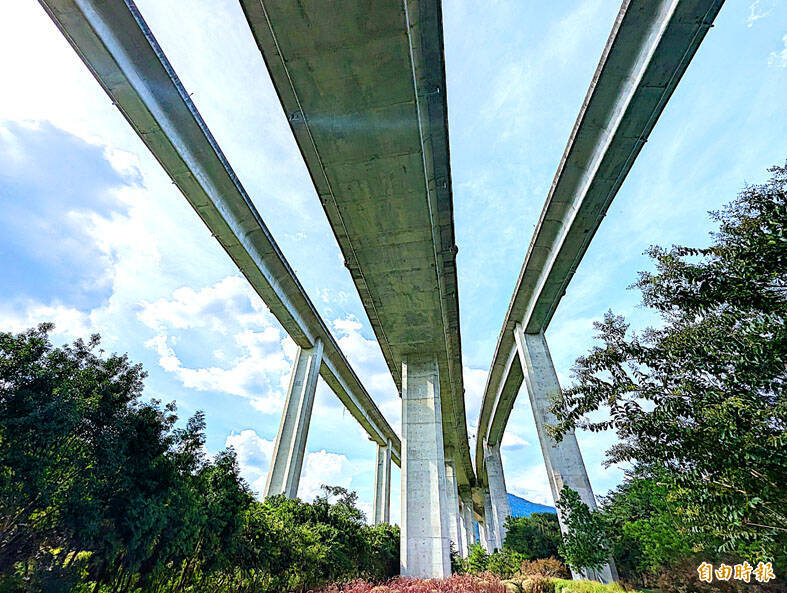
The Bridge Soaring into the Clouds scenic spot is pictured on National Freeway No. 6 in Guosing Township in an undated photograph. Photo: Wu Liang-yi, Taipei Times
By Wu Liang-yi and Shelley Shan / Staff reporters
Extending the Shuishalian Freeway (Freeway No. 6) to link Nantou County and Hualien County would require 18 new tunnels, while the route would cross eight geological faults zones and likely encounter geothermal water, a geophysical survey released by the Freeway Bureau showed.
The proposed 88.9km corridor for the highway extension would link Nantou County’s Puli Township (埔里) and Jian Township (吉安) in Hualien County.
In July 2023, the bureau commissioned Sinotech Engineering Consultants to conduct the survey, collect and analyze geophysical data, and complete magnetotelluric site surveys.
Sinotech found that the 49.37km of freeway would have to be tunnels, with one of them — labeled tunnel No. 5 — to be 17.5km long, surpassing the 12.9km-long Hsuehshan Tunnel (雪山隧道), which connects New Taipei City and Yilan County on Chiang Wei-shui Memorial Freeway (Freeway No. 5).
The Nantou-Hualien corridor would pass to the west of Lushan geothermal area in Nantou County, which is where Yunhai Hot Spring (雲海溫泉) is.
Eighteen strata and rock formations were identified along the proposed route, which also crosses eight fault zones, the survey showed.
If the government approves the project, construction workers might encounter severe groundwater conditions similar to those faced during the construction of the Hsuehshan Tunnel.
If tunneling work encounters geothermal water, it could be as hot as 120°C to 180°C, although it was unclear if a low-resistivity zone in the area that tunnel No. 5 would be is a geothermal area, the bureau said.
Bureau Deputy Director General Chen Hung-ren (陳宏仁) said that the purpose of the survey was to gain a preliminary understanding of the geological formations along the corridor, adding that it is not a feasibility study.
Some sections of the extension would have to be built at elevations of 1km to 2km above sea level, Chen said.
Even if the project were technically feasible, those sections would likely be affected by fog and icy conditions, raising significant safety concerns, he said.
The annual maintenance costs for those sections of the completed road would be substantial, he added.
新聞來源:TAIPEI TIMES