離開
離開 進入
進入《TAIPEI TIMES》 Chinese drone enters Pratas airspace
2026/01/18 03:00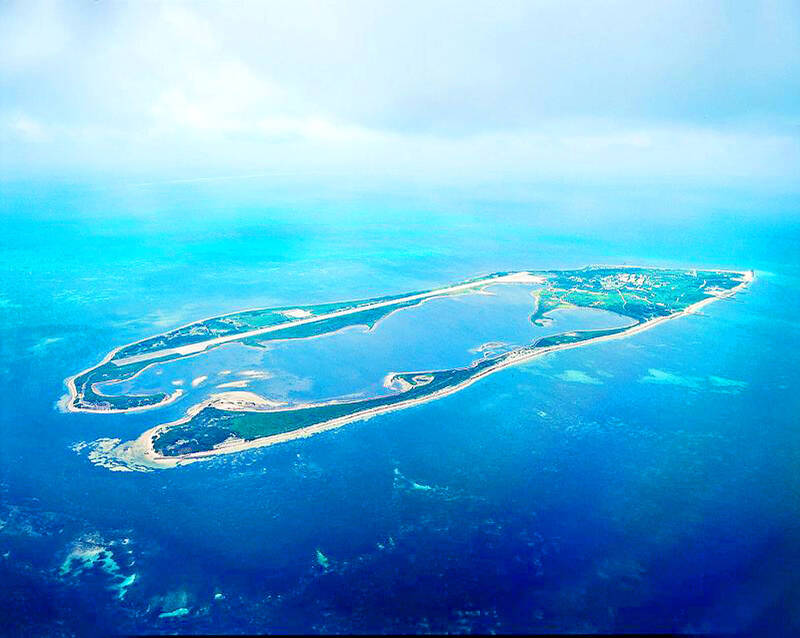
The Pratas Islands (Dongsha Islands) are pictured on Nov. 5, 2017. Photo provided by the Water Resources Agency via CNA
‘SALAMI-SLICING’:Beijing’s ‘gray zone’ tactics around the Pratas Islands have been slowly intensifying, with the PLA testing Taiwan’s responses and limits, an expert said
By Fan Wei-li / Staff reporter
The Ministry of National Defense yesterday condemned an intrusion by a Chinese drone into the airspace of the Pratas Islands (Dongsha Islands, 東沙群島) as a serious disruption of regional peace.
The ministry said it detected the Chinese surveillance and reconnaissance drone entering the southwestern parts of Taiwan’s air defense identification zone early yesterday, and it approached the Pratas Islands at 5:41am.
The ministry said it immediately notified the garrison stationed in the area to enhance aerial surveillance and alert levels, and the drone was detected in the islands’ territorial airspace at 5:44am, maintaining an altitude outside the effective range of air-defense weaponry.
Following warnings issued by the military through international radio channels, the drone left the area at 5:48am, it said.
The actions of the Chinese People’s Liberation Army (PLA) were highly provocative and irresponsible, the ministry said, adding that it severely undermined regional peace and stability, as well as contravened international norms, which would inevitably draw condemnation.
The armed forces would continue to maintain close surveillance and remain on high alert, and respond according to the Regulations on Handling Contingencies During the Regular Combat Readiness Period of the Republic of China Armed Forces (國軍經常戰備時期突發狀況處置規定), it said.
China’s harassment tactics towards the Pratas Islands have gradually shifted, evolving from simple “gray zone” harassment into “all-domain pressure,” with the clear intent of carrying out a functional blockade, analysts said.
Beijing tested the limits of Taiwan’s administrative resupply operations during a 2020 incident, during which a Uni Air charter flight was blocked from entering the airspace; China has since employed “salami-slicing” tactics, they said.
The tactics include integrating Chinese coast guard vessels, maritime militias and research ships in “civil-military fusion” incursions, aimed at incrementally invalidating Taiwan’s restricted and prohibited waters.
The situation has escalated in the past few years, as Beijing deployed semi-permanent facilities, such as the Nanhai No. 2 drilling platform around the Pratas Islands, with the intent of turning the surrounding waters into its “internal waters” and a “military stronghold.”
Beijing has also frequently dispatched drones along with research vessels to jointly conduct high-intensity hydrological reconnaissance and battlefield environment preparations.
The latest drone incursion highlights Beijing’s expansionist ambitions in carrying out its anti-access/area denial strategy, an expert said.
The strategy aims to compress Taiwan’s depth of defense through routine deterrence, they said, adding that it also secures its underwater and aerial advantage on the western side of the Bashi Channel to block potential military support from Taiwan’s allies.
These actions pose a severe challenge to Indo-Pacific regional security, they added.
Su Tzu-yun (蘇紫雲), a research fellow at the government-funded Institute for National Defense and Security Research, said the PLA was employing “edge-ball tactics” by entering the airspace above the 12-nautical-mile (22.2km) territorial sea baseline of the Pratas Islands, rather than flying directly over the military camps stationed in the area, to test Taiwan’s rules of engagement and strategic bottom lines.
Asked if the armed forces’ use of radio warnings to drive away the aircraft was overly cautious, he said that due to historical international political considerations, the Pratas Islands are only lightly equipped for air defense.
The Stinger missiles stationed in the area have a range of about 4km, and the Dual Mount Stinger system requires a line-of-sight lock-on, so large to medium drones operating at high altitudes at the edge of territorial airspace are beyond the effective range of the islands’ anti-aircraft weaponry, he said.
To counter Beijing’s increasingly frequent aerial harassment, Su urged the armed forces to consider upgrading the air defense systems on outlying islands, such as deploying the Tien Chien 2N (Land-based Sky Sword II, 天劍) air defense missile system, which has a range of up to 20km.
It could also be paired with high-power jamming systems to sever the satellite links that large-to-medium size PLA drones rely on for long-range operations away from their home bases, he added.
新聞來源:TAIPEI TIMES