離開
離開 進入
進入《TAIPEI TIMES》 Sea Oryx missile system to enter mass production
2025/12/18 03:00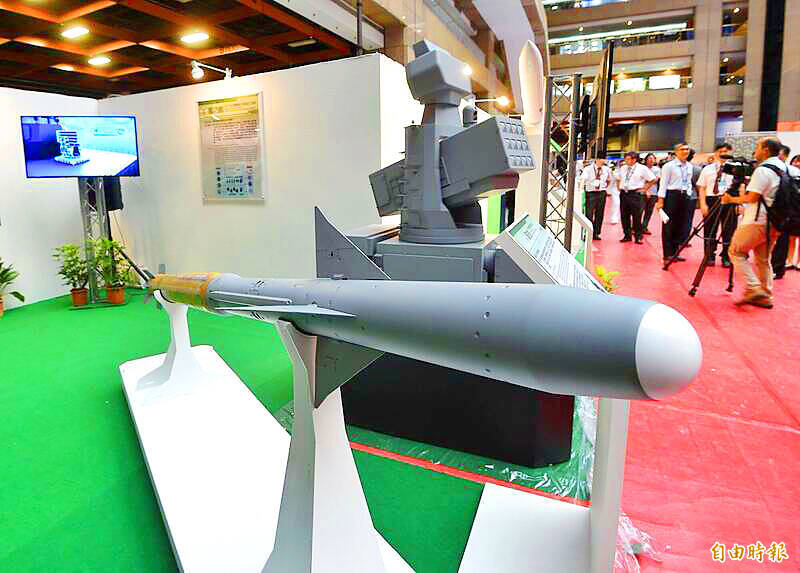
A model of the Sea Oryx missile system is pictured in an undated photograph. Photo: Fang Bin-chao, Taipei Times
By Lo Tien-pin and Jake Chung / Staff reporter, with staff writer and Reuters
The Chungshan Institute of Science and Technology-developed Sea Oryx missile system, which passed combat trials in October, is to enter mass production.
Sea Oryx, one of the few infrared homing short-range air defense systems, intercepted drones and anti-ship missiles in the trials, a source within the military said.
Modified Hsiung Feng II (Brave Wind, 雄風二型) subsonic anti-ship missiles were used in the trials for greater authenticity, the source said, adding that the modification process provided further insight on the Hsiung Feng II missiles.
The Sea Oryx, which has a 15km range, is equipped with a warhead containing the polycyclic nitroamine explosive CL-20, widely regarded as the most powerful non-nuclear explosive, they said.
Following the US Navy’s decision to replace MK 15 Phalanx systems on Arleigh Burke-class destroyers with the longer-range RIM-116 Rolling Airframe Missile systems, Taiwan would outfit its newer ships with Sea Oryx systems, they said.
One of the three types of Sea Oryx systems is mounted on a stand-alone launcher that can hold 12 missiles, with a small active phased array radar, developed by the institute, which is more suitable for smaller combat vessels, the source said.
The “combat series,” which has 24 launch tubes, but not its own antennae or radar system, must be plugged into a vessel’s targeting system and fed coordinates and firing commands from the ship’s bridge, they said.
It is more suited for mid-sized to large ships, they added.
A 24-tube version mounted on a land-based launcher vehicle would work in tandem with a mobile radar truck, they said.
The version tested in October was the stand-alone system with built-in radar, the source said.
Separately, during a question-and-answer session in the legislature on Monday, Chungshan Institute of Science and Technology president Lee Shih-chiang (李世強) said the institute was investigating the use of CL-20 on loitering munitions drones, adding that it is also looking into adapting its use across drones for all military units.
In other news, China’s newest and most advanced aircraft carrier, the Fujian (福建), sailed through the Taiwan Strait on Tuesday, the Ministry of National Defense said yesterday, its first transit of the waterway since formally entering service last month.
The ministry in a statement said that Taiwan’s forces had monitored the ship.
It provided a grainy, black-and-white picture of the carrier with no aircraft on its deck. It did not say where the picture was taken and offered no other details.
The Chinese Ministry of National Defense did not immediately respond to a request for comment.
Minister of National Defense Wellington Koo (顧立雄) told lawmakers that the ship was probably on its way to Shanghai’s Changxing Island, which is home to China’s main naval shipbuilding yard, and that the ministry had not observed it carrying out any military activities.
In a separate statement later in the day, the ministry said that China had been carrying out a “joint combat readiness patrol” near the island, involving 23 aircraft and warships, since the morning.
The aircraft included J-10 fighters and nuclear weapon-capable H-6K bombers, it added.
In September, the Fujian sailed through the Taiwan Strait and into the disputed South China Sea during trials.
The Fujian is China’s third aircraft carrier, with a flat flight deck and electromagnetic catapults to launch aircraft, which make it a potentially far more powerful naval weapon than China’s first two Russian-designed carriers.
The deployment of a third aircraft carrier by the PLA is just another indicator of its military build-up and campaign to intimidate Taiwan and deter intervention in maneuvers in the Western Pacific and East and South China Seas.
As of the end of November, PLA aircraft, including jet fighters, had flown 4,935 sorties in Taiwan’s vicinity, and the full year total was likely to surpass the previous record of 5,107 flown in 2024, up from 2,799 in 2022, according to CommonWealth Magazine figures based on publicly available MND data.
Of the sorties in 2025 through November, 3,467 had crossed the median line of the Taiwan Strait, already topping the previous full year record of 3,074 set in 2024, signaling a further ratcheting up of pressure by the PLA on Taiwan, the data showed.
新聞來源:TAIPEI TIMES