離開
離開 進入
進入《TAIPEI TIMES》 TIER raises GDP forecast to 5.94% on boom in AI
2025/11/07 03:00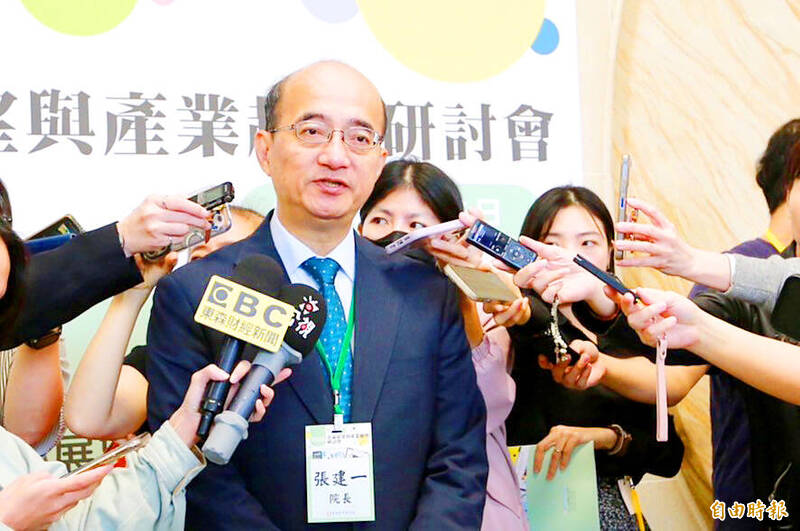
Taiwan Institute of Economic Research president Chang Chien-yi speaks to reporters in Taipei yesterday. Photo: Liao Chia-ning, Taipei Times
THE AI WAVE: The economy expanded 7.1% in the first three quarters, which would lead to nearly 6% annual growth, even if GDP moderates this quarter, TIER said
By Crystal Hsu / Staff reporter
Two more institutes have sharply raised their GDP growth forecasts for Taiwan this year, after the economy delivered a much stronger-than-expected performance in the third quarter, driven almost entirely by booming demand for artificial intelligence (AI)–related products.
The upward revisions underscore how Taiwan’s AI supply chain has become the dominant force behind its economic expansion, offsetting persistent weakness in traditional sectors.
The Taiwan Institute of Economic Research (TIER, 台經院) yesterday raised its growth estimate from 3.02 percent to 5.94 percent, two days after UBS Investment Bank revised up its projection from 5 percent to 6.5 percent.
The AI-led surge in semiconductors, servers and related equipment has fueled exports and private investment this year, TIER president Chang Chien-yi (張建一) said.
In contrast, traditional sectors such as textiles, petrochemicals and steel have remained sluggish amid weak overseas demand and competition from low-priced Chinese goods.
Taiwan’s economy expanded 7.1 percent in the first three quarters, supported by a 30 percent year-on-year jump in outbound shipments — the strongest growth in Asia.
That momentum would allow Taiwan to achieve nearly 6 percent annual growth even if GDP growth moderates this quarter, Chang said.
However, major technology firms issued upbeat guidance for the final quarter — the peak season for electronics.
US cloud service providers are ramping up investment in AI infrastructure, while Apple Inc expects double-digit percentage growth in sales of its latest iPhones during the holiday season — trends that could further benefit Taiwanese suppliers across global supply chains and set the stage for more upside surprises.
Shipments of automatic data processing machines and parts, excluding portables, accounted for about two-thirds of Taiwan’s export growth this year, UBS senior economist for Asia and China William Deng (鄧維慎) said in a report.
The surge reflects Taiwan’s dominant role in graphics processing units, AI servers and component manufacturing, he added.
TIER and UBS observed a marked upswing in tech industrial production, while non-tech output has remained flat.
Traditional industries should perform better next year as early signs of a recovery emerge, although AI-related exports would remain the main growth driver, albeit at a slower pace, Chang said.
However, private consumption has been underwhelming. To bolster spending, the government would launch a cash handout program offering NT$10,000 per person starting next week through April next year.
The stimulus could lift overall GDP growth by 0.3 to 0.4 percentage points, Chang said.
TIER expects Taiwan’s GDP growth to moderate to 2.6 percent next year, while UBS projects a 3.3 percent rise, both citing a higher comparison base.
Even so, Taiwan’s economic performance this year ranks among the best in Asia — trailing only Vietnam and India, yet far outpacing more developed peers such as South Korea, Singapore and Japan, UBS said.
新聞來源:TAIPEI TIMES
熱門賽事、球星動態不漏接