離開
離開 進入
進入《TAIPEI TIMES》First Formosat-8 satellite leaves for US launch
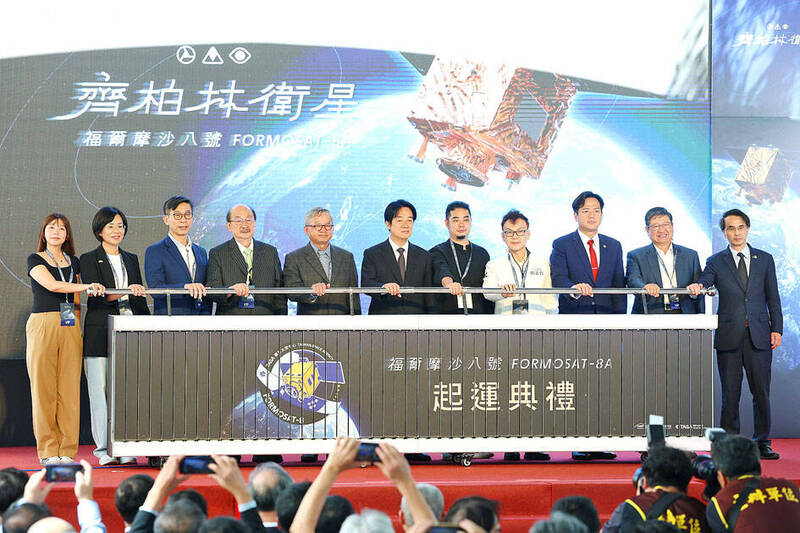
President William Lai, sixth right, and other dignitaries attend a ceremony for the Chi Po-lin Satellite at the Taiwan Space Agency in Hsinchu City yesterday. Photo: CNA
By Shelley Shan / Staff reporter
The first satellite of Formosat-8, Taiwan’s first domestically developed optical remote sensing satellite constellation, left the Taiwan Space Agency (TASA) headquarters in Hsinchu yesterday ahead of its launch in the US next month.
The Formosat-8 system is to replace Formosat-5, the nation’s first self-manufactured single satellite, that was launched into space in 2017.
President William Lai (賴清德), National Science and Technology Council Minister Wu Cheng-wen (吳誠文) and TASA Director-General Wu Jong-shinn (吳宗信) were at the ceremony for the satellite’s send-off at TASA’s headquarters.
Lai said the Formosat-8 system is the pillar of the third phase of the National Space Technology Long-Term Development Program, which was approved during his term as premier.
The launch of the first satellite of Formosat-8 marks the start of the construction of Taiwan’s own satellite constellation, with more Taiwanese satellites expected to enter orbit in the future, he said.
Lai also announced that the first satellite is to be named Chi Po-lin Satellite (齊柏林衛星) after the Taiwanese documentary filmmaker and aerial photographer who died in a helicopter crash in 2017 while shooting a sequel to his documentary Beyond Beauty: Taiwan From Above (看見台灣).
“During his 25-year career as an aerial photographer, Chi recorded the natural sceneries of Taiwan and how they have changed, raising public awareness about their responsibility to this land. We hope to extend his spirit to space through the satellite, so that it can continue to watch over Taiwan,” Lai said, thanking Chi’s family for allowing the satellite to be named after him.
Chi’s son Chi Ting-huan (齊廷洹) said that “Chi Po-lin” now stands for the vision and spirit of how Taiwanese protect their homeland.
“My father recorded from the sky the changes in the landscape wrought by the magnitude 7.3 earthquake on Sept. 21, 1999, and disasters caused by Typhoon Morakot from Aug. 6 to Aug. 10, 2009, to assist disaster-relief efforts,” Chi Ting-huan said.
“The launch of the Chi Po-lin satellite would make it possible to look at Taiwan and record the world from a higher vantage point and wider field of view. The world would also see Taiwan’s capabilities and the assistance that it can offer,” he added.
Wu Cheng-wen said that 84 percent of the Chi Po-lin satellite’s key components were developed in Taiwan, adding that it is scheduled to be launched next month after completing tests.
Formosat 8’s resolution has been enhanced to show objects smaller than 1m, a significant improvement over the 2m resolution of Formosat 5, the minister said.
“There are other satellites in the Formosat-8 constellationthat have yet to be created. Our goal is to push the resolution further to 70cm, even to 50cm,” he said. “Formosat-5 allowed us to see a house from space, but we can clearly identify a car with Formosat-8.”
The Executive Yuan in July approved the Next-Generation Communication Technology Development Plan to complement the third phase of the National Space Technology Long-Term Development Program and advance the development of satellite communications technologies, he said.
Wu Jong-shinn said Formosat-8’s high domestic content ratio was made possible after TASA took the lead in advancing the domestic development of optical, mechanical, electrical control and flight control systems.
The technology breakthroughs achieved by the new satellite system mark a steady advance toward Taiwan’s autonomous space development, he added.
Formosat-8 is to have eight satellites, with the launch of all of them scheduled to be completed by 2031, he said.
Once in operation, the new satellite system would pass over Taiwan three times a day, allowing rescuers to gauge the scope of damage after a disaster through real-time images, he added.
新聞來源:TAIPEI TIMES
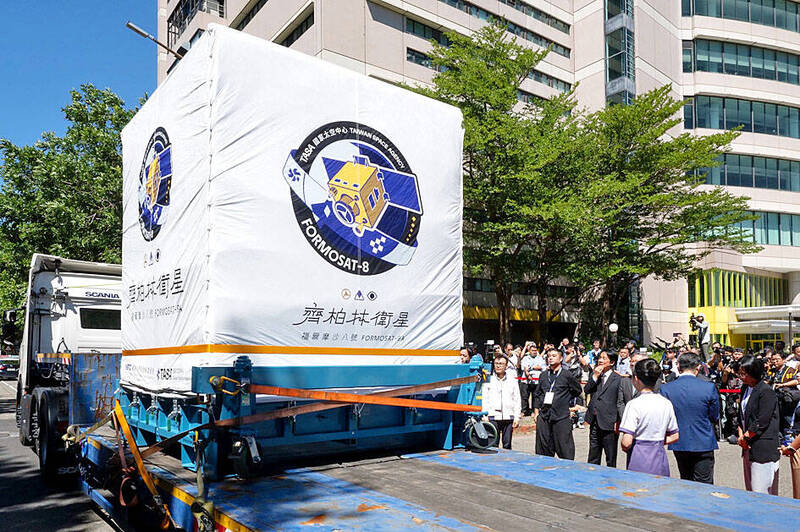
President William Lai, fourth right, sees off the Chi Po-lin Satellite at the Taiwan Space Agency headquarters in Hsinchu City yesterday. Photo: Screen grab from the Presidential Office’s Flickr page