離開
離開 進入
進入《TAIPEI TIMES》 Kaohsiung recommends healthy holiday dieting
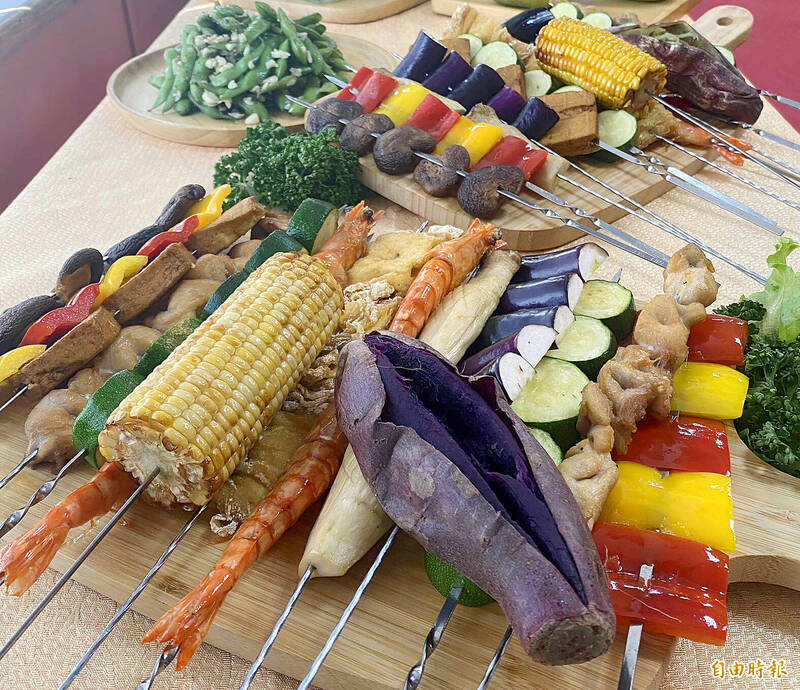
Vegetables, corn and shrimp are pictured on a grill in an undated photograph. Photo: Tsai Shu-yuan, Taipei Times
SUBSTITUTIONS: Doctors recommended incorporating seasonal vegetables, whole grains and legumes into festival dishes for a more balanced intake of nutrients
By Huang Liang-chieh, Tsai Shu-yuan and Esme Yeh / Staff reporters
The Kaohsiung City Government’s Department of Health recommended “low-carbon,” healthy meals over red meat and high-fat foods to celebrate the Mid-Autumn Festival holiday.
The festival, celebrated on the 15th day of the eighth month of the lunar calendar, is being celebrated today. It usually involves family reunions and, in the past few decades, barbecuing has become a popular way to spend the holiday.
While most traditional mooncakes with meat contain large amounts of sugar and oil, ingredients like red bean, sweet potato, taro, pineapple and guava could be used to make mooncake fillings instead, with their natural sweet taste substituting for refined sugar, the department said.
That could help support local agricultural businesses and reduce carbon emissions from long-distance transportation, it said, adding that small packs are recommended to avoid overeating.
As red meat and high-oil ingredients would burden both human health and the environment, locally grown in-season vegetables, such as cabbage, water bamboo, sweet peppers, loofahs or eggplants, could instead be used as primary ingredients in dishes, with red meat partially replaced by seafood or white meat, it said.
In terms of seasoning, natural spices like lemon, Thai basil and coriander are recommended to help avoid processed sauces with high salt content, the department said.
Whole grains and legumes could also be incorporated for balanced intake of nutrients, it said, calling for controlled meal preparation to prevent wasting food.
The department’s Community Health Promotion Center dietitian Fu Yu-kuo (傅鈺國) said wise choices begin with purchasing.
People are advised to prioritize local, seasonal vegetables, as well as more fruits and vegetables than meat, to reduce carbon emissions from transportation and the livestock industry, he said, adding that single-use items should be avoided and reusable tableware is recommended.
Fu also suggested having a cup of sugarless, low-carb tea to ease the greasy taste after eating mooncakes and barbecue.
Separately, the Ministry of Health and Welfare’s Taichung Hospital doctor Chuang Chia-shun (莊家舜) said that roast meat should be fully cooked and eaten in controlled amounts without delay, as food is prone to spoilage and bacterial contamination under the hot weather over the holiday.
He cited the example of a 17-year-old boy who had acute gastroenteritis last week allegedly due to eating undercooked roast meat or seafood with friends in early celebration of the festival.
He suffered from nausea, vomiting and diarrhea in the middle of the night, and checked into the emergency room, Chuang said.
However, he began to run a fever and experience severe diarrhea after returning home, so he returned to the doctor and spent three days in hospital, Chuang said.
The boy had intestinal inflammation, swelling and fluid accumulation, and was treated with antibiotics and anti-diarrheal medicines, with intravenous fluids given to help him rehydrate, Chuang said.
The number of people contracting acute gastroenteritis due to overeating increased by about 20 percent around the Mid-Autumn Festival every year, he added.
Hospital dietitian Yeh Hsin-hsien (葉欣憲) said that vegetables like green peppers, baby corn or mushrooms should play the main role in barbecues to avoid excessive intake of meat.
Low-fat meat, such as lean pork tenderloin, small chicken thigh or fish fillets, is recommended, while big slices of vegetable leaves can be used to wrap meat in place of sliced bread to boost vegetable intake, he said.
Regarding pomeloes, also commonly eaten during the festival, hospital pharmacist Chen Te-cheng (陳德鉦) said that they contain furanocoumarins, which would inhibit cytochrome P450 3A4 — a metabolic enzyme in the liver — and the P-glycoprotein activity in the small intestine.
Medicines that are commonly affected by pomeloes include anticoagulants, blood pressure-lowering drugs, lipid-lowering drugs, antiarrhythmic drugs, immunosuppressants, sedatives and sleeping pills, erectile dysfunction drugs, and antiepileptic drugs, Yeh said.
People on any of these medicines should avoid eating pomeloes, or eat only one or two sections, he said, adding the amount should not be more than half a pomelo.
新聞來源:TAIPEI TIMES
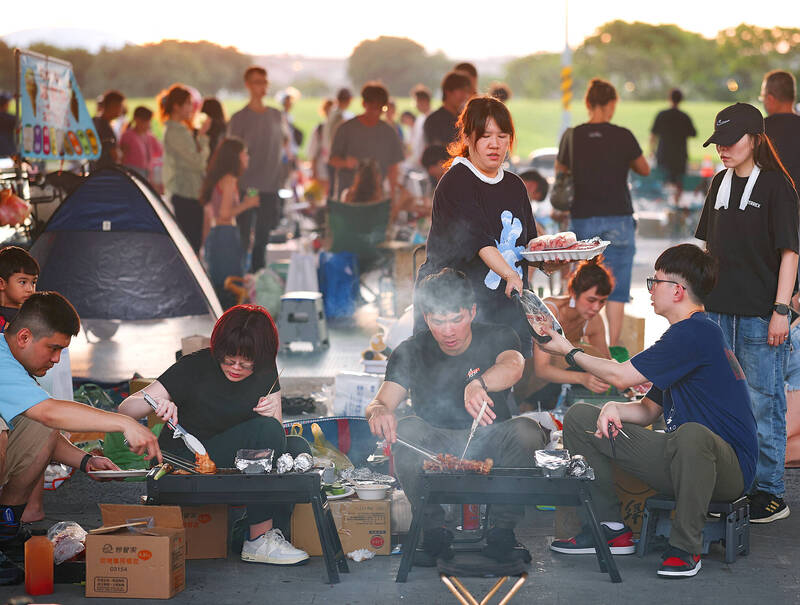
People barbecue with family and friends to celebrate the Mid-Autumn Festival under the Dazhi Bridge at Dajia Riverside Park in Taipei yesterday. Photo: CNA