離開
離開 進入
進入《TAIPEI TIMES》Japanese lawmaker supports Abe’s ‘Taiwan contingency’
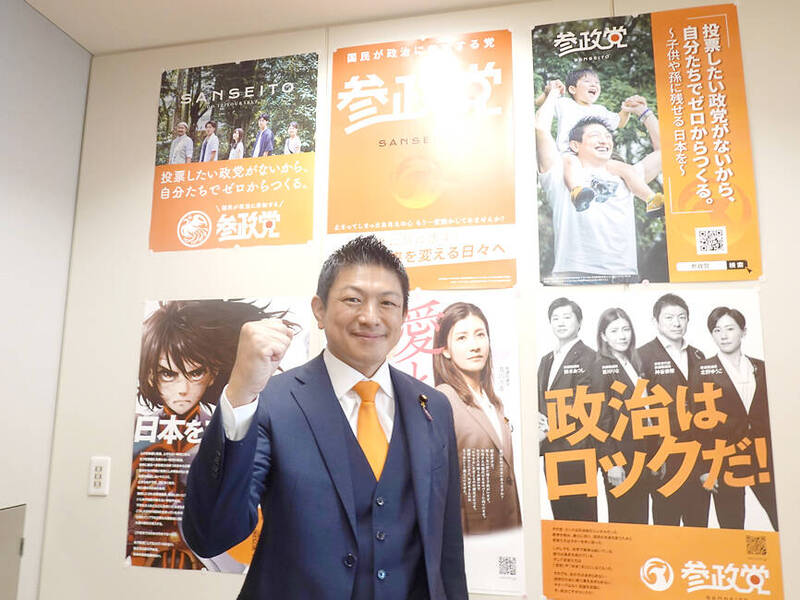
Japanese House of Councillors member Sohei Kamiya, leader of the political party Sanseito, poses for a photograph in his office in Tokyo earlier this month. Photo: CNA
By Jake Chung / Staff writer, with CNA
A Japanese lawmaker who leads the populist Sanseito party has voiced support for the concept “a Taiwan contingency is a Japan contingency,” and called for preventing a conflict in the Taiwan Strait and stepping up Taiwan-Japan security collaborations.
During an interview published yesterday by the Central News Agency, Japanese House of Councillors member Sohei Kamiya, who is also the founder and secretary-general of Sanseito, said he agreed with the phrase “a Taiwan contingency is a Japan contingency,” coined in 2021 by the late former Japanese prime minister Shinzo Abe.
“I absolutely agree ... any conflict involving Taiwan will result in the severance of maritime travel routes, which is a life-or-death issue for Japan. We should dedicate efforts to prevent conflict, instead of inciting it,” he said.
Commenting on the lack of high-level dialogue between Taipei and Tokyo and formal diplomatic relations, Kamiya said that Sanseito hoped to increase Taiwan-Japan interaction through the Japan-ROC Diet Members’ Consultative Council, which he and all Sanseito members were a part of.
The party would continue to promote civilian and local collaborations between Taiwan and Japan, he said, urging more Japanese lawmakers to participate.
The party hopes to organize a delegation to Taiwan including all 18 members who currently hold seats in the upper house, he said.
Sanseito issued a formal protest with the Nagasaki City Council when it initially failed to invite Taiwan to attend the ceremony to mark the 80th anniversary of the city’s atomic bombing, calling it an “act of unfairness,” Kamiya said.
The party, which was founded on YouTube, has faced criticism for calling for limiting immigration and foreign capital, and its opposition to globalism and “radical” gender policies.
Kamiya said that the party was a target of criticism from traditional media, but on social media it has been received positively.
The party is focused on achieving a balance of observing national interests and maintaining international harmony, he said, adding that it is not anti-globalism, but opposes capitalist monopolies that are a result of globalism.
In a report on the July 30 Japanese House of Concillors election, the Chinese-language, state-run Global Times portrayed Sanseito as aiming to turn Japan into a military and political powerhouse.
Kamiya said that Tokyo should be alert to how China is infiltrating Japan, citing the increased number of Chinese who have received Japanese citizenship and have become active in politics.
The party, was founded in 2020 with a focus on an anti-vaccine and anti-masking policies, won its first seat in the upper house in 2022. In last month’s elections, Sanseito ran on a “Japanese First” campaign, winning 14 seats.
新聞來源:TAIPEI TIMES