離開
離開 進入
進入《TAIPEI TIMES》 Twelve locations selected for Han Kuang exercises
2024/07/09 03:00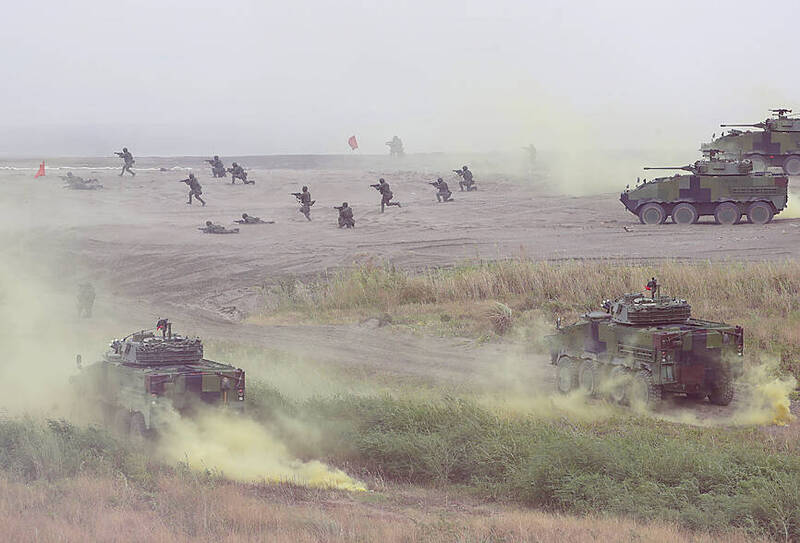
Soldiers on July 27 last year simulate an anti-landing operation near the coast in New Taipei City during the annual Han Kuang military exercises. Photo: Chiang Ying-ying, AP
OVERALL DEFENSE: The selection of airports and ports for the exercises is to train to repel invaders from landing at strategically important locations, military experts said
/ Staff writer, with CNA
The military has selected 12 locations, including airports and beaches, that would likely be used for anti-aircraft landing drills during the live-fire component of the annual Han Kuang exercises later this month, with a focus on testing troops’ multi-point simultaneous defensive capabilities in real combat scenarios, experts said on Sunday.
Taiwan Taoyuan International Airport, Taipei International Airport (Songshan airport), the port of Taipei, Guandu Plain A and B, Guanyin Beach, Jiben Beach, Beipu Beach, Penghu Beach, Siahusi, Tainan Airport and Jianan Beach would be used for the “annual military exercises and training involving the use of helicopters,” a recent live-fire notice issued by the Maritime and Port Bureau showed.
It is thought that these locations, selected mainly due to their proximity to critical infrastructure, would be used to hold anti-aircraft landing drills, military experts said.
Previously, the Ministry of National Defense announced that the airspace around Taoyuan airport and Songshan airport would be closed for an hour on July 25 and July 23, respectively, due to the Han Kuang military exercises.
The military conducted anti-aircraft landing drills at Taoyuan airport for the first time during last year’s Han Kuan exercises, said Shu Hsiao-huang (舒孝煌) and Su Tzu-yun (蘇紫雲), research fellows at Taiwan’s Institute for National Defense and Security Research.
They said that the drill locations were chosen because they are in the vicinity of ports, airports, beaches, political and economic centers and oil depots.
The Chinese People’s Liberation Army (PLA) would aim to capture those locations in the event of an invasion, and the military exercises are designed to prevent the PLA from seizing them, they said.
For instance, the port of Taipei, which is close to Guandu Plain, has been an important defensive stronghold in many past exercises, because if the PLA were to capture the plain, they could advance toward the headquarters of the nation’s major political institutions, they said.
Drills are set to be held at Guanyin Beach and Jianan Beach because they are close to Taoyuan airport and Taichung Ching Chuang Kang Airport, respectively, they said.
Drills would also be conducted at Penghu Beach because if Penghu were occupied, it could serve as a military supply base for Chinese troops, they said.
Su said the PLA has about 1,000 helicopters, and its fleet is as large as the US military is, adding that if a helicopter took off from Penghu, which is about 24 nautical miles (44.45km) from Taiwan proper, it could reach Taiwan’s coast in about 10 minutes, whereas it would take about one hour to fly across the Taiwan Strait.
Therefore, in the event of an invasion, Taiwan’s key locations could be occupied and controlled by the PLA, which would enable a second group of PLA troops to unload heavy equipment for another wave of attacks, Su said.
This year’s exercises exhibit the nation’s overall defense strategy of regional defense, and anti-landing scenarios would not be concentrated in one place as in previous drills, but feature “multi-point simultaneous defense,” Su said.
The focus on the defense of the areas surrounding airports, ports and other key military infrastructure demonstrates the military’s awareness of the importance of regional defense, he added.
This year’s live-fire segment of the Han Kuang exercises, the largest annual training drills conducted by the nation’s military and held since 1984, is to take place from July 22 to July 26 and focus on unscripted and real combat drills, the ministry said.
The exercises would not feature live-fire drills on Taiwan proper. However, troops stationed on outlying islands would use live ammunition, it said.
新聞來源:TAIPEI TIMES