離開
 進入
《TAIPEI TIMES》 New golden pear scion to bolster produce resilience
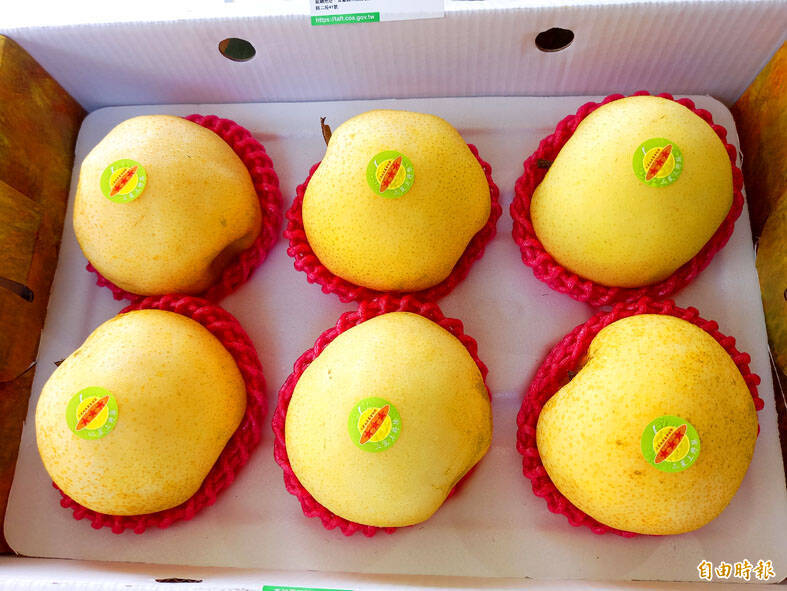
Sansing golden pears are pictured in an undated photograph. Photo: Taipei Times
By Chiang Chih-hsiung and Esme Yeh / Staff reporter, with staff writer
Taiwan has successfully propagated Sansing golden pears with newly developed pear scions after the scions sourced from China’s Shandong Province were discontinued four years ago, the Agriculture and Food Agency said.
The scions were developed by the Hualien District Agricultural Research and Extension Station’s Lanyang Branch Station this summer after two years of testing, it said.
They would be grafted to pear trees from around the beginning of next year and could help resume Sansing golden pear production in summer next year, it added.
“Married-up” pears grown in Yilan County’s Sansing Township (三星) are nicknamed Sansing “admiral” pears for their high quality, with golden pears being one of the three major Sansing admiral pears aside from Kosui and Hosui pears.
“Married-up” pears refers to those cultivated by grafting scions of high-quality pears — usually high-altitude or high-latitude varieties — to pear varieties adapted well to the warm climate in Taiwan.
The township’s admiral pear cultivation areas total more than 40 hectares with an annual output of more than NT$100 million.
Golden pears used to account for more than half of Sansing golden pear production given its soft mouthfeel, sweetness and light yellow fruit peel.
It is also a distinctive pear cultivar to the township and rarely seen in other pear-growing regions, as it is more sensitive to climate and other growth factors.
However, scions sourced from Shandong for golden pear grafting were discontinued by China four years ago following increased cross-strait tensions.
While Kosui and Hosui pear scions continued to be sourced from Japan over the past few years, golden pears faced suspended production due to the Shandong pear scion stockout.
The stockout is widely considered to be a result of political tensions with China, which also discontinued imports of Taiwanese pineapples, atemoya and groupers.
To boost the resilience of Taiwanese produce against Chinese threats, the Agriculture and Food Agency formed a group to help agricultural workers build the capability for self-sustained production of golden pear scions.
The domestic scions developed by the Lanyang Branch Station would be promoted to pear farmers for graft testing, with golden pears expected to return to the market by next summer.
The Lanyang Branch Station said the pear scions were selected from golden pear trees in Taichung’s Lishan (梨山) for development.
The Sansing Farmers’ Association said a golden pear scion production base would be set up in Taiwan’s mountainous areas to establish a stable supply for sustainable golden pear farming.
Hualien District Agricultural Research and Extension Station Director Yang Ta-chi (楊大吉) said that pear scion production management techniques would be advanced to improve the industrial resilience of Sansing golden pears and other “married up” pears grown in low lying areas.
新聞來源:TAIPEI TIMES