離開
 進入
《TAIPEI TIMES》TIER forecasts GDP to grow 12.34% this year
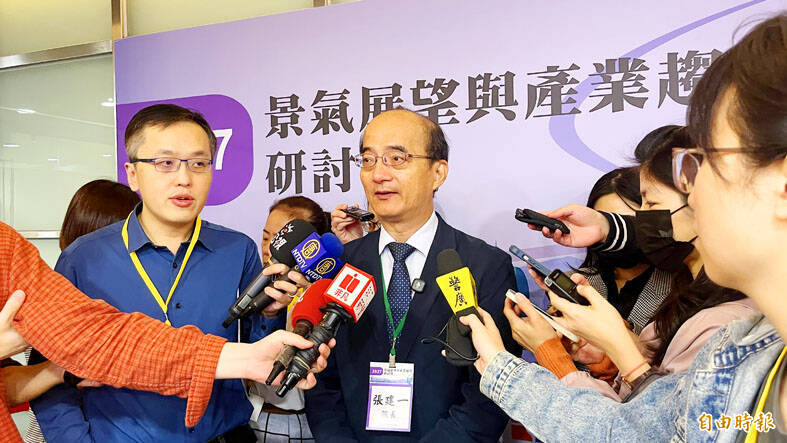
Taiwan Institute of Economic Research president Chang Chien-yi speaks to reporters in Taipei yesterday. Photo: Liao Chia-ning, Taipei Times
STILL BOOMING: Although companies might reassess data center plans, many orders have already been secured, which should sustain growth, TIER said
By Crystal Hsu / Staff reporter
Taiwan’s economy is forecast to grow 12.34 percent this year and 6.45 percent next year, as sustained global investment in artificial intelligence (AI) continues to fuel exports, business investment and household consumption, the Taiwan Institute of Economic Research (TIER, 台經院) said yesterday.
The Taipei-based think tank raised its forecast for this year and released its projection for next year, citing stronger-than-expected AI investment by US technology giants, despite mounting concerns over the sustainability of the boom and increased volatility in global financial markets.
The AI trend is unlikely to reverse, although the industry is shifting from an investment arms race toward more measured expansion, TIER president Chang Chien-yi (張建一) said at a forum in Taipei.
“Occasionally tapping the brakes does not mean the car will stop,” Chang said, adding that moderation in AI investment does not mean the boom is coming to an end.
He described last week’s market sell-off as a short-term correction that could put the industry’s growth on a more sustainable footing.
The results of last week’s US midterm elections could prompt technology companies to reassess their data center expansion plans and improve coordination with local communities, ultimately benefiting the industry’s long-term development, Chang said.
However, AI demand is expected to remain strong in the near term, as many orders have already been secured and many data center projects have obtained permits or are already under construction, he said.
The commitments should sustain growth through the first half of next year, Chang said.
The outlook for the second half would depend on whether market concerns ease, with AI investment likely to keep growing, but at a slower pace than over the past two years, he said.
Broader AI adoption would sustain demand for Taiwan’s semiconductor, advanced packaging and server supply chains, underpinning exports and private investment, TIER said.
Stronger corporate earnings should also bolster household spending by supporting income growth, it said.
Private investment and consumption have emerged as additional growth drivers alongside exports, making Taiwan’s economy more resilient, despite conflicts in the Middle East, TIER Economic Forecasting Center director Gordon Sun (孫明德) said.
Consumer prices are forecast to rise 2.05 percent this year and 1.94 percent next year, with international oil and raw-material prices expected to stabilize next year, TIER said.
The duration of conflicts in the Middle East and the strength of AI investment would be the two main factors shaping Taiwan’s economic outlook, Sun said.
Continued data center expansion and a return to normal shipping through the Strait of Hormuz would support a more optimistic scenario, while a prolonged regional conflict could pose challenges, he said.
Separately, the controversy over an extramarital affair acknowledged by Nvidia Corp CEO Jensen Huang (黃仁勳) is unlikely to derail the broader AI industry or have a major impact on Taiwan’s AI supply chain, even if it damaged his reputation, Chang said.
What investors should closely watch is whether competition from Advanced Micro Devices Inc and other rivals could erode Nvidia’s gross margin, he said.
新聞來源:TAIPEI TIMES