離開
 進入
《TAIPEI TIMES》 CCP’s ‘overseas policing’ activity rising, report says
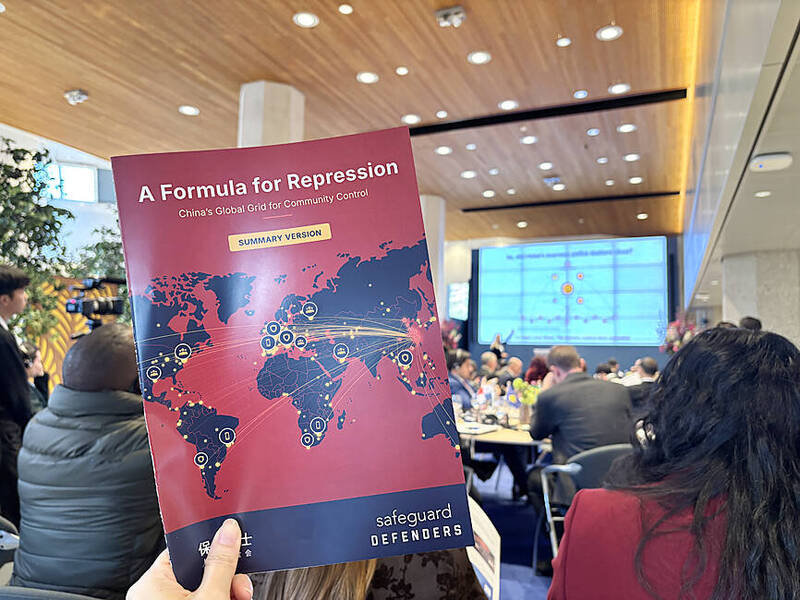
A person holds a copy of a Safeguard Defenders report titled A Formula for Repression: China’s Global Grid for Community Control at a meeting of the Inter-Parliamentary Alliance on China in The Hague, Netherlands, on Friday. Photo: CNA
THREAT TO SOVEREIGNTY: Safeguard Defenders said in a report that policymakers should devise strategies to confront the ‘superstructure of CCP interference’
By Fion Khan / Staff writer, with CNA
The Chinese Communist Party’s (CCP) “overseas police stations” have not been shut down, but are instead expanding in number, with nearly 1,250 formally designated operations in at least 91 countries, human rights organization Safeguard Defenders said in a report released on Friday.
The report, titled A Formula for Repression: China’s Global Grid for Community Control, was released at the Inter-Parliamentary Alliance on China’s (IPAC) annual summit in the Netherlands.
The report identified 74 Chinese authorities and CCP bodies operating through 1,247 designated overseas liaison points at the direction of the CCP’s United Front Work Department that are using the offices to monitor Chinese diaspora communities.
The number is likely an underrepresentation of actual activity, the report said, adding that Beijing’s claim that its overseas Chinese police stations were closed was false.
Safeguard Defenders in 2022 published two reports detailing the activity of more than 100 overseas stations operating in more than 50 countries, prompting many of the countries affected to denounce the illegal operations, with some launching criminal investigations, it said.
China later claimed that the stations had been closed, but more than 10 police forces from five Chinese provinces are involved with a global network of CCP operatives, this week’s report said.
Since late 2024, five new national policies instructed authorities across China to expand such activities abroad, aiming to export the domestic system of grid management to control Chinese diaspora, it said.
The system of mass surveillance, control and suppression is projected through a global grid of “united front”-affiliated organizations or designated offices that provide the infrastructure other Chinese authorities — police, prosecutors, courts, justice bureaus and others — plug into, it said, adding that they are mostly run by the Overseas Chinese Federation.
Every liaison office designated and every task carried out by them are breaches of sovereignty, it said, describing them as “transnational repression embodied” and an “active national security threat.”
Policymakers should swiftly devise strategies to confront the “superstructure of CCP interference,” the group said.
Laura Harth, Safeguard Defenders’ lead on transnational repression and author of the report, said that the operations should no longer be described as police stations, but rather as a “network system.”
China’s illegal overseas police stations have not only remained operational, but have continued to expand under the guise of legitimate community services, Harth said.
The system threatens the sovereignty of other countries, undermines democratic institutions, and subjects Chinese diaspora communities to widespread surveillance and coercion, creating fear, she said.
The CCP’s definition of the Chinese diaspora extends back as far as 10 generations, she said.
Anyone of Chinese descent living overseas, including people from Hong Kong and Taiwan, could be regarded by the CCP as an overseas Chinese, making them potential targets of its surveillance network, she said.
IPAC warned that the CCP’s overseas interference and transnational repression in democratic countries were growing increasingly widespread, pervasive and harmful.
IPAC cofounder and executive director Luke de Pulford said democratic nations should introduce foreign agent registration systems and impose criminal liability for violations.
Organizations affiliated with the CCP’s United Front Work Department should be required to register, De Pulford said.
Registration and enforcement requirements should follow an organization’s “united front” affiliations, regardless of changes to its public name, he said.
Governments should also issue public notices detailing the CCP’s and the United Front Work Department’s activities, strategies, objectives and targets, as well as publish annual national reports on Chinese interference, he said.
They should establish channels for affected diaspora communities to report incidents, and engage directly with isolated communities and groups, De Pulford said.
Democratic governments and parliaments must resist the CCP’s persecution of specific groups, he said.
Government officials should expand formal meetings with Taiwanese elected representatives, pro-democracy dissidents, human rights advocates and vulnerable diaspora communities, he said.
They should also publicly confront CCP officials who attempt to suppress these communities, as doing so would be a direct way to defend national sovereignty and improve democratic resilience, he added.
新聞來源:TAIPEI TIMES