離開
離開 進入
進入《TAIPEI TIMES》Taiwan to build more anti-ship missiles
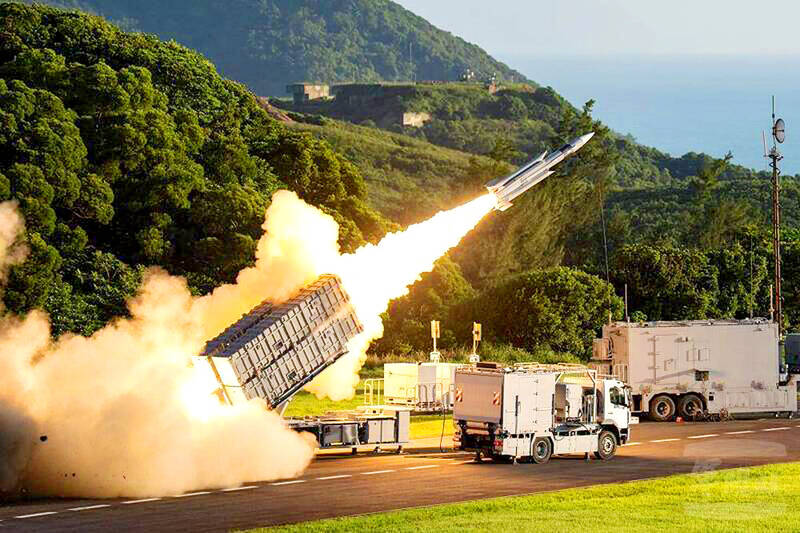
A Hsiung Feng III medium-range supersonic missile is launched in an undated photograph. Photo courtesy of the Military News Agency
RESILIENCE: Keeping the defense industry’s assembly lines open would prove essential should the nation be involved in a prolonged conflict, a source said
By Lo Tien-pin and Jonathan Chin / Staff reporter, with staff writer
The Ministry of National Defense has prepared a NT$22 billion (US$692.3 million) program to acquire about 200 improved Hsiung Feng anti-ship missiles from next year to 2035, a source said.
Commenting on condition of anonymity, a high-ranking defense official said the ministry’s plan for enhanced-capability Hsiung Feng II and Hsiung Feng III missiles would be funded as part of the regular defense budget.
The 200 missiles would be added on top of the 1,400 missiles being funded via the Sea-Air Combat Power Improvement Plan, they said.
The program is not about padding missile numbers, but expanding the capability to defeat electronic countermeasures and sink the Chinese People’s Liberation Army Navy’s (PLAN) Type 052D and Type 055 destroyers, he said.
The improved Hsiung Feng II and Hsiung Feng III missiles feature advanced microchips that use signal filtering technology to cut through electronic interference to achieve first-shot kills, the official said.
The massive ammunition consumption observed in the ongoing Russian invasion of Ukraine demonstrated that Taiwanese military must improve magazine depth to sustain combat operations in a conflict, he said.
Military planners expect to fight a large number of PLAN warships, each of which would take two to four missiles to sink, he said.
High missile expenditure rates mean warships would exhaust their missile loads in one volley and need to re-arm, the official said, adding that losses of ships and missiles to the enemy must also be considered.
Taiwan would need to prepare about 1,600 missiles to meet operational requirements, the official said.
Continuing missile production would increase the resilience of the defense industry, as keeping assembly lines open would prove essential should the nation be involved in a prolonged conflict, they said.
More missile orders would also ensure indigenous missile assembly lines and manufacturing capacity remain in use, which would prove essential should the nation ever need to fight a prolonged conflict, the official said.
The navy’s strategy is to counter PLAN fleets with surface combatants and coastal defense batteries deployed in Taiwan proper and the nation’s outlying islands.
The warships and land-based batteries’ arsenal would be comprised of US-made subsonic Harpoon missiles and the indigenous subsonic Hsiung Feng II and supersonic Hsiung III missiles, forming a “low-high” mix to overwhelm enemy defenses.
新聞來源:TAIPEI TIMES