離開
離開 進入
進入《TAIPEI TIMES》‘Time’ cover focuses on China threat
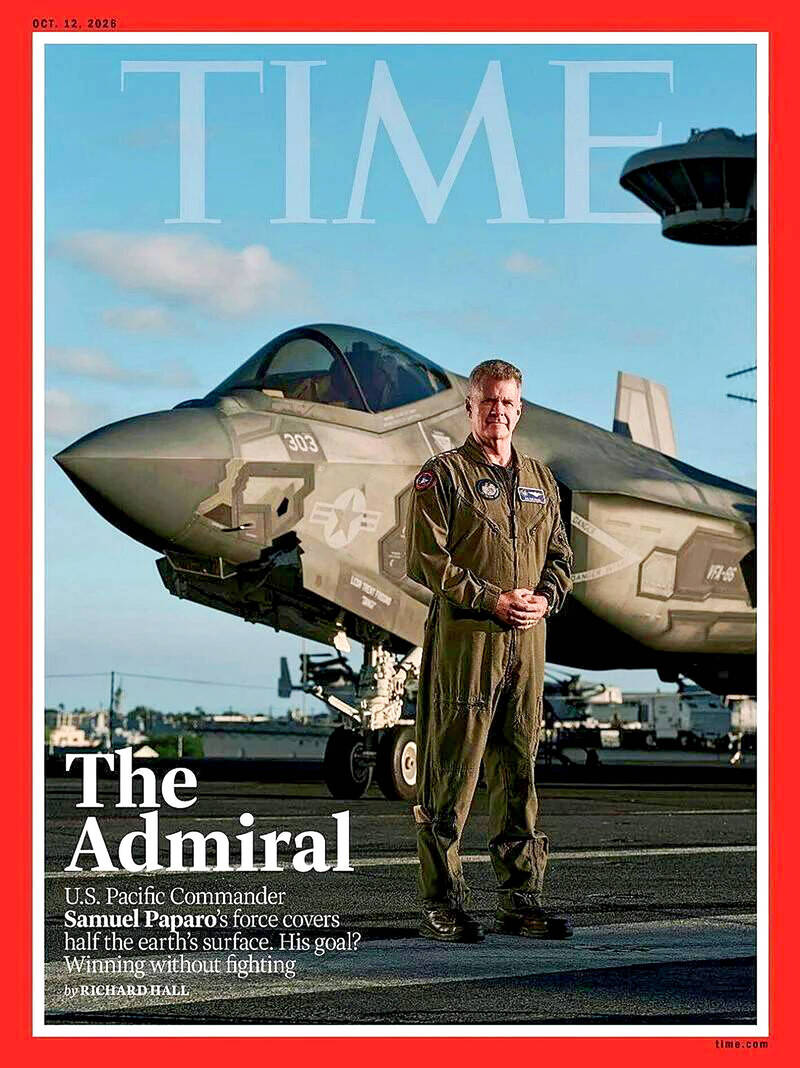
Admiral Samuel Paparo, commander of the US Pacific Command, is featured on the cover of Time magazine’s Oct. 12 issue. Photo: Screen grab from Time’s X account
By Chen Cheng-liang and William Hetherington / Staff writers
Admiral Samuel Paparo, commander of the US Pacific Command, is featured on the cover of Time magazine’s Oct. 12 issue, alongside an interview published online on Thursday in which he outlined a “deterrence by denial” strategy aimed at countering a potential Chinese attack on Taiwan.
In the interview, Paparo detailed his approach to defense, describing deterrence by denial as central to preventing a conflict in the Taiwan Strait.
The goal of the strategy is to convince China that “where America’s direct vital interests are involved, there’s a high probability of denying your aggression,” the magazine quoted him as saying.
Should diplomacy fail, Paparo has proposed using large numbers of low-cost, mass-produced precision drones alongside conventional high-tech missile firepower to create what he calls a “Hellscape” — a battlefield environment designed to prevent or significantly delay a Chinese amphibious landing on Taiwan.
Paparo commands the oldest and largest US geographic combatant command, which covers about half the globe. It has about 400,000 military and civilian personnel, while the Pacific Fleet has about 200 warships, five carrier strike groups and more than 1,000 aircraft.
US dominance in the Pacific is facing its most serious challenge since World War II, with Paparo’s primary mission being to deter China from taking military action against Taiwan, Time said.
Referencing Chinese strategist Sun Zi’s (孫子) The Art of War (孫子兵法), Paparo said that “winning without fighting is the acme of skill.”
“Mission success for me is not to fight and win a war; it’s to provide a deterrent capability so that we never go to war in the first place,” he said.
The key to deterrence by denial is demonstrating credible military capabilities and the will to use them while protecting critical military secrets, he said.
However, with the Chinese People’s Liberation Army Navy now 12 times larger than it was 25 years ago, the US military must still prepare for combat in case deterrence fails, Paparo said.
If a conflict erupts in the Taiwan Strait, the US military could institute the “Hellscape” strategy to prevent China from launching an amphibious invasion of Taiwan or, at a minimum, significantly delay the operation, he said.
“We need not gain air or maritime superiority of a space; we need only deny its use to aggressors,” he said.
A 2023 war game conducted by the Washington-based Center for Strategic and International Studies found that although US forces could repel a Chinese invasion of Taiwan in most scenarios, the effort would include the loss of two aircraft carriers, dozens of warships and hundreds of aircraft — losses that would rank among the heaviest suffered by the US military since World War II, Time said.
The war game did not account for the depletion of US missile stocks resulting from military operations in the Middle East at the time.
Despite the severity of the challenges, Paparo said he was confident in the US’ ability to prevail.
The focus is not to prove that the US military can win a war, but to maximize the margin of victory while minimizing the costs of war in terms of lives, military capabilities, money and time, he said.
The goal is to “drive that bill down to zero,” he added.
新聞來源:TAIPEI TIMES