離開
離開 進入
進入《TAIPEI TIMES》Literature awards under threat from AI, writer says
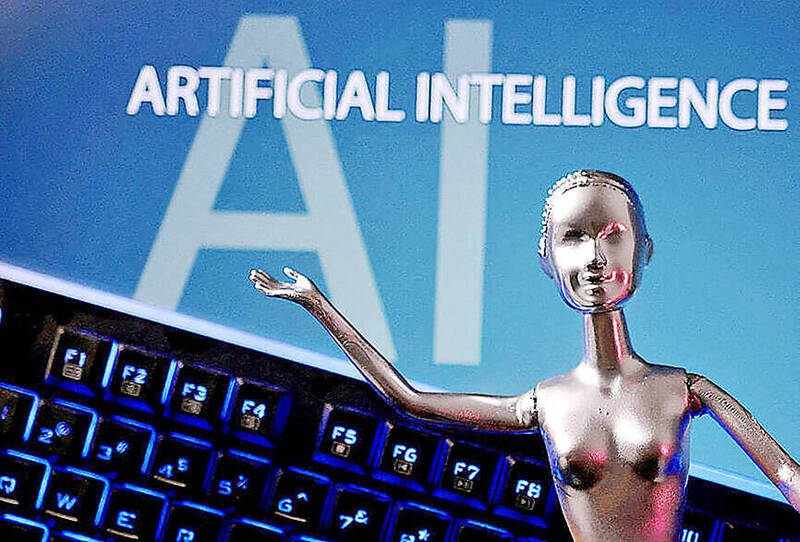
A figurine stands in front of a computer keyboard and a display reading “artificial intelligence” sign in an undated photograph. Photo: Reuters
HALL OF MIRRORS: Reviewing submissions is like being a batter facing a pitcher throwing three balls at once, two of which are illusions, a literary judge said
By Fion Khan / Staff writer
Artificial intelligence (AI) is dealing a heavy blow to literature and literary judging, Taiwanese writer Chu Yu-hsun (朱宥勳) said on Saturday, adding that nearly 40 percent of the novel submissions he reviewed this year appeared to be AI-generated.
Chu wrote on Facebook that this year has been his most painful as a judge, as the literary community attempts to fend off an infinitely replicable industrial production line with limited human labor.
In many cases, he said he only realized he was dealing with a new AI writing model after reading a batch of entries and noticing the same stylistic patterns appearing repeatedly.
He said he observed a noticeable difference between AI-generated submissions received in the first and second halves of this year.
Preliminary judging previously involved selecting outstanding works, but judges now have to rank submissions while also trying to determine whether they were written by humans, Chu said.
“It is like a baseball pitcher throwing three balls at once, two of which are illusions,” he wrote. “The batter has to figure out which one is real before deciding whether to swing.”
Reading 200 submissions containing 20 AI-generated entries required as much effort as reading 400 or 500 works, he said, adding that the current system is destined to undermine judging quality and cannot effectively defend against AI-generated content.
He added that mistakes were inevitable, adding that he could misidentify human-written works as AI-generated and fail to detect some AI-generated submissions.
Even if his accuracy rate was as high as 95 percent, reviewing 1,000 entries would still result in 50 incorrect judgements, Chu said.
AI-generated submissions would eventually destroy the literary award system, he said.
Working conditions for judges have deteriorated so severely that compensation would need to be raised substantially to maintain quality or every literary award would be riddled with problems, he said.
Chu said that starting next year, he would refuse to serve as a judge for any literary award that does not explicitly prohibit AI-generated works, while prioritizing events that adopt stronger preventive measures, such as requiring contestants to sign declarations affirming the originality of their work or preserve records of their creative process.
He also issued a stern warning to contestants who use AI to create their entries.
“I know there is no point in trying to persuade you, because you simply do not have the talent or soul of a creator. As a result, you lack the pride and self-discipline that creators hold themselves to,” Chu said.
“Make the most of the last few chances you have to game the system and pocket the prize money,” he added.
“Once the literary award system collapses, you would not even know where to submit your work or where you can get your writing seen and noticed,” he said.
新聞來源:TAIPEI TIMES