離開
離開 進入
進入《TAIPEI TIMES》Google to grow office space in Taiwan by 60%
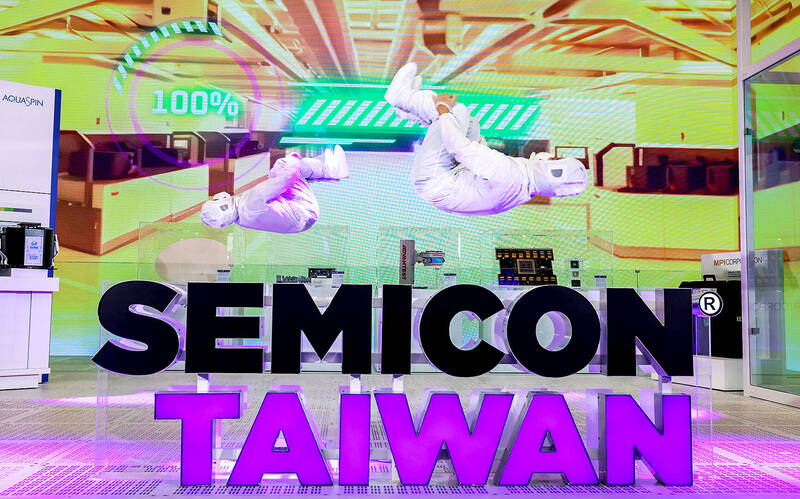
Dancers wearing clean room suits perform during the opening ceremony of the Semicon Taiwan trade show in Taipei yesterday. Photo: Cheng I-hwa, AFP
‘CODESIGN’: An executive hailed the role of Taiwanese firms’ hardware operations, saying without it, Google could not have built the compute platform it has
Staff writer, with CNA
Google is expanding its Taiwan office space by 60 percent as local partners take on a growing role in developing the company’s artificial intelligence (AI) infrastructure, a senior executive said yesterday.
The US technology giant expects its operations in Taiwan to continue growing, said Amin Vahdat, Google’s senior vice president, and chief technologist for AI and infrastructure, without providing an investment figure, hiring target or timetable for the expansion.
Speaking at a media session after delivering an opening keynote speech at the Semicon Taiwan trade show in Taipei, Vahdat described Taiwan as a critical engineering hub connecting an ecosystem that extends beyond silicon to advanced packaging, liquid cooling and high-power systems.
Much of Google’s hardware design and manufacturing takes place in Taiwan in collaboration with local companies, while its engineers work “shoulder to shoulder” with Taiwanese partners, he said.
When the first chips designed by Google are produced by Taiwan Semiconductor Manufacturing Co’s (TSMC, 台積電), the company’s Taiwan team helps bring them up, test them and validate their performance and functionality before they are handed to software developers, Vahdat said.
“You can’t imagine how much anticipation there is for those first few chips that come off the assembly line,” he said. “All that actually starts in Taiwan.”
Taiwan’s role in Google’s hardware operations extends beyond procurement and manufacturing, with Taiwanese companies already participating in the codesign of its AI systems, he said.
Google is in discussions with multiple Taiwanese partners on future generations of hardware, including rack-level architecture, design for manufacturing and system reliability, he said.
“We couldn’t be building the infrastructure, the compute platform that we do today, without this deep codesign,” Vahdat said, adding that the cooperation was accelerating “month over month, quarter over quarter, year over year.”
Google opened a data center in Changhua County in 2013 and has invested in several undersea cable projects connecting Taiwan to the world, he said.
Taiwan is also home to Google’s largest hardware engineering hub outside the US, Vahdat said.
The expansion comes as demand for computing power grows by “perhaps 10 times year over year,” driven by increasingly capable AI models and services, he said.
Asked which constraint would be most severe over the next 18 months, Vahdat said bottlenecks could shift rapidly among power availability, chip supply, memory, cooling, rack delivery and networking.
“You can’t afford to take your eye off any of the constraints,” he said, adding that energy represents a significant constraint for Google and Taiwan.
Google remains committed to achieving round-the-clock, carbon-free energy and would continue investing in renewable energy, batteries and geothermal power, Vahdat said.
For Taiwan to protect its position in the global technology industry, it should pursue greater manufacturing automation and power efficiency while improving cooperation throughout the supply chain, he said.
Speaking at the opening of the trade show, Premier Cho Jung-tai (卓榮泰) said that rapid AI development has created a global wave of technological innovation and cooperation, with Taiwan playing an important role alongside other countries.
Taiwan’s semiconductor production value reached US$209.1 billion last year, up 22.7 percent from a year earlier, while TSMC and other major global companies continue to invest in advanced manufacturing, packaging and memory production in Taiwan, Cho said.
The government will prepare the necessary land, energy, talent and financial support to keep pace with the industry’s expansion, including by preparing factory space so companies can move in quickly, he said.
Semicon Taiwan runs through Friday at Taipei Nangang Exhibition Center, featuring more than 1,300 exhibitors and 4,300 booths from more than 60 countries and areas.
新聞來源:TAIPEI TIMES
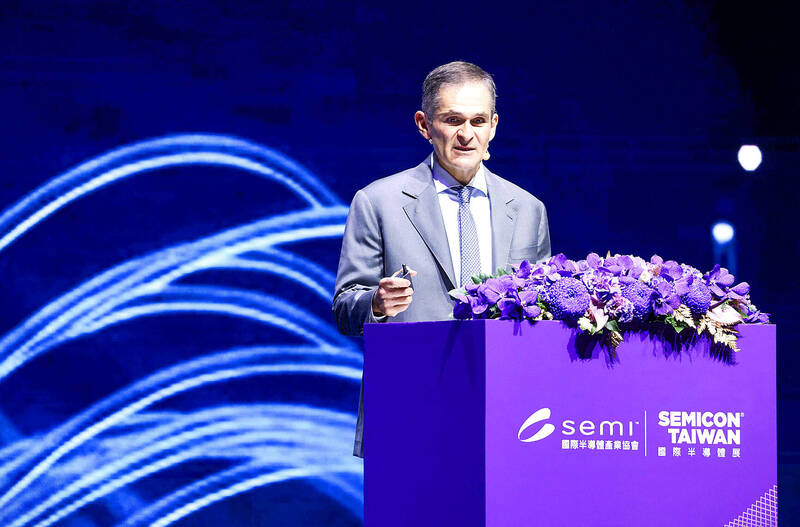
Amin Vahdat, Google’s senior vice president and chief technologist for artificial intelligence and infrastructure, speaks at the Semicon Taiwan trade show in Taipei yesterday. Photo: Cheng I-hwa, AFP