離開
離開 進入
進入《TAIPEI TIMES》US testing Harpoon missiles Taiwan purchased
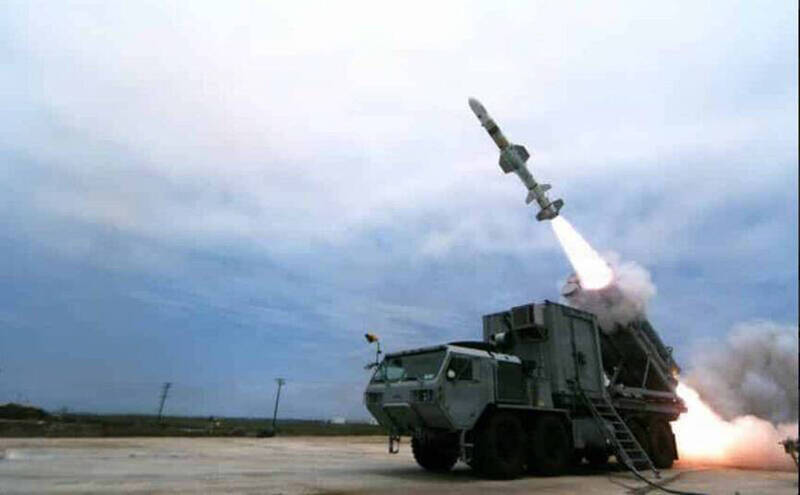
A Harpoon missile is fired in an undated photograph. Photo: Screen grab from US Navy’s Web site
DEFENSE PROCUREMENT: The Pentagon has told a US congressional hearing that Taiwan has ‘top priority worldwide’ in the delivery of Harpoon missile systems
By Lo Tien-pin, Hung Ting-hung and William Hetherington / Staff reporters, with staff writer
The US Navy and Boeing Co have conducted a series of tests for land-based Harpoon anti-ship missile system being supplied to Taiwan and released footage showing the system striking a target vessel at sea.
The weapons system and support equipment tested were reportedly tailored for Taiwan, while the first launch vehicles and other components have already begun arriving in Taiwan, with the full delivery of 100 systems scheduled to be completed by the end of 2028.
Pentagon officials have previously told a US congressional hearing that Taiwan has “top priority worldwide” in the delivery of Harpoon missile systems, with production lines operating at full capacity to address threats in the Taiwan Strait.
The navy has budgeted more than NT$90.2 billion (US$2.85 billion) for the procurement of the systems, as part of a program running from 2021 to 2030 to establish a dense network of land-based anti-ship missile defenses.
Taiwan has purchased 100 land-based Harpoon Coastal Defense Systems from the US, which included 400 missiles, four training missiles, 100 missile launch vehicles and 25 radar vehicles. Several launch vehicles, command-and-control vehicles and radar vehicles have arrived in Taiwan, and the navy’s Littoral Combat Command is conducting equipment acceptance and simulated strike training.
The procurement is scheduled to be completed by the end of 2028.
The missiles being acquired by Taiwan are the latest upgraded RGM-84L-4 Harpoon Block II (U) land-based anti-ship missiles. They are equipped with enhanced resistance to electronic countermeasures, which would allow them to identify and engage enemy vessels in heavy-jamming environments, as well as GPS guidance and active radar guidance systems.
The missiles can be used against amphibious landing forces and carrier strike groups, while also possessing a land-attack capability against military installations along the coast. Their range exceeds the about 100km range of earlier ship-launched versions, significantly expanding the area they can cover across the Taiwan Strait.
A key feature of the latest tests was the use of Oshkosh-made Heavy Expanded Mobility Tactical Trucks (HEMTTs), which are among the US military’s newest heavy-duty tactical vehicles, military news Web site Naval News reported.
Unlike the older trailer-mounted launchers supplied by Boeing to other countries, Taiwan is receiving a highly mobile configuration in which the launch system and vehicle are integrated.
Each eight-wheel-drive HEMTT launch vehicle is equipped with an armored cab and carries four Harpoon missile canisters. The vehicles are designed for rapid movement and concealed deployment over unpaved terrain, providing greater battlefield mobility and survivability than conventional commercial truck-based trailers.
Taiwan Association for Security and Development chairman Chi Tung-yun (紀東昀) said his organization obtained four photographs of the land-based Harpoon system in southern Taiwan last year.
The equipment shown in the photographs almost completely matches footage released by the US military, Chi said.
The photographs show Harpoon missile launch vehicles that differ from those used by Denmark and South Korea, but they use the same Oshkosh HEMTT 8x8 heavy tactical truck chassis as Patriot missile systems, while carrying a new type of missile, he said.
The photographs’ backgrounds were altered using artificial intelligence to obscure identifying details, while text on the transport trailers was removed, he said.
Researchers at the Institute for National Defense and Security Research have previously said that once the US-made Harpoon systems are fully deployed, they would be integrated with Taiwan-made Hsiung Feng II (Brave Wind II, 雄風二型) and Hsiung Feng III anti-ship missiles.
The systems are expected to be linked to the navy’s Littoral Combat Command, creating a layered coastal defense network designed to deter and disrupt an amphibious assault.
The deployment is part of Taiwan’s broader effort to develop a highly mobile, distributed anti-ship capability aimed at countering Chinese military operations across the Taiwan Strait.
新聞來源:TAIPEI TIMES