離開
離開 進入
進入《TAIPEI TIMES》 Taiwan protests S Korean biennale over name change
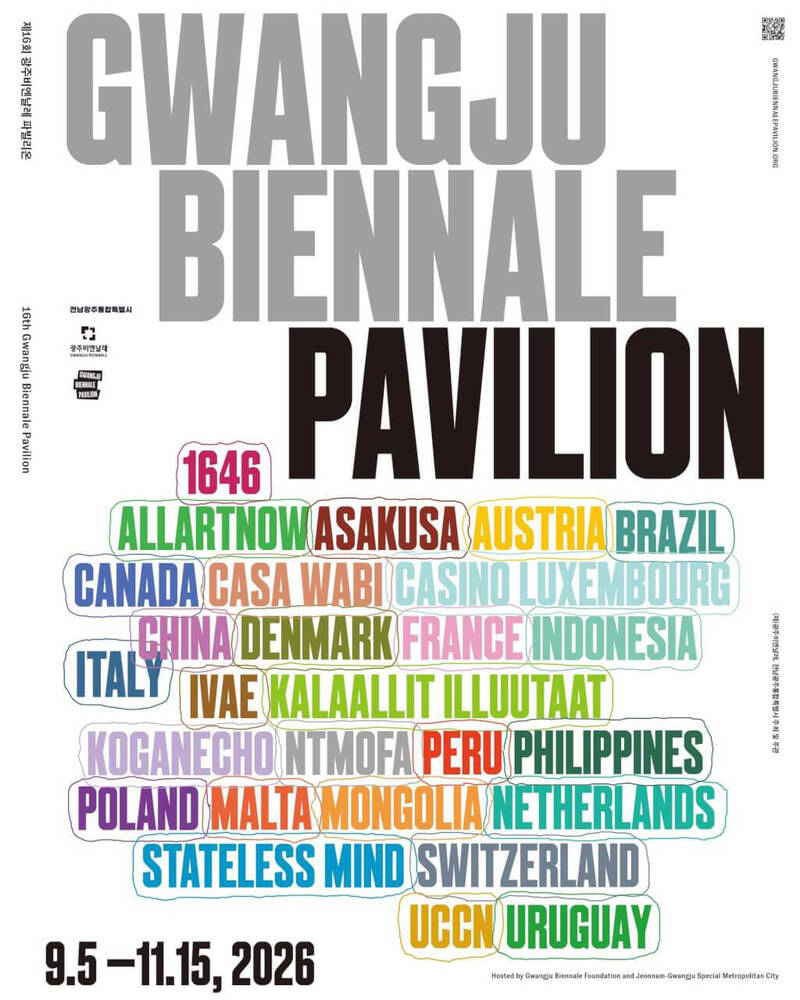
A promotional poster for the 16th Gwangju Biennale is pictured in an undated photograph. Photo: Screen grab from the biennale’s X account
‘POLITICAL CENSORSHIP’: International audiences would see how Taiwanese artists respond to information warfare and geopolitics through their works, an artist said
By Ling Mei-hsueh and Fion Khan / Staff reporter, with staff writer and CNA
Taiwan yesterday reiterated its protest over the removal of “Taiwan” from the Gwangju Biennale pavilion name as participating Taiwanese artists condemned the move as political censorship.
The 16th Gwangju Biennale is scheduled to take place in South Korea from Sept. 5 to Nov. 15. For the first time, the National Taiwan Museum of Fine Arts proposed participating under the name “Taiwan Pavilion.”
However, promotional materials on the biennale’s official Web site changed the name to “NTMOFA,” the museum’s English acronym, effectively removing “Taiwan” from the poster.
The 10 Taiwanese artists and curators invited to participate in the Gwangju Biennale in a joint statement on Saturday criticized organizers for arbitrarily renaming the “Taiwan Pavilion” to “NTMOFA.”
In the joint statement titled: “The censored Taiwan Pavilion” addressed to the Gwangju Biennale Foundation, the artists said the organizer ignored repeated protests and negotiation attempts by the museum.
“We believe a biennale whose history is rooted in democracy, human rights and the Gwangju spirit has a duty to explain why participants’ self-naming must face political restrictions,” the statement said. “We strongly condemn the foundation’s political censorship of art exhibitions.”
The disappearance of the Taiwan Pavilion was neither unusual nor an isolated incident, it added.
“It is not merely the erasure of a name, but a threat to freedom of expression and the global art community,” it said. “Through this statement, we stand with all art workers who have faced, are facing, or will face political censorship.”
The joint statement was signed by 10 Taiwanese artists and curators: Lee Yi-fan (李亦凡), Juan Po-yuan (阮柏遠), Lin Yu-liang (林瑜亮), Chang Wen-hsuan (張紋瑄), Hsu Che-yu (許哲瑜), Chen Hsiang-wen (陳湘汶), Chen Wan-yin (陳琬尹), Cheng Hsien-yu (鄭先喻), Cheng Ting-ting (鄭亭亭) and Su Hui-yu (蘇匯宇).
Chang, who is based in the Netherlands, said that all parties had referred to the exhibition as the “Taiwan Pavilion” since an invitation to participate in the event was confirmed in March.
However, the organizer abruptly renamed it “NTMOFA” this month, a move she called political censorship and triggered protests from artists and the museum.
The event organizer has yet to respond publicly, potentially affecting the upcoming setup phase, she said, adding that the biennale’s political censorship on the Taiwan Pavillion could undermine its credibility in the international art world.
The Gwangju Biennale is South Korea’s largest and one of the world’s best-known biennales, she said.
With this year’s exhibition scheduled to run alongside the Busan Biennale and Frieze Seoul art fair, the event would draw heavy international attention, and renaming the Taiwan Pavilion risks tainting the biennale with political censorship and distrust, she said.
Political censorship, such as altering artwork descriptions or changing artists’ birthplaces, has emerged in the past few years at some international biennales over controversies including accusations of anti-Semitism, she said, adding that many global artists are resisting.
As one of the artists of the Taiwan Pavilion, she said her work would not be viewed solely as an individual creation, but as part of a broader and more complex narrative shared with the works of other participating artists.
International audiences would see how Taiwanese artists respond to information warfare and geopolitics and use their works to reflect on contemporary politics, she said.
From the initial exhibition proposal and contract signing through preparations for the event, the museum has consistently used the name “Taiwan Pavilion” in its communications with the organizers, the Ministry of Culture said.
The ministry added it has instructed Taiwan’s overseas offices and the museum to continue lodging strong protests with the organizers while evaluating possible responses.
新聞來源:TAIPEI TIMES