離開
離開 進入
進入《TAIPEI TIMES》 Taiwan could host more clinical trials
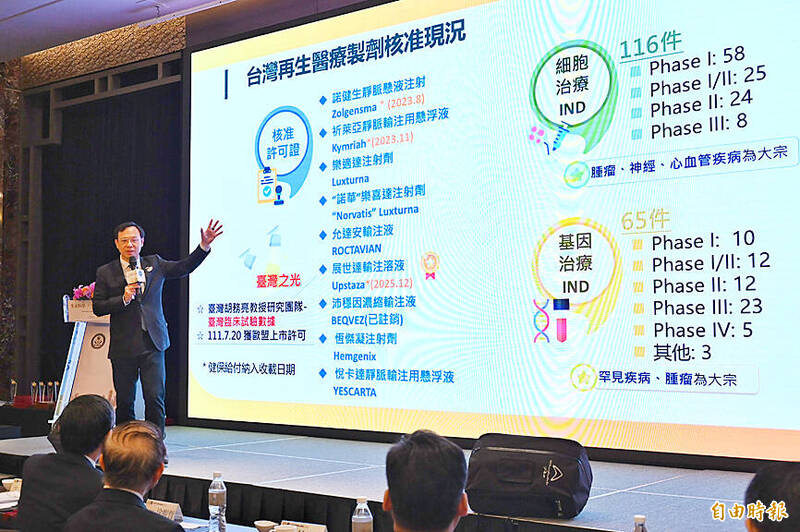
Minister of Health and Welfare Shih Chung-liang speaks at a forum in Taipei yesterday. Photo: Chen Yi-kuan, Taipei Times
IDEAL RESOURCES: Taiwan’s tech and healthcare could be ideal for hosting clinical trials as the cell and gene therapy industry expands worldwide, the health minister said
By Lo Pi / Staff reporter
Taiwan should capitalize on its strengths in Phase 1 and Phase 2 clinical trials and strive to overtake competitors, with the goal of establishing Taiwan as an “Asia-Pacific center for innovative treatments for rare diseases,” said Minister of Health and Welfare Shih Chung-liang (石崇良) yesterday.
He made the remark while promoting the Regenerative Medicine Act (再生醫療法) and aligning with international standards in a forum titled “From Innovation to IPO: Redefining Global Healthcare Capital” in Taipei.
According to Shih, global competition in cell and gene therapy (CGT) has entered a new phase, with the number of clinical trials in Asia-Pacific reaching 990 cases this year, surpassing North America’s 916 cases for the first time, with China serving as a driving force behind the region’s rapid growth.
Global markets are expanding, he said, showing that the CGT market was projected to grow from US$10.1 billion last year to US$57.3 billion in 2031 — a SIX-year compound annual growth rate of 34 percent.
The numbers show that regenerative medicine has become a crucial arena of competition for the biotech industry, he said.
The CGT industry in the US is growing steadily, while China is developing very rapidly, so Taiwan must consider its own advantages, Shih said, adding that China’s rapid growth presents opportunities and challenges for Taiwan.
Taiwan has a relatively small population size, so it is more difficult to compete with larger nations in conducting Phase 3 clinical trials that require a large number of enrolled cases, he said.
Shih said Taiwan has a high-quality healthcare system and excellent clinical research capabilities, giving it an advantage in Phase 1 and Phase 2 early-stage clinical trials, which could accelerate commercialization through more precise clinical trial designs.
The Regenerative Medicine Act and the Regulations Regenerative Medicine Product Act (再生醫療製劑管理條例) came into effect on January 1 this year, establishing a “medical technology” and “pharmaceutical products” dual-track management framework, he said.
The framework aims to let safe and promising therapies enter clinical trials earlier, while allowing mature products to move toward pharmaceutical authorization, commercialization and international markets, he added.
Shih said a total of 651 applications for regenerative medicine technologies have been submitted, with 515 approved for implementation, as of the end of June this year.
A total of 78 medical institutions and 40 cell processing facilities were involved, with 2,545 patient enrollments across the nation, he added.
There were 116 domestic investigational new drug (IND) clinical trials for cell therapy, including 58 Phase 1, 25 Phase 1/2, 24 Phase 2, and eight Phase 3 trials, as of May this year, primarily focusing on oncology, neurological and cardiovascular diseases, Shih said.
There were 65 IND applications for gene therapy, primarily targeting rare diseases and oncology, he said, adding that the numbers highlight Taiwan’s solid foundation in early-stage clinical trials.
To attract more international innovative therapies to Taiwan, the government is promoting a streamlined, single-window service for clinical trials, Shih said.
The goal is to complete the overall review process within 180 days, shortening the time for new drugs to enter clinical trials through standardized Institutional Review Board reviews, standardized template clinical trial agreements and digital patient enrollment, he added.
A dedicated guidance taskforce for regenerative medicinal products would be established in Taiwan to assist products smoothly through research and development, clinical trials and commercialization, he said.
While regenerative medicine brings new hope for medical treatment, its high cost remains a major challenge, Shih said.
If CGT technologies and manufacturing could be localized, leveraging Taiwan’s manufacturing and contract development and manufacturing organization capacity to reduce cost, more patients would have access to them, he said.
He used the example of Chimeric Antigen Receptor T-cell therapy, which, if manufactured in Taiwan, would reduce prices to one-half or even one-third of current costs.
Precision medicine has moved beyond disease classifications in traditional textbooks, toward developing customized treatments, including cancer being broken into more precise classifications based on genetic and molecular characteristics, Shih said.
Taiwan hopes to integrate regenerative medicine, precision medicine and smart healthcare to help innovative treatments take root locally, he said.
The ultimate goal of this effort is not only to benefit local patients, but to share these achievements globally, positioning Taiwan as an innovation center for rare disease treatment in the Asia-Pacific region, he added.
新聞來源:TAIPEI TIMES