離開
離開 進入
進入《TAIPEI TIMES》 KMT defends cuts, while DPP calls them irrational
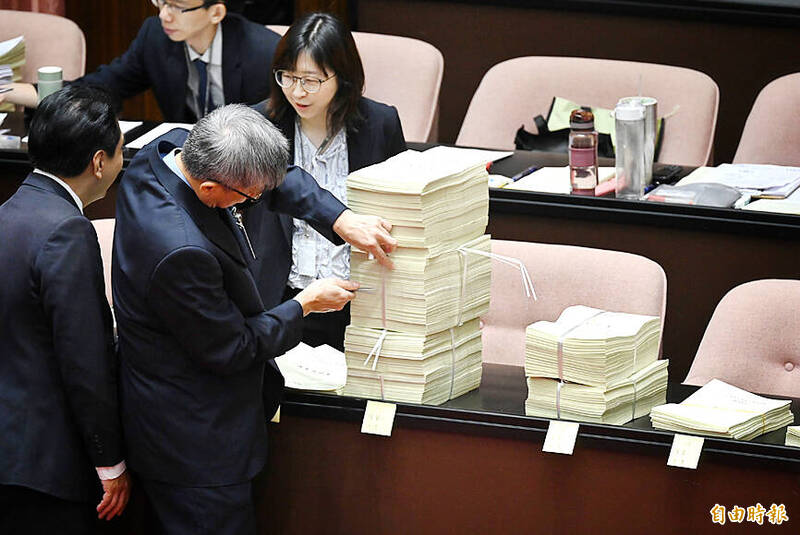
Legislative Yuan staff prepare budget proposals ahead of a vote by lawmakers in Taipei on Friday. Photo: Chen Yi-kuan, Taipei Times
WORRIES:The cuts raise questions about whether the government can maintain basic operations and quickly respond to the public’s needs, a Cabinet official said
/ Staff reporters, with CNA
The Chinese Nationalist Party (KMT) and the Cabinet traded barbs over cuts to the central government budget, with KMT caucus whip Fu Kun-chi saying that the 1.689 percent reduction to this year’s central government budget should be seen as a gesture of “great goodwill,” while the Cabinet described the cuts as “irrational.”
Lawmakers from the KMT and the Taiwan People’s Party, who together hold a majority in the legislature, passed the cuts on Friday amid strenuous objections from the central government and Democratic Progressive Party lawmakers.
The cuts included NT$10 million (US$312,051) from President William Lai’s (賴清德) confidential state affairs fund, with an additional NT$20 million from the fund frozen until Lai promulgates several bills passed by the legislature.
The legislature also eliminated funding for the Cabinet’s Department of Human Rights and Transitional Justice, halved the operating budget of the Ill-gotten Party Assets Settlement Committee and cut NT$684 million from the NT$1.379 billion funds for central government agencies’ policy promotion, including NT$69.32 million requested by the Cabinet and NT$47.38 million by the Ministry of Culture.
Fu said the opposition had shown its “greatest goodwill” by passing this year’s central government budget with NT$48 billion in cuts, or just 1.689 percent of the original proposed expenditures.
More than 1,700 proposed cuts had been reduced through negotiations, resulting in 98.4 percent of the Cabinet’s proposed budget passing and allowing the government to operate normally, Fu said.
Fu also criticized the central government for failing to implement laws passed by the Legislative Yuan, including: allocating more tax revenues to local governments; raising pensions for police, firefighters and civil servants; and increasing military salaries.
However, Cabinet spokeswoman Michelle Lee (李慧芝) said such “irrational” cuts could seriously impact government operations, as well as hamper Taiwan’s progress on human rights.
Reduced funds for policy promotion risked allowing disinformation to spread, Lee said, adding that a NT$52.54 million cut to the Department of Information Services’ operating budget could fall on the shoulders of contract workers, whose salaries were now uncertain.
Moreover, cuts to the confidential state affairs fund two-thirds into the year had effectively rendered it unusable, depriving the president of necessary flexible resources for public engagements, military inspections and other state affairs operations, she said.
The basic resources needed by the Executive Yuan to conduct on-site disaster assessments have also been completely cut, she said, adding: “Disasters will not disappear simply because funding has been cut.”
The budget cuts are no longer about individual programs, but about whether the government can continue to function normally, the spokeswoman said.
From the National Communications Commission and the Ill-gotten Party Assets Settlement Committee to funding for the Executive Yuan’s policy outreach and implementation, human rights and transitional justice, and the president’s official and confidential affairs, the cuts are no longer simply a matter of “how much money is being cut,” she said.
Rather, they raise questions about whether the government can maintain basic operations, respond promptly to public needs, and constitutional bodies can fulfill their legal duties, she said.
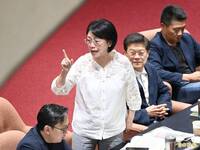
In response, KMT caucus deputy secretary-general Hsu Yu-chen (許宇甄) said that Taiwan is a democratic country, not one where the Executive Yuan has the final say.
Accusing the DPP of labeling legislation and budget measures “irrational” or “unconstitutional” whenever they fail to conform to its wishes, Hsu said the Executive Yuan refusing to countersign or implement laws passed by a legislative majority is what truly harms the nation’s democracy.
Additional reporting by Chung Li-hua and Lo Kuo-chia
新聞來源:TAIPEI TIMES