離開
離開 進入
進入《TAIPEI TIMES》 Taiwan-US Institutes hail AI-piloted drone test
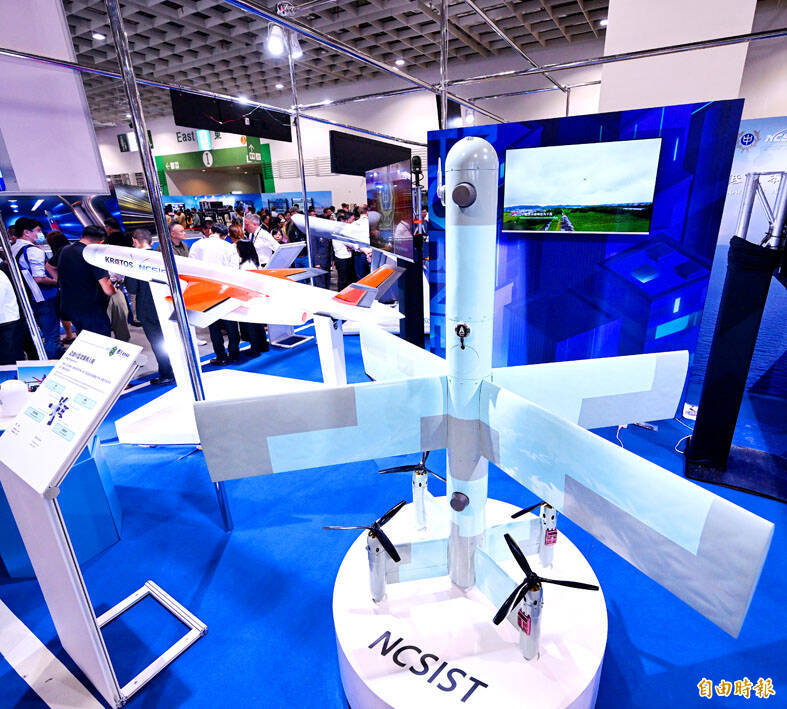
Mighty Hornet III, front, and Mighty Hornet IV, back, attack drones are pictured at the Taipei Aerospace and Defense Technology Exhibition at the Taipei Nangang Exhibition Center on Sept. 18 last year. Photo: Fang Pin-chao, Taipei Times
By Jonathan Chin / Staff writer
The National Chungshan Institute of Science and Technology and a US-based start-up yesterday announced a successful test of artificial intelligence (AI) pilots controlling multiple Mighty Hornet III drones in a search operation.
The success prompted the institute to renew its partnership with Shield AI to use its proprietary Hivemind AI pilots more broadly across Taiwan’s uncrewed aerial vehicle (UAV) fleet, the two said in a statement.
In less than three months, institute engineers implemented the AI pilots in three attack drones, the statement said.
The Hivemind-piloted UAVs “launched and coordinated ... a wide-area search while respecting a designated no-fly zone” before returning to base, all under autonomous control, it said.
Each AI-piloted UAV was assigned a search area, maintained communications with the other platforms, while one drone “operated around a partial no-fly zone within its search sector,” the statement said.
“What impressed us most was not only the high performance of the AI pilot, but Shield AI’s commitment to ensuring we could independently operate and employ the technology in such a short period,” institute president Li Shih-chiang (李世良) said in the statement.
“Their hands-on training and technical expertise and mentorship gave Taiwanese engineers the confidence to integrate and use Hivemind on our own,” Li said.
Shield AI president and cofounder Brandon Tseng (曾國光) said in the statement that “you can build 10 million drones, but you can’t train 10 million drone pilots.”
“Autonomy is the critical enabling technology to effectively leverage drones on the battlefield,” Tseng said.
“Hivemind’s ability to enable autonomous teaming is why autonomy is becoming one of the most important force multipliers in modern defense,” he added.
Hivemind’s Web site says it is “an end-to-end software for building and scaling AI pilots” to operate in contested battlespaces that feature GPS and communications jamming.
The software allows drones to autonomously execute operations and make use of coordinated multi-agent teaming and swarming, it said.
The use of autonomous attack drones has been demonstrated as a key capability in the Ukraine-Russia war, with both sides routinely targeting UAVs with electronic warfare systems.
As electronic warfare countermeasures target the wireless link between the machine and its human operator, an autonomous UAV operating independently of such connections would be immune to jamming, nullifying a mainstay in anti-drone defense.
The Mighty Hornet III, a platform developed by the institute and private-sector partners, is an X-wing anti-armor attack drone that has a 3D-printed airframe, the institute said on its Web site.
The vertical take-off-and-landing UAV has electro-optical sensors that enable autonomous navigation and target identification, it said.
The main design goals of the platform are low cost, high mobility, and ease of manufacture and deployment, it said.
Additional reporting by Aaron Tu
新聞來源:TAIPEI TIMES