離開
離開 進入
進入《TAIPEI TIMES》 TPP vows to abolish the Control Yuan
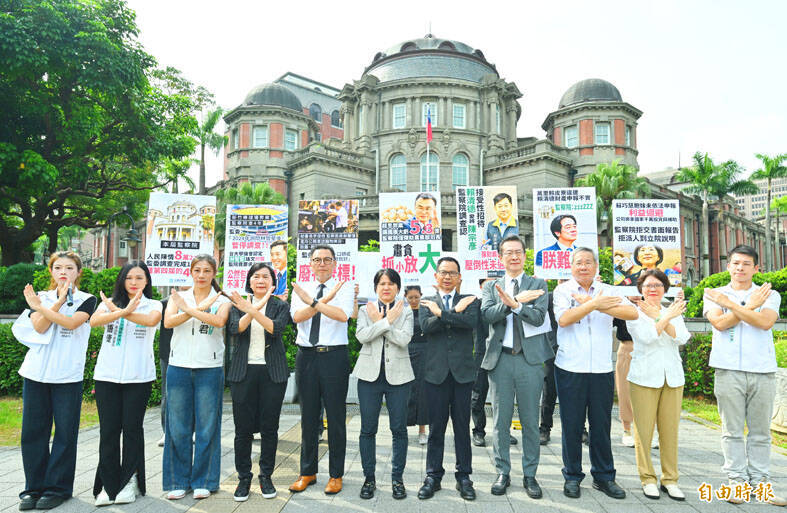
Taiwan People’s Party legislators and candidates make a “no” gesture during a news conference outside the Control Yuan in Taipei yesterday. Photo: Tien Yu-hua, Taipei Times
SHELL OF A BRANCH: Without new members, the Control Yuan would be unable to investigate, impeach or issue corrective measures, a Control Yuan official said
By Lo Kuo-chia, Fang Wei-li, Lin Hsin-han and Jonathan Chin / Staff reporters, with staff writer
The Taiwan People’s Party (TPP) caucus yesterday vowed to abolish the Control Yuan, as the branch’s members have reached their term limits, but no successors have been approved.
The legislature has to date refused to hear the Cabinet’s candidates for the Control Yuan. By law, new appointees should have been inaugurated today, after the current members’ terms ended yesterday.
The TPP caucus leaders slammed the branch, alleging that it had failed to check government power, protected elites’ malfeasance and lacked ethics.
The party’s stance has long been to abrogate the Control Yuan and Examination Yuan in favor of a three-branch system, TPP Legislator Hsu Chung-hsin (許忠信) said.
Under the Constitution, the Control Yuan is the independent watchdog of the nation’s five branches, on equal standing as the Executive Yuan, Legislative Yuan, Justice Yuan and Examination Yuan.
The Examination Yuan should be downgraded to a Cabinet ministry and the legislature should take over the Control Yuan’s duties, Hsu said.
The TPP would continue to boycott all appointees for the Control Yuan and its budget until the branch can be abolished via a constitutional amendment, he said.
The current session of the Control Yuan investigated 1,300 of the 82,000 complaints it received over six years, showing poor efficiency and performance, Hsu said.
TPP Taipei City Council candidate Osmar Hsu (許甫) accused the Control Yuan of shielding former minister of agriculture Chen Chi-chung (陳吉仲) from the consequences of a corruption case involving egg imports during the avian flu outbreak in 2023.
By law, the Control Yuan must wait two months before opening an investigation into alleged official misconduct, meaning the news cycle would have moved on by the time a probe produced results, they said.
Separately yesterday, Chinese Nationalist Party (KMT) Legislative Speaker Han Kuo-yu (韓國瑜) announced that the legislature would vote on the government’s Control Yuan appointments on Sept. 29, following a round of negotiations with the ruling Democratic Progressive Party.
The opposition and ruling parties have agreed to schedule the hearing for the appointments on Thursday next week, begin deliberations three days after that, and hold the vote late in the following month, he said.
The vote would be conducted with open ballots, he added.
The KMT caucus had said it would suspend the Control Yuan’s budgets for personnel remuneration, administrative overhead, meetings, travel funds for investigations and the National Human Rights Commission.
A Control Yuan official said on condition of anonymity that the branch would lose its ability to investigate, impeach or issue corrective measures should the legislature refuse to approve new members.
The Control Yuan would have no authority other than tracking political donations, property disclosures of officials, and miscellaneous tasks related to training, they said.
The branch could still collect information regarding cases of alleged official misconduct without any members in office — a situation that has happened multiple times in the past, they said.
However, as a result, new Control Yuan officials often find themselves immediately embroiled in four to five cases that had accrued when the branch had no serving members, they added.
A military tribunal’s wrongful conviction and execution of airman Chiang Kuo-ching (江國慶) in 1997 — using a confession obtained by torture — is an example of a case handled across the third, fourth and fifth sessions of the Control Yuan, they said.
The then-Council of Grand Justices in 2007 had ruled that the KMT lawmakers’ boycott of former president Chen Shui-bian’s (陳水扁) Control Yuan appointees was unconstitutional.
The legislature must enter the nomination of the Control Yuan members into its agenda, it had said.
“The purpose of the Constitution in installing various national agencies is to uphold their respective and necessary functions within the constitutional governance, which is not to be interrupted for even a day due to change of personnel,” it added.
新聞來源:TAIPEI TIMES