離開
離開 進入
進入《TAIPEI TIMES》 Air force fielding long-range drone
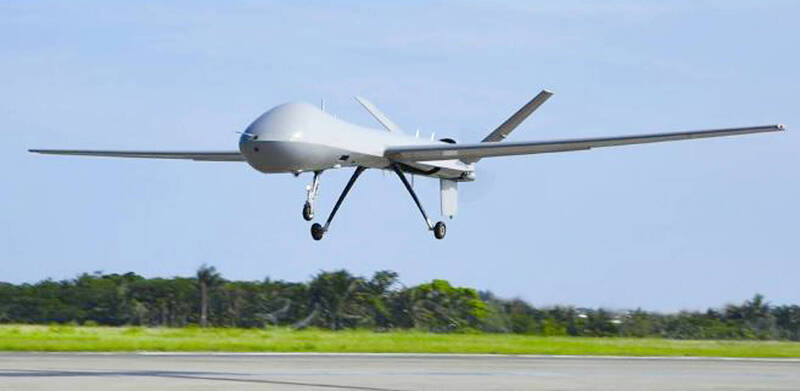
A Teng Yun 2 drone is pictured in this undated photograph. Screengrab from the Website of the National Chung-Shan Institute of Science & Technology
By William Hetherington / Staff writer, with CNA
The air force plans to procure domestically developed Teng Yun 2 drones alongside US-made MQ-9B uncrewed aerial vehicles (UAVs) in a “high-low mix” after the Teng Yun 2 completed operational evaluations, a source said yesterday.
The Teng Yun 2 would serve as a lower-cost complement for the higher-end US platform, broadening the air force’s intelligence, surveillance and reconnaissance capabilities, the source said.
Developed by the National Chungshan Institute of Science and Technology (NCIST), the UAV is undergoing improvements to increase its endurance and payload capacity, while future variants could be equipped with electronic warfare capabilities, the source said.
The Russia-Ukraine war has underscored the growing importance of drones in modern warfare. As Taiwan faces increasing military pressure from China, the military has accelerated efforts to expand their UAV fleet through commercial purchases, foreign military sales and domestic development.
The first-generation Teng Yun, developed by the NCIST in 2007, was never formally delivered to the air force because it did not meet military requirements. The institute subsequently launched development of the second-generation model, which was unveiled in 2019 and features the same engine used by the MQ-9B, along with a redesigned airframe and onboard systems.
The Teng Yun 2 completed the first phase of development testing in March 2022, including satellite-guided automatic takeoff and landing and endurance flights lasting almost 24 hours. Air force personnel began training on the system in January 2023, with operational testing beginning two months later and concluding in May last year, the institute said.
President William Lai (賴清德) visited the institute’s facilities in Taichung on Friday, with photographs released by the Presidential Office showing the Teng Yun 2 on display.
The source said the NCIST is continuing research and development aimed at equipping the platform with electronic warfare capabilities.
Since its announcement in 2019, the institute has developed and validated a number of onboard subsystems and payloads, including satellite command-and-control capabilities, electronic intelligence collection equipment and synthetic aperture radar. The UAV features redundant flight-control and navigation systems that automatically activate backup functions in the event of a failure.
Although the Teng Yun 2 uses the same engine as the MQ-9B, most of its other components are domestically produced, helping lay the foundation for an indigenous large-UAV development program.
新聞來源:TAIPEI TIMES