離開
離開 進入
進入《TAIPEI TIMES》 Cases of Taiwanese detained, missing in China rising rapidly
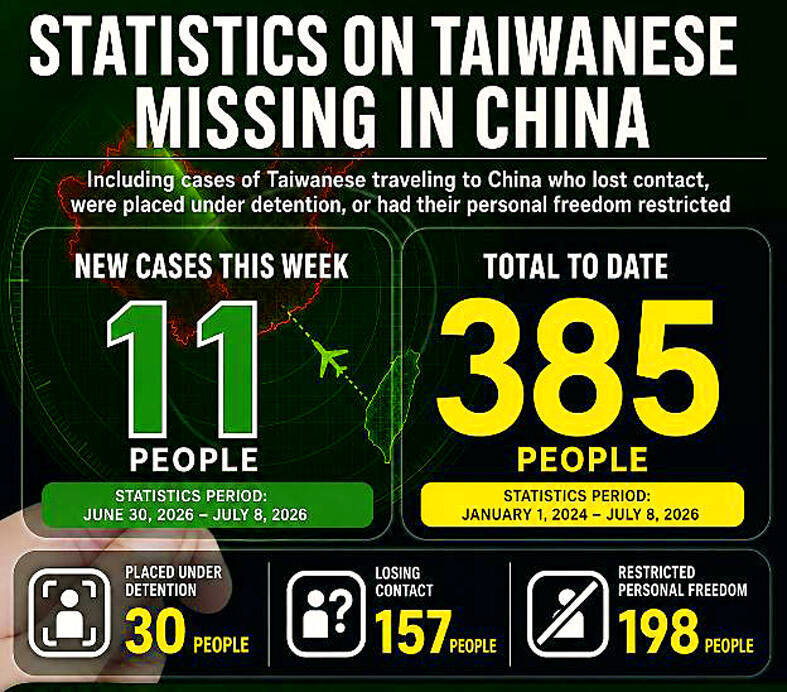
An infographic on Taiwanese who have gone missing or are being detained in China since 2024. Photo: Screen grab from the Mainland Affairs Council’s Facebook page
UNHEALTHY EXCHANGE: China promotes cross-strait exchanges while targeting Taiwanese’s privacy and liberties, so they amount to traps, the DPP said
By William Hetherington / Staff writer, with CNA
The government has received 385 reports of missing or detained Taiwanese in China from the beginning of 2024 to Wednesday, the Democratic Progressive Party (DPP) said in a post yesterday, urging the public to avoid non-essential travel there.
The post followed a news conference on Thursday, during which Mainland Affairs Council (MAC) Deputy Minister and spokesman Liang Wen-chieh (梁文傑) said 10 such cases had been reported in the previous week alone.
The number of cases rose from 55 in 2024 to 221 last year, with 109 reported so far this year, MAC data showed.
The DPP department called on Beijing to immediately end what it described as improper political controls.
It warned the public that risks associated with traveling to China continue to increase and advised them not to take non-essential trips to the country.
During questioning, Chinese authorities might inspect mobile phones, ask about relationships with colleagues and require connecting on WeChat, the council warned.
The DPP department said the incidents suggested that Beijing follows a standard operating procedure involving advanced intelligence gathering, identification of targets, assessment of political views and the establishment of ongoing contact.
A string of laws over the past few years — such as the National Security Law, the Anti-Espionage Law, the National Intelligence Law, the Law on Guarding State Secrets, the Data Security Law, the Anti-Foreign Sanctions Law and the Law on Promoting Ethnic Unity and Progress — reflects Beijing’s efforts to strengthen political control, it said.
Together with the 2005 “Anti-Secession Law” and the “22 guidelines” that outline punishments for so-called “die-hard” Taiwanese independence advocates, the measures have created a comprehensive legal framework covering border inspections, information collection, ideological scrutiny, transnational prosecution and political pressure, the department said.
As a result, activities such as taking photographs, using GPS devices, collecting commercial information, conducting research or interviews, or even speaking with local residents could be arbitrarily interpreted by Chinese authorities as matters of national security, it said.
The department criticized Beijing for layering vague national security legislation, shifting political red lines and asserting extraterritorial jurisdiction in ways that could lead to more Taiwanese being questioned, detained, barred from leaving China or losing contact with family and friends in Taiwan.
While publicly promoting cross-strait exchanges, Beijing treats Taiwanese as targets for surveillance, questioning, intelligence gathering and infiltration, it said.
If exchanges come at the expense of personal liberty, privacy and national security, they cannot be regarded as healthy exchanges, but rather as politically motivated traps, it added.
The department said simply exercising caution in China is no longer sufficient, as the Chinese Communist Party can arbitrarily redefine legal red lines and anyone could suddenly lose their freedom.
It urged the public to avoid non-essential travel to China, particularly for civil servants, judges, military personnel, police officers, technology professionals, researchers, journalists and political workers.
新聞來源:TAIPEI TIMES